
Key points
- Specify barrier as performance (OTR, WVTR, seal strength at stated conditions), not as a material name. “Foil laminate” is not a specification.
- Vacuum, nitrogen flushing and oxygen absorbers solve different problems. Vacuum protects fragile pieces badly; nitrogen does nothing for moisture.
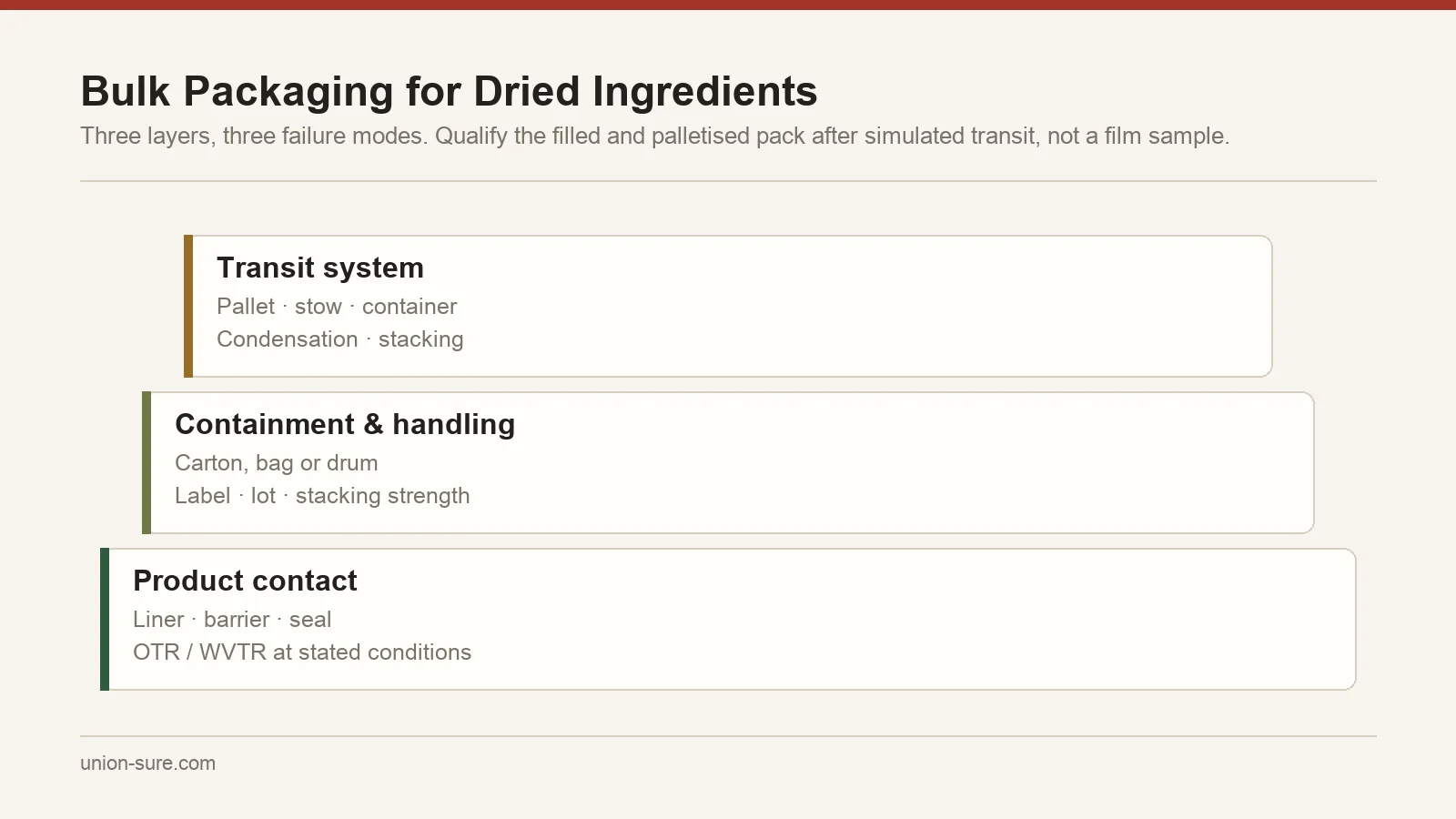
- Build the pack in three layers: product-contact, containment/handling, transit system. Each fails differently and each needs its own acceptance criteria.
- Qualify the filled, sealed, palletised pack after simulated transit — not a film sample from the supplier’s laboratory.
- Condensation inside the container is a packaging problem. Cold goods loaded into a warm box will sweat regardless of how good the liner is.
A 25 kg bag has exactly one job: deliver the ingredient in the condition the specification promised, after four weeks inside a steel box crossing the tropics.
Most of the packaging conversations we have with buyers come back to that sentence. The film is not the specification. The seal, the liner, the headspace, the pallet pattern and the container all have to survive the same journey, and each of them fails in its own way — a perfect barrier film sealed over a fold in the liner protects nothing at all.
Write the product protection brief
Define the filled product and route before selecting a film.
| Product factor | Packaging question |
|---|---|
| Release moisture and water activity | How much moisture pickup can occur before safety or quality fails? |
| Hygroscopicity / sorption isotherm | How rapidly will the product gain water at expected humidity? |
| Fat and oxygen sensitivity | Is rancidity, colour loss or flavour oxidation a concern? |
| Aroma | Must the pack retain volatiles or block external odours? |
| Piece geometry | Can sharp edges puncture the liner? |
| Powder behaviour | Is dust leakage, seal contamination, static or caking likely? |
| Bulk density | What filled volume and package stress will the lot create? |
| Light sensitivity | Is an opaque structure required? |
| Distribution | Temperature/humidity range, voyage length, stacking and handling |
| Opening pattern | Will a customer use the whole pack or repeatedly reopen it? |
Water activity and moisture content are related through a product-specific sorption curve; one cannot be converted to the other with a universal formula. FDA notes that water activity should be brought to and maintained at a suitable level during storage. (FDA water-activity guide) Set the pack around the actual critical attribute.
Use a three-layer package architecture
Product-contact layer
The inner liner or bag touches the food. Specify:
- material structure and thickness or basis weight;
- food-contact compliance for the market and intended food type;
- temperature and contact conditions;
- migration or declaration documentation where required;
- seal type, width and validated settings;
- bag dimensions and fit within the outer container;
- cleanliness, odour and foreign-material controls;
- lot traceability and change notification.
For the EU, all food-contact materials fall under the general framework, must be made under good manufacturing practice, and may also be subject to material-specific and national rules. (European Commission FCM overview) “FDA approved” is not a complete declaration for EU use, and an EU declaration must match the actual laminate and conditions.
Containment and handling layer
This may be a multiwall bag, woven sack, carton, fibre drum, plastic pail or other rigid/semi-rigid container. It protects the liner from puncture and gives the pack stacking, lifting and identification strength. Define net weight, dimensions, closure, handles, drop resistance and pallet pattern.
Transit system
The pallet, stretch wrap, corner boards, slip sheets, container and securing plan form the third layer. A high-barrier liner can still fail if a drum chafes against a nail, cartons collapse, or the container roof leaks.
Specify barrier as performance
Material names such as “PE,” “foil,” “metallised” or “Mylar” do not establish performance. Ask for:
- water-vapour transmission rate (WVTR);
- oxygen transmission rate (OTR) where relevant;
- test standard, temperature and relative humidity;
- whether the value applies to flat film or the finished pack;
- seal, crease and flex-crack performance;
- pinhole and puncture controls;
- shelf-life model assumptions.
Transmission values change with test conditions and package area. A small consumer pouch and a 20 kg liner made from the same film do not admit the same total amount of moisture. Calculate or test the filled package.
Vacuum, nitrogen and oxygen absorbers do different jobs
Buyers ask us to vacuum pack freeze-dried fruit fairly often, and we usually push back. Vacuum is excellent for dense, robust material and poor for anything with structure — pulling the film down onto a freeze-dried strawberry produces a bag of fragments with a beautiful seal. Nitrogen flushing keeps the piece shape and controls oxygen; it does nothing for moisture, which is the liner’s job.
Vacuum packing
Vacuum removes part of the headspace gas and can compact a flexible pack. It can reduce oxygen but may crush fragile freeze-dried pieces, pull powder into the seal, expose puncture points or cause a liner to creep around sharp product. Specify vacuum level, seal process and acceptable piece breakage if used.
Nitrogen flushing
Nitrogen replaces air in the headspace and can provide a cushion for fragile pieces. Performance depends on gas purity, flush method, fill/headspace ratio, seal integrity and residual oxygen. “Nitrogen flushed” without a residual-oxygen limit and measurement time is a process description, not an acceptance criterion.
Oxygen absorbers and desiccants
An absorber can address residual and ingress oxygen; a desiccant can absorb a calculated amount of moisture. Neither compensates for a leaking pack. Confirm food-use suitability, capacity, placement, activation, potential direct contact, customer removal and label requirements. UNECE guidance advises calculating required absorption capacity when drying agents are used in cargo transport units. (CTU packing guidance)
Match the format to the ingredient
| Ingredient condition | Priority | Common design direction to evaluate |
|---|---|---|
| Fragile freeze-dried pieces | Moisture barrier, cushion, low breakage | Rigid outer case/drum plus high-barrier liner; nitrogen where validated |
| Dried fruit with intermediate moisture | Seal integrity, stickiness, SO₂/aroma retention | Compatible liner, robust seals, controlled blockiness |
| Dehydrated vegetable flakes | Moisture, colour, odour and puncture | Barrier liner plus strong carton or drum |
| Fine powder | Moisture, caking, dust and seal contamination | Powder-compatible liner/valve/closure and controlled filling |
| Fat-containing crisps or nuts | Oxygen and moisture | Higher oxygen barrier plus residual-oxygen control where justified |
These are design directions, not universal pack prescriptions. Validate with the exact product, fill weight and route.
Build a measurable packaging specification
Include:
- product and net weight;
- complete primary-pack structure and approved supplier/code;
- food-contact documents and intended-use conditions;
- WVTR/OTR with methods and test conditions where critical;
- dimensions and tolerances;
- seal or closure method and inspection rule;
- vacuum, nitrogen or absorber parameters where used;
- residual oxygen limit and timing if claimed;
- outer container strength and pallet pattern;
- label, lot and storage marks;
- metal, staple and foreign-material restrictions;
- change notification;
- defect sampling and acceptance criteria;
- storage, transport and opening instructions.
Avoid unqualified claims such as “moisture proof” or “oxygen free.” Define a measurable requirement and a test.
Qualify the filled pack, not only the film
Run a protocol that reflects real handling:
- line trial for filling, dust and seal contamination;
- seal-strength and leak testing;
- drop, compression and vibration testing appropriate to the distribution system;
- puncture review after transport simulation;
- temperature/humidity exposure;
- product moisture, water activity, texture, colour, aroma or oxidation checks over time;
- residual oxygen trend where used;
- repeated-opening study if customers do not consume the full pack;
- pallet and container loading trial.
Record the product lot, pack lot, equipment settings and test conditions. Shelf life belongs to the product-pack-process system, not to the film data sheet alone.
Container loading and condensation
Worth being blunt about this one, because it generates more claims than any film failure: if goods are loaded cool into a container that then sits in the sun, moisture condenses on the ceiling and rains back onto the top layer. No liner specification fixes that. It is solved with loading temperature, ventilation, desiccant and stow pattern — decisions made at the dock, not in the packaging specification. Inspect the cargo transport unit for odour, pests, residue, holes, wet flooring, damaged seals and protrusions. Use dry pallets and bracing. Do not co-load moisture-sensitive ingredients with wet, leaking or strong-odour cargo.
The joint IMO/ILO/UNECE CTU Code is a non-mandatory global code for packing transport units and addresses suitability, securing and condensation risk. (UNECE CTU Code) A liner cannot correct a leaking roof or a wet pallet.
Frequently asked questions
Is foil laminate always the best pack for a dried ingredient?
No. It can provide strong barrier performance but may flex-crack, puncture, cost more or complicate recycling. Compare required performance, filled-pack durability and route.
Does nitrogen flushing extend shelf life?
It can reduce headspace oxygen when correctly controlled, but shelf life must be demonstrated for the actual product and package. Define residual oxygen, seal integrity and test timing.
Should a bulk bag be vacuum packed?
Only after testing. Vacuum may benefit some dense products and damage fragile pieces or powder seals. A controlled trial should measure both atmosphere and physical quality.
Where to go next
Packaging is downstream of two decisions: what the ingredient is, and how dry it has to stay.
- moisture content versus water activity — the number that decides whether your barrier requirement is real or theoretical.
- state pack, pallet and label in the RFQ — pack format changes the price per kilo more often than buyers expect.
- labelling and documents for the destination market — the outer carton is where market-access rules become physical.
- ask for a pack specification — send the destination, transit time and application and we will propose a format.
Published 11 November 2025. Last reviewed 15 August 2026 by the Union Sure technical team. Regulatory limits, standards and market requirements change — verify every legal limit against the current official source before it is used to approve a shipment.