
Key points
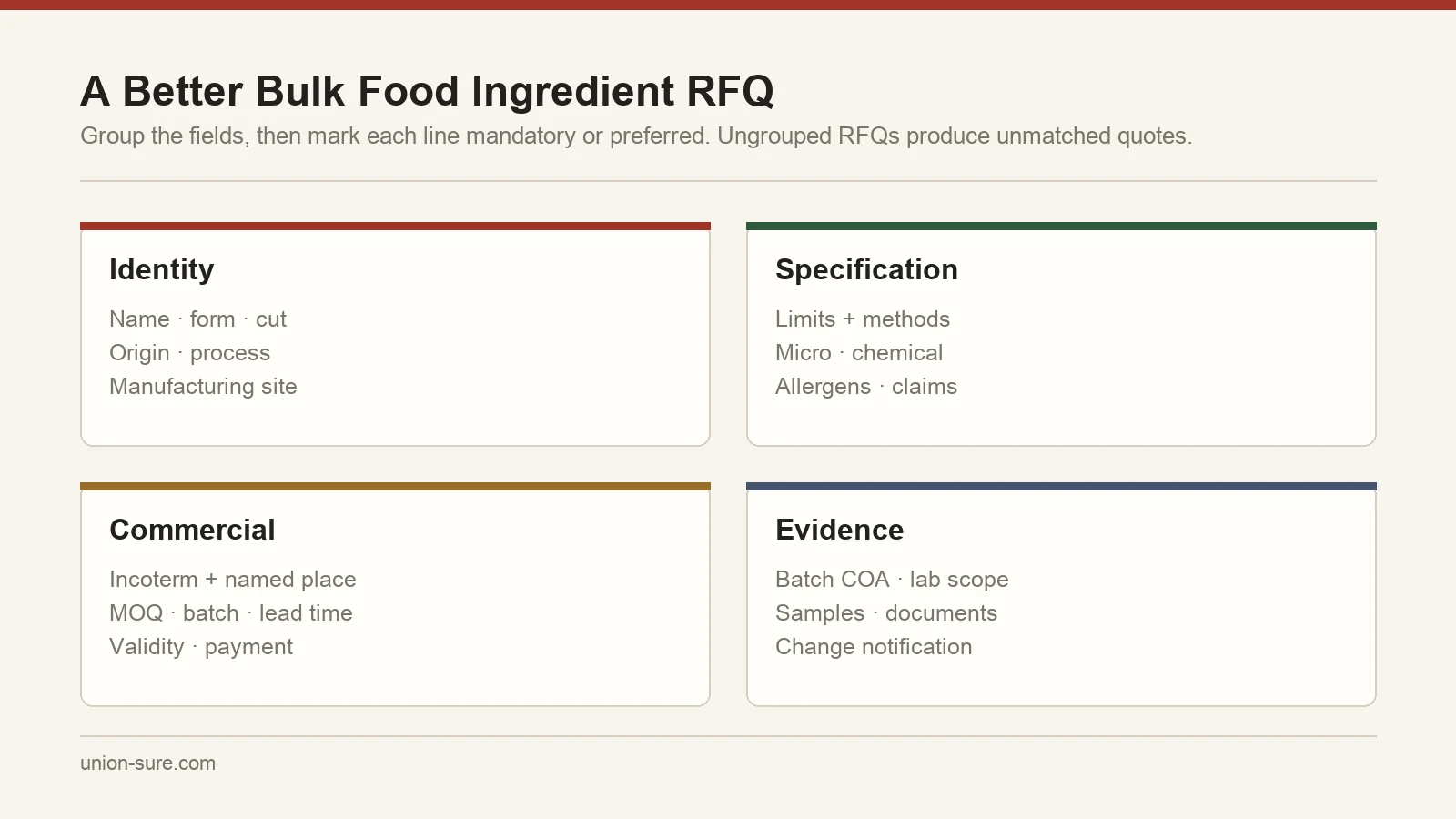
- A good RFQ makes offers comparable before it makes them visible. Price is the last field, not the first.
- Separate mandatory acceptance criteria from preferred features and information requests — otherwise a supplier’s typical data quietly becomes a contractual promise.
- “Freeze-dried strawberry” is a category, not a product. Whole, sliced, 5–10 mm pieces and powder have different yields, breakage and prices.
- Every specification line needs a method and a status (mandatory / preferred). A limit without a method is unenforceable.
- Normalise quotes on one sheet: same currency, same Incoterm and named place, same usable yield — then score evidence separately from price.
We answer a lot of RFQs. The ones that come back fast, accurate and competitively priced all share a trait: they describe the product precisely enough that we cannot accidentally quote something cheaper and different.
That is really the whole purpose of a request for quotation. It makes offers comparable before it makes them visible. What follows is the field list we wish every enquiry arrived with, and — more usefully — the reason each field exists.
The one-page RFQ summary
Start with the decision:
- buyer and project reference;
- ingredient and intended application;
- destination country;
- trial, launch and annual forecast quantities;
- required delivery windows;
- mandatory certifications or claims, with market basis;
- required quote deadline and validity;
- contact for technical and commercial questions.
State whether alternatives are allowed. If they are, require the supplier to show every deviation in a separate table rather than burying it in a specification attachment.
Section 1: exact product identity
Here is the failure mode, stated plainly. Send five suppliers “please quote your best price for freeze-dried strawberry” and you will get five quotes for five different products: whole berries, slices, 5–10 mm dice, fines, and something that is 30% powder by the time it reaches you. The cheapest number will almost always belong to the least useful material. That is not dishonesty, it is an underspecified enquiry. Request:
- common name and scientific name where relevant;
- ingredient statement, carriers, processing aids and additives;
- production method: air-dried, freeze-dried, vacuum-fried, fermented or crystallised, as applicable;
- country and region of agricultural origin where required;
- manufacturing and packing sites;
- physical form, cut, mesh or particle-size distribution;
- grade or product code and the standard behind it;
- intended food-grade status and application limitations.
Codex’s dried-fruit standard distinguishes styles and requires product naming that does not mislead about condition or treatment. (Codex CXS 360-2020) A quotation should not shorten “sweetened dried cranberry pieces” to “cranberry.”
Section 2: application and functional target
Tell the supplier what the material must do.
- visible inclusion, powder, topping, rehydrated vegetable or texture modifier;
- process exposure: shear, heat, acid, salt, fat or water;
- finished-product matrix and critical defect;
- sensory benchmark;
- desired piece integrity or hydration behaviour;
- whether the finished product receives a validated kill step;
- label or claim constraints.
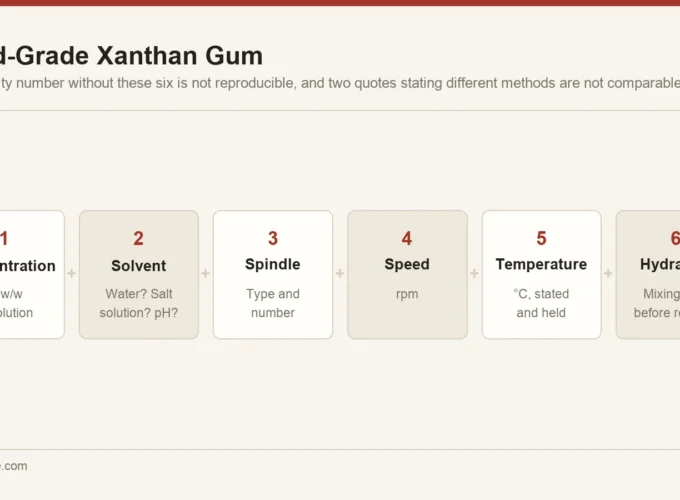
For xanthan gum, “viscosity 1,200 cP” is incomplete unless test conditions match. For freeze-dried fruit in chocolate, water activity and piece integrity may matter more than rehydration. Application detail lets the supplier select the right grade instead of the closest name.
Section 3: specification table
Use four columns: parameter, limit/target, method, status.
| Parameter | Requirement | Method | Status |
|---|---|---|---|
| Product identity | Defined material | Agreed identity method | Mandatory |
| Piece size | Buyer range | Sieve/manual method | Mandatory |
| Moisture | Buyer limit | Named method | Mandatory |
| Water activity | Buyer limit at stated temperature | Named method | Mandatory if risk-based |
| Colour / sensory | Reference or controlled method | Agreed panel/instrument | Preferred or mandatory |
| Foreign material | Defined defect and sampling | Agreed inspection | Mandatory |
Do not copy a competitor’s table without knowing the method and application. Ask suppliers to propose justified alternatives, then revise the buyer specification through change control.
Section 4: microbiological requirements
List target organisms, limits, units, analytical portion, method and sampling plan. State whether the product is ready-to-eat and what later processing exists.
Avoid “standard microbiology.” The appropriate panel differs by ingredient and use. If a microbial-reduction treatment is required, ask for the treatment type, facility, validation basis, routine process record, post-treatment protection and residual/legal controls. Do not ask for “sterile” when the commercial process is a validated reduction rather than sterilisation.
Section 5: chemical and allergen controls
Request only evidence connected to the risk and market, but define it precisely:
- pesticide analyte scope, MRL basis and reporting limits;
- heavy metals and other contaminants;
- sulphites or preservatives, use declaration and residual limit;
- mycotoxins where relevant;
- residual solvents for applicable additives;
- allergen presence, site profile and cross-contact controls;
- GMO, organic or other claim substantiation.
FDA’s FSVP framework explicitly includes biological, chemical and physical hazards and evaluates both the food and supplier performance. (FDA FSVP rule) The RFQ should feed that evaluation, not replace it.
Section 6: COA and laboratory evidence
Specify:
- which tests appear on every batch COA;
- actual results versus pass/fail wording;
- agreed methods and units;
- third-party tests and frequency;
- sampling responsibility;
- laboratory identity and accreditation scope where required;
- corrected-report and out-of-specification controls;
- retention samples and record period.
ISO/IEC 17025 is a standard for competent and consistently operating laboratories, but check the relevant scope rather than accepting a logo. (ISO overview)
Section 7: packaging and palletisation
Include:
- net weight per pack and tolerance;
- primary liner structure or performance;
- vacuum, nitrogen or absorber requirement and acceptance rule;
- outer carton, bag, drum or pail;
- label and lot fields;
- packs per pallet, pallet material and maximum height/weight;
- container-loading restrictions;
- storage and transport conditions;
- customer opening/reclosure needs.
Codex has a general standard for labelling non-retail food containers; destination law and the commercial quality agreement can require more. (Codex standards list)
Section 8: quantity and capacity
Provide separate figures for:
- laboratory sample;
- pilot quantity;
- first commercial order;
- forecast per shipment;
- annual forecast;
- acceptable MOQ;
- maximum lot size or need for single-lot supply.
Ask for standard MOQ, production batch, lead time, seasonal constraints, reserved-capacity assumptions and how split deliveries affect price. Forecasts should be labelled non-binding unless the contract says otherwise.
Section 9: delivery and quote basis
Require:
- currency and unit price;
- price basis per net kilogram or other agreed unit;
- named Incoterm and named place/port;
- included packaging, testing, certificates and pallet cost;
- freight, insurance, duty and tax treatment;
- quote validity and price-adjustment mechanism;
- production lead time and transit estimate;
- payment terms;
- sample and tooling charges;
- demurrage/document-error responsibilities where negotiated.
Use the full formulation “FCA [named place] Incoterms 2020,” for example, rather than writing only “FOB price.” ICC is the official publisher of the Incoterms rules. (ICC Incoterms 2020)
Section 10: document pack and changes
List documents required at qualification, per batch, per shipment and annually. Common examples include specification, batch COA, process flow, allergen statement, food-safety certificate/audit evidence, origin document, organic transaction document, invoice, packing list and transport document.
Require prior notification for changes to agricultural origin, factory, subcontractor, formulation, process, treatment, test method, specification, packaging and certificate status.
Three category examples
Freeze-dried strawberry pieces
Define fruit ingredients, piece distribution, fines/breakage method, moisture and water activity, sensory/colour, seed or foreign-material defects, microbiological status, pack barrier and application. “10 mm” may mean a nominal cut or a sieve range; state which.
Dried goji berries
Define species, origin claim, count per 50 g method, defect categories, moisture, SO₂ declaration/limit, pesticide plan, microbiology, stickiness and packing. A size grade does not replace a complete specification.
Xanthan gum
Define food standard, viscosity method in full, particle-size requirement, loss on drying, ash, pyruvic acid or other identity/purity attributes as applicable, residual solvent, microbiology, application and hydration trial.
Compare quotations on a normalised sheet
One piece of advice we would give even to buyers who never contact us: do not invent a “quality premium” percentage to justify the offer you already prefer. Convert everything to landed cost per usable kilogram, mark every specification deviation, then run the samples under one protocol. If the more expensive material wins, the trial will show it — and you will have a defensible record instead of a hunch. Create one row per supplier and preserve deviations.
- Convert price to the same currency and net unit.
- Align Incoterm and destination.
- Add freight, insurance, duty, broker, testing and handling assumptions.
- Adjust for usable yield where fines, breakage, dilution or moisture differ.
- Mark every mandatory specification deviation.
- Score evidence separately from price.
- Run samples under one controlled application protocol.
Do not invent a “quality premium” percentage. Let the technical trial and landed-cost model show whether the difference has value.
Copy-ready RFQ field list
- Project / application / destination
- Product identity and ingredient statement
- Origin, manufacturer and sites
- Process and physical form
- Specification with methods
- Microbiological and chemical controls
- Allergen and claim documentation
- Batch COA and laboratory requirements
- Sample and pilot protocol
- Pack, pallet and label
- Quantity tiers, MOQ and capacity
- Incoterm, named place, currency and validity
- Lead time, payment and shipment schedule
- Qualification, batch, shipment and annual documents
- Change notification and deviation table
- Commercial and technical contacts
Send this information with a request for a representative sample and recent batch-specific COA. A complete RFQ shortens clarification, but more importantly, it prevents a low price from winning by quoting a different product.
Frequently asked questions
Should an RFQ include the buyer’s specification?
Yes, when available. Mark mandatory limits, methods and negotiable targets. If the specification is still developing, state that clearly and request the supplier’s proposed standard with deviations.
Is MOQ the same as production batch size?
No. MOQ is a commercial minimum; production batch and available lot size affect traceability, COA coverage and repeatability. Ask for all three.
Can the cheapest FOB quote be compared with a DDP quote?
Not directly. Normalise the named delivery point, included costs, duties/taxes, testing, documents and risk assumptions before comparing landed cost.
Where to go next
An RFQ is the start of an evidence trail. These are the next two documents in it.
- check the supplier before you compare the prices — a competitive quote from an unapproved site is not a saving.
- read the COA the offer is based on — ask for a recent batch certificate with the quote, not a typical-values sheet.
- get the pack and pallet specification right — pack format moves the per-kilo price more than most buyers expect.
- send us an RFQ — intended use, destination market and specification get you a real number instead of a range.
Published 23 September 2025. Last reviewed 15 August 2026 by the Union Sure technical team. Regulatory limits, standards and market requirements change — verify every legal limit against the current official source before it is used to approve a shipment.