
Key points
- A number outside a limit starts an investigation, not automatically a rejection or automatically a pass.
- Check the result is real before checking the product: sample identity, method, units, basis and transcription.
- Measurement uncertainty is part of the result. A value marginally over a limit may not be a demonstrated exceedance.
- Retesting is legitimate only under a rule agreed in advance — deciding to retest after seeing a bad number is not investigation.
- Where a legal limit is involved, treat it as a compliance decision, not a commercial one, and verify the current limit at the time of the decision.
A result comes back over the limit. Somebody wants to reject the container, somebody else wants to ship it, and both are arguing from the same single number.
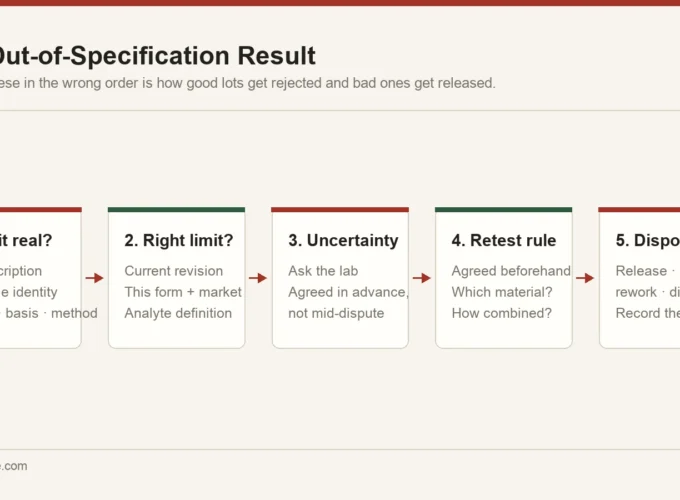
The useful discipline here is boring and it works: establish that the result is real, establish what it is being compared against, and only then decide what to do with the goods. Doing those in the wrong order is how good lots get rejected and bad ones get released.
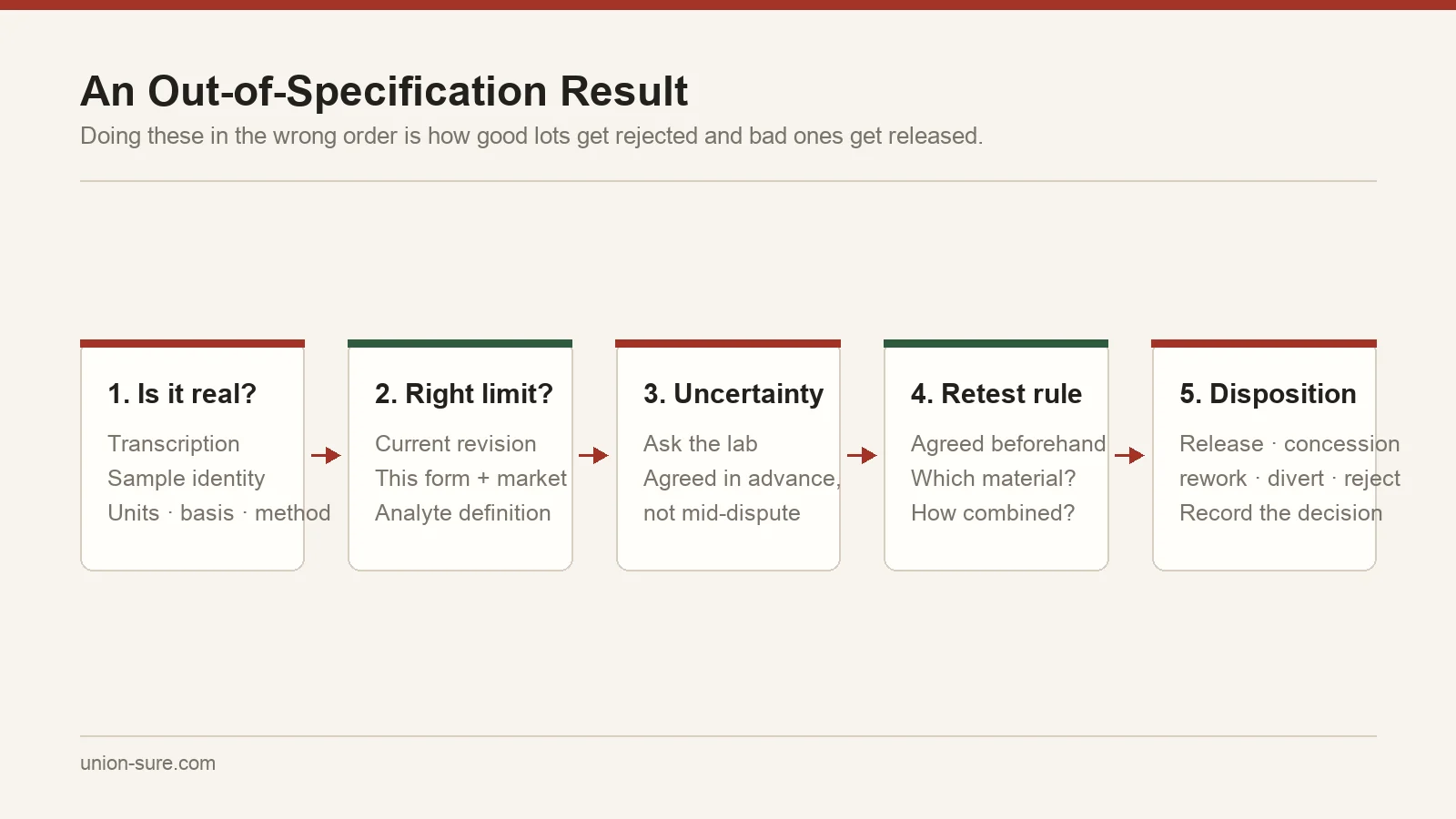
Step 1: is the result real?
Before the product is questioned, question the result. The order below is deliberate — it runs cheapest and most likely first.
The paperwork checks, in order
Before the product is questioned, question the result. In rough order of how often each is the answer:
- transcription — a digit moved, a decimal shifted, the wrong row copied;
- sample identity — the result belongs to a different lot or a different sub-sample;
- units and basis — mg/kg versus µg/kg, as-is versus dry basis, per gram versus per portion;
- method — a different method than the specification names, giving a different answer legitimately;
- analytical portion — a smaller or larger portion than the specification requires;
- sample handling — time, temperature or container between sampling and analysis.
A surprising share of exceedances resolve here, at no cost, in an hour. It is worth doing first every time.
Ask the laboratory the right question
Not “can you re-run it” — that skips to step four. Ask instead:
- what method was used, and was it the one the specification names?
- what was the analytical portion, and does it match the specification?
- what is the reporting limit, and where does the result sit relative to it?
- what is the measurement uncertainty for this analyte at this level?
- was anything unusual about the sample as received — condition, temperature, packaging, quantity?
The last one resolves more cases than people expect. A sample that arrived warm, crushed or short of the required mass produces a legitimate result about a compromised sample.
Step 2: is it the right limit?
Then check what the number is being compared against:
- the current revision of the specification, not an older one;
- the limit for this product form and market, not a related one;
- the correct residue or analyte definition, where one exists — some definitions include metabolites and a laboratory reporting against a different definition will produce a different number;
- any processing factor that legitimately applies between forms;
- whether the limit is a release limit or an end-of-life limit.
The analyte definition trap
Worth separating out because it produces exceedances that are not exceedances. For some analytes the regulated or specified quantity is not a single compound but a defined sum — parent plus named metabolites, or a class expressed as one equivalent.
If the laboratory reported against a different definition from the one the limit uses, the numbers are not comparable and the comparison is invalid before uncertainty even enters. Check the definition on both sides before anything else in step three.
Step 3: measurement uncertainty
Every measurement has an uncertainty, and for many analyses it is not small. A result marginally above a limit may not demonstrate an exceedance once uncertainty is taken into account; a result marginally below may not demonstrate compliance.
How uncertainty is applied is a decision the parties should have made in advance — it changes commercial outcomes, and deciding it while looking at a specific number invites the answer to follow the preference. Ask the laboratory for the uncertainty with the result, not after the argument starts. Where competence matters, check the relevant scope of the accreditation rather than the certificate logo. (ISO/IEC 17025)
Competence for the specific method is what matters here, not accreditation in the abstract — check that the method appears in the laboratory’s accredited scope rather than reading the certificate as a general endorsement. (ISO/IEC 17025)
Write the uncertainty rule down in advance
There are only a few defensible conventions, and the point is to pick one before you need it:
| Convention | What it means | Typical use |
|---|---|---|
| Result alone | Compare the reported value to the limit | Contractual limits with wide margins |
| Result minus uncertainty | Exceedance only if the lower bound exceeds | Where a demonstrated exceedance is required |
| Result plus uncertainty | Compliance only if the upper bound complies | Conservative, buyer-protective |
Which is appropriate depends on whether the limit is contractual or legal and on who carries the risk. What is not defensible is choosing after seeing the number.
Step 4: retesting, under a rule
Retesting is legitimate. Retesting until you get the answer you want is not, and the difference is entirely whether the rule existed beforehand.
An agreed rule states: what triggers a retest, on what material (the same prepared extract, a fresh portion of the same sample, or a fresh sample from the lot), how many replicates, and how the results combine into a decision — average, worst case, or majority. Write it into the quality agreement so it is never invented mid-dispute.
Investigate the cause, not only the result
Even when the disposition is straightforward, close the loop on why. A result that missed because of sampling tells you to fix sampling; one that missed because of a process drift tells you the next lots are at risk; one that missed because a supplier changed something without telling you tells you the change-notification clause is not working.
Record the cause category, not just the outcome. Over a year those categories are the most useful quality data you will have, and they cost nothing extra to collect.
Step 5: disposition
Only now does the product decision arrive. The options are usually:
- release as-is, where the investigation showed the result was not real or the limit was misapplied;
- release against a documented concession, where the deviation is understood, bounded and acceptable for the intended use — never available where a legal limit is involved;
- rework or reprocess, where a defined process brings the material into specification and the process itself is controlled;
- divert to a different use where it is genuinely suitable and permitted;
- reject or destroy.
Whatever is decided, record the investigation, the evidence, the decision, who made it and on what authority. The record is what protects the decision later, and it is the first thing anyone will ask for.
Concessions need boundaries
A documented concession is legitimate where the deviation is understood, bounded and acceptable for the specific intended use. To be worth anything it has to state: which lot, which attribute, the actual result, why it is acceptable for this use, any restriction on use, who approved it, and that it does not set a precedent.
A concession that omits the last two lines tends to become the new limit within about three lots.
For low-moisture ingredients in particular, be careful about treating a microbiological result as a candidate for concession at all — the relevant hygiene practice for this category is built around the fact that these products are not usually subject to a further kill step. (Codex CXC 75-2015)
A note on legal limits
Where the limit comes from law rather than from the contract, the decision is a compliance decision. Commercial concessions do not apply, the current limit must be verified at the time of the decision rather than assumed from a previous shipment, and the destination market’s own notification duties may attach. Get that determination from someone whose job it is, not from the person holding the purchase order.
Frequently asked questions
Can I just retest and use the second result?
Only under a rule agreed before the first result existed. Otherwise the second result is not evidence, it is selection. Agree the retest rule in the quality agreement, including which material is retested and how results combine.
Is a result inside measurement uncertainty a pass?
It is not a demonstrated failure, which is not the same as a pass. How uncertainty is applied to acceptance decisions should be agreed in advance and stated in the specification or quality agreement.
Who should make the final call?
Someone with quality authority, on a written record, against a rule that existed beforehand. Where a legal limit is involved it is a compliance decision and should not sit with the commercial owner of the order.
Where to go next
Disposition is the clause you wrote earlier, executed under pressure.
- what belongs in a quality agreement — the disposition and retest rules that have to exist beforehand.
- reading a COA line by line — most exceedances resolve in the units, basis or method.
- writing limits you can justify — an aspirational limit produces marginal failures on acceptable material.
- tell us about a result — send the method, units and basis with the number and we will investigate from our side.
Published 13 August 2026. Last reviewed 15 August 2026 by the Union Sure technical team. Regulatory limits, standards and market requirements change — verify every legal limit against the current official source before it is used to approve a shipment.