
Key points
- Dried ingredients almost always cube out before they weigh out. Bulk density, not payload, is the binding constraint.
- Freeze-dried product is the extreme case: a container can fill completely while carrying a fraction of its legal weight.
- Model the load in cartons per pallet, pallets per container — not in tonnes. Tonnes hide the problem until booking.
- Stacking strength decides whether you can double-stack, and double-stacking is usually worth more than any packaging saving.
- Fixing a cube-out means changing pack size, compression, pallet pattern or product form — not squeezing the freight rate.
A 40-foot container will legally carry somewhere in the region of 26 tonnes. A container of freeze-dried strawberry slices will be completely full at a small fraction of that, and the difference is money.
This is the single most common surprise for buyers moving from dense commodities into dried and freeze-dried ingredients. The freight quote looks fine per tonne. Then the load plan comes back and the container is full at eight tonnes, and the per-kilo freight has tripled.
Cube out versus weigh out
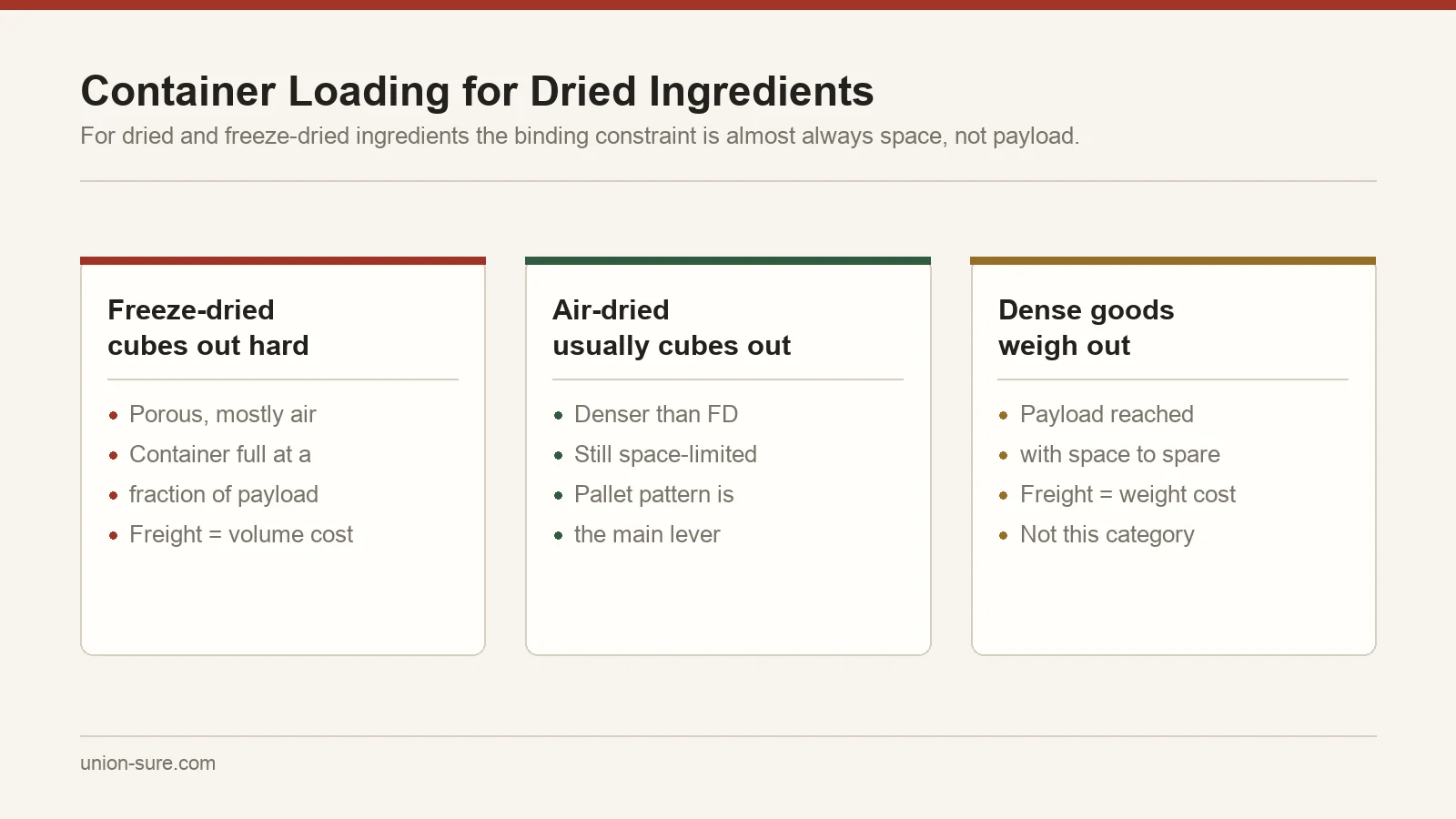
Every container load hits one of two limits first:
- weigh out — the payload limit is reached while space remains. Typical of dense, heavy goods.
- cube out — the space is full while payload remains. Typical of everything in this category.
Air-dried vegetables sit in the middle. Freeze-dried fruit and puffed or vacuum-fried snacks cube out hard, because the porous structure that makes them valuable is mostly air by volume.
The practical consequence: for these products, freight cost is driven by how well you fill the box, not by how much the goods weigh. A packaging change that adds five percent to material cost and improves the pallet pattern by fifteen percent is usually a large net saving.
A worked example
The arithmetic is not complicated, which is exactly why it is worth doing before booking rather than after. Take a light dried product packed in cartons:
| Step | Figure |
|---|---|
| Carton footprint, filled and settled | 400 × 300 mm |
| Cartons per pallet layer (1200 × 1000 pallet) | 10 |
| Carton height | 250 mm |
| Layers to a 1.9 m pallet height, pallet included | 7 |
| Cartons per pallet | 70 |
| Net weight per carton | 8 kg |
| Net weight per pallet | 560 kg |
| Pallets on the floor of a 40 ft container | 21 |
| Net weight, single-stacked | 11.8 t |
Against a payload in the region of 26 tonnes, that container is full at under half its legal weight. Double-stacking, if the cartons can carry it, roughly doubles the figure and changes the freight cost per kilogram by about as much as any negotiation ever will.
Change one input and watch it move: a carton 50 mm shorter adds an eighth layer, which is 10 more cartons per pallet and about 1.7 tonnes across the container.
Model in cartons, not tonnes
Work up from the physical unit:
- Outer carton or bag dimensions, as packed and settled, not as designed.
- Cartons per pallet layer, and layers per pallet, at the agreed pallet footprint.
- Pallet height including the pallet itself, against the container’s usable internal height.
- Pallets per container floor, for the pallet type in use.
- Whether double-stacking is possible.
Only then convert to net weight and check that you are still inside payload. Buyers who start from tonnes discover the problem at booking; buyers who start from cartons discover it while it is still fixable.
The two details that routinely cost a layer
Cartons bulge once filled, so the designed dimension is optimistic. Measure a filled, sealed, settled carton, ideally after a day under its own stack weight, and use that number.
Pallet overhang is not free space. Product hanging past the pallet edge loses a disproportionate share of its stacking strength, because the corners — which carry most of the load in a corrugated case — are no longer supported. Overhang also invites handling damage and can foul the container walls during stuffing.
Pallet choice is a container-fill decision
Pallet footprint decides how many pallets fit on the floor, and the arithmetic differs by container length and pallet type. Work it out for the specific combination rather than assuming a number, and check whether the goods are better floor-loaded: for some dried products, loading cartons directly and slip-sheeting them uses noticeably more of the cube, at the cost of slower handling at both ends.
The internationally used reference for how cargo transport units should be packed, secured and weight-distributed is the IMO/ILO/UNECE Code of Practice for Packing of Cargo Transport Units. It is the document to point a forwarder at when stow quality is in dispute. (IMO/ILO/UNECE CTU Code)
Stacking strength is the lever
If you can double-stack, you often gain a large share of the container’s cube back. Whether you can depends on whether the bottom pallet’s cartons can carry the top pallet through the whole journey, in humidity, with vibration, for weeks.
Carton compression strength is not a fixed number. It falls with humidity, it falls with time under load, and it falls when the product inside does not support the walls — which is exactly the case for a light, porous product in a large carton. If double-stacking matters, specify the compression requirement and have it verified on the filled pack, not quoted from a board specification.
Weight distribution and securing
Filling the cube is not the only constraint. A container also has to be loaded so the mass is distributed within limits and the stow does not shift, and for light, high-stacked cargo the risk is movement rather than overloading.
Practical points that come up repeatedly with dried goods:
- avoid leaving a large void at the door end; if the load does not reach the doors, fill or brace the gap;
- keep heavy and light lines separated vertically, with the dense material low;
- brace against lateral movement, not only fore-and-aft;
- do not rely on shrink wrap as a securing method — it holds a pallet together, it does not secure it to the container.
What to change when you cube out
In rough order of how often it works:
- Pack size. Larger packs usually mean less void volume per kilo and fewer voids between cartons.
- Pallet pattern. A different carton footprint can add a column per layer. This is arithmetic and it is free.
- Carton design. Reducing wasted headspace inside the carton is often the biggest single gain.
- Product form. A denser cut or a partially compressed format, where the application allows it.
- Compression or vacuum, where the product tolerates it — usually not for fragile freeze-dried pieces.
- Consolidation. Pairing a light line with a dense one in the same container evens out the load.
Notice that “negotiate the freight rate” is not on the list. It is worth doing, but it moves the number by far less than the pallet pattern does.
Dunnage and liners are food-contact decisions
Anything placed inside the container that can touch the product is a food-contact question, not only a logistics one: cargo liners, kraft separators, desiccant sachets and the pallets themselves. Where the product is unwrapped or the primary pack can be breached, materials in contact with food are separately regulated in most markets. {cite(‘fcm’)}
The practical rule: specify the liner and dunnage in the same document that specifies the pack, and require the same declaration of suitability you would require for a bag.
Condensation is a loading decision
Warm, humid air sealed into a container with cool cargo will condense on the ceiling and rain back onto the top layer. For dried goods this is the single most damaging thing that can happen in transit, and no liner specification prevents it.
The controls are all at the dock: load temperature relative to ambient, ventilation setting where the container has one, desiccant quantity matched to the cargo and route, and avoiding pallets and dunnage that carry their own moisture. Agree these with the forwarder before the booking, and record what was actually done — when a claim arrives, the loading record is the evidence.
The CTU Code sets out the planning stage that should precede all of this: who is responsible for what information, what the packer needs to know before the unit is stuffed, and how the cargo, the unit and the journey are matched to each other. Most condensation claims trace back to a planning step that nobody performed. {cite(‘ctu_plan’)}
Weight, moisture and declared quantity
Two housekeeping points that cause disputes. Dried products can gain or lose moisture in transit, so gross weight at destination may not match gross weight at origin — agree how net weight is determined and at what point. And pallet, liner and packaging weight has to be handled consistently between the packing list, the invoice and the transport document, or someone will reconcile them at the border.
A pre-booking checklist
- [ ] Filled and settled carton dimensions measured, not taken from the design.
- [ ] Pallet pattern agreed, with overhang stated as zero or quantified.
- [ ] Pallet height including pallet checked against usable container height.
- [ ] Double-stack decision made and compression requirement specified if yes.
- [ ] Load plan expressed in cartons and pallets before it is expressed in tonnes.
- [ ] Net, tare and gross weights consistent across all documents.
- [ ] Loading temperature and condensation risk considered for the route.
Frequently asked questions
Why is my freeze-dried freight so expensive per kilogram?
Because you are paying for volume, not weight. The porous structure that gives freeze-dried fruit its texture and rehydration is mostly air, so the container fills long before the payload limit. Compare landed cost per usable kilogram and treat freight as a volume cost for this category.
Is a bigger pack always cheaper to ship?
Usually but not always. Larger packs reduce void volume per kilogram, but only if they still tile efficiently onto the pallet and still fit the customer’s handling. Check the pallet pattern before assuming the saving.
Does double-stacking risk the product?
It risks it if the compression strength was never verified on the filled pack under realistic humidity and time. Verified properly, it is one of the largest freight savings available in this category.
Where to go next
Loading is decided by the pack, and by whether the container is shared.
- bulk packaging, cartons, liners and pallets — carton and pallet decisions are where cube-out is won or lost.
- mixed-container sourcing — pairing a light line with a dense one is the standard fix for cubing out.
- why freeze-dried quotes differ — the same low bulk density that raises freight also drives the unit price.
- ask for a load plan with the quote — send the pack format and destination and we will model pallets before you book.
Published 28 October 2025. Last reviewed 15 August 2026 by the Union Sure technical team. Regulatory limits, standards and market requirements change — verify every legal limit against the current official source before it is used to approve a shipment.