
Key points
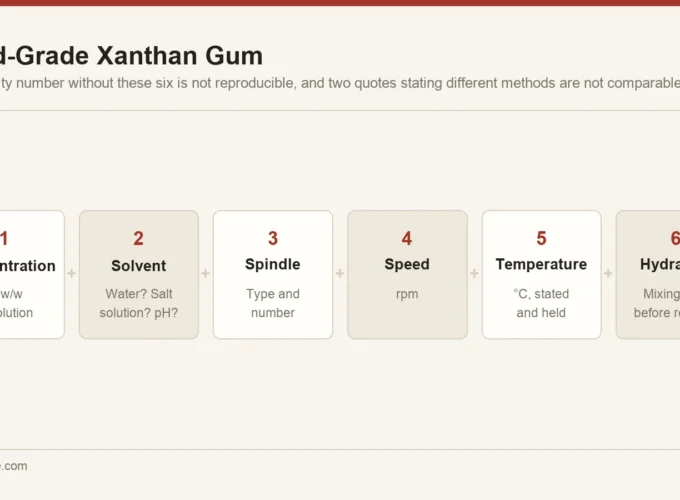
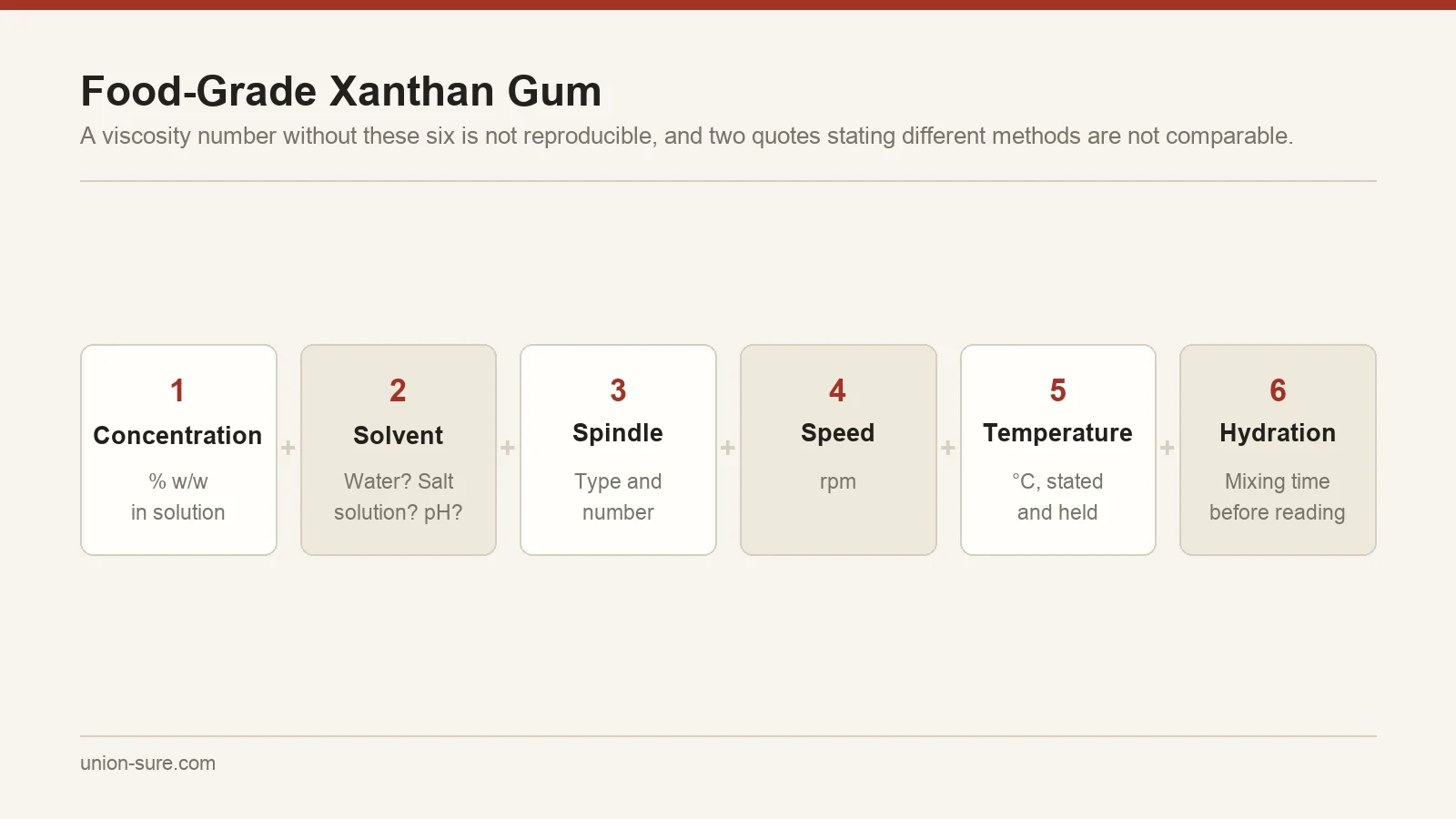
- “Viscosity 1,200 cP” is not a specification. Without concentration, solvent, spindle, speed, temperature and hydration time it cannot be reproduced.
- Mesh is a handling parameter, not a performance one. It affects dispersion, dust and hydration rate, not final viscosity.
- Match the grade to the formula: shear, salt, acid, alcohol and other hydrocolloids all change behaviour.
- Identity and purity belong in the specification alongside function — a functional result does not evidence compliance with a food-grade standard.
- Buyers shipping to the United States should check current anti-dumping duties on Chinese xanthan gum, and the specific rate applying to their supplier, before modelling a landed cost.
“Xanthan gum, food grade, 80 mesh, 1,200 cP.” That line appears on a lot of enquiries, and it is not enough information to quote against — or to compare two quotes with.
Viscosity without its method is a number without units. Mesh describes how the powder handles, not how the solution performs. And the grade that suits a salad dressing may behave badly in a high-salt sauce or a low-pH beverage. Getting this line right is the difference between an offer you can evaluate and three offers you cannot.
What food-grade xanthan is
JECFA defines xanthan gum as a high-molecular-weight polysaccharide produced by pure-culture fermentation of carbohydrate with Xanthomonas campestris, recovered with ethanol or isopropanol, dried and milled. It identifies glucose and mannose as dominant hexose units, with glucuronic and pyruvic acids. (JECFA xanthan specification)
JECFA lists functional uses including thickener, stabilizer, emulsifier and foaming agent. Its specification also covers:
- identification and solubility;
- assay;
- loss on drying;
- ash;
- pyruvic acid;
- nitrogen;
- residual ethanol/isopropanol;
- lead;
- total plate count, E. coli, Salmonella, yeasts and moulds.
Those criteria are a useful reference, not a universal purchasing document. The U.S., EU, destination law, customer and current compendial edition may differ. State which requirements control and how conflicts are handled.
Do not compare viscosity without the method
We quote against a stated method or we say we cannot quote, because a viscosity figure from a different concentration, spindle or temperature is not comparable to ours by any factor. If you take one line from this page into your next RFQ, make it the full viscosity method. It removes more ambiguity than anything else in a hydrocolloid specification. The 2025 U.S. CFR codification shows how specific a viscosity statement can be. Section 172.695 requires an aqueous solution with 1% additive and 1% potassium chloride, stirred for two hours, to have a minimum viscosity of 600 cP at 75°F using a Brookfield LVF or equivalent with No. 3 spindle at 60 rpm. It also includes a viscosity ratio at 75°F and 150°F. (21 CFR 172.695, 2025 edition)
That 600 cP value cannot be compared directly with a supplier result obtained at:
- a different xanthan concentration;
- deionized water without KCl;
- 30 or 60 minutes hydration;
- 25°C instead of 75°F;
- another spindle/speed;
- a different instrument geometry;
- a different result-reading time.
Check the current eCFR section before relying on the annual codification.
A method-complete COA line
Use this structure:
Viscosity: [acceptance range] mPa·s/cP, measured on [x%] xanthan in [water/buffer/salt composition], hydrated [time and procedure] at [temperature], using [instrument, spindle/geometry, speed/shear rate], read at [time].
Centipoise and mPa·s are numerically equivalent units, but that does not make different methods equivalent.
One-point viscosity is not a full rheology profile
Xanthan solutions are shear-dependent. A one-speed Brookfield result may be appropriate for incoming QC but may not predict pumping, filling, suspension at rest or sensory thickness. For a critical application, build a flow curve over relevant shear rates and define yield/suspension or thixotropy tests where justified.
Do not make universal claims such as “higher viscosity grade always uses less.” Hydration, matrix salts/acids, other hydrocolloids and target texture can reverse the commercial outcome.
Mesh is a handling parameter
“80 mesh” and “200 mesh” can describe different screen controls only when the sieve standard, aperture and percentage passing/retained are stated. A bare mesh number may use different systems or an internal supplier convention.
Particle size can influence:
- dust during dumping;
- wetting and fish-eye formation;
- dry-blend uniformity;
- dispersion time;
- screen residue;
- hopper flow and caking.
It does not by itself set the polymer’s final equilibrated viscosity. A finer powder may wet rapidly at the surface and form lumps if added poorly. A coarser/agglomerated grade may disperse differently. Test the actual addition method.
Specify particle size separately:
- named sieve standard and aperture;
- minimum percentage passing;
- maximum oversize and fines where relevant;
- sample preparation and method;
- bulk density, if dosing by volume;
- dust/flow or dispersion test tied to the plant process.
Match the grade to the formula
Supplier grade names such as “standard,” “transparent,” “salt-tolerant,” “rapid dispersing” or “oil-drilling” are not interchangeable. For food, confirm food-grade scope and evaluate any specialized claim.
Create a bench protocol that reproduces:
- process water mineral profile;
- pH and acid addition order;
- sugar, salt and protein levels;
- other gums/starches;
- temperature history;
- shear equipment and time;
- xanthan dosage;
- hold time before measurement;
- filling, storage, freeze–thaw or heat cycle as relevant.
Measure the attributes the consumer/process needs: low- and high-shear viscosity, suspension, pour, cling, syneresis, emulsion stability, mouthfeel, pump pressure or fill-weight control. Keep the protocol constant across blind-coded supplier samples.
Dispersion test
Document:
- preblend or direct-add route;
- liquid temperature and agitation;
- addition rate and point;
- time to visible wet-out;
- undispersed lump/screen residue;
- viscosity development at multiple times;
- final application result.
Do not compensate for a poor addition process by selecting a higher viscosity number without diagnosing dispersion.
Build the identity and purity specification
Choose the governing market and reference. A purchasing sheet can include:
| Area | Example field |
|---|---|
| Identity | Xanthan gum/E415/INS 415; named standard |
| Source/process | Fermentation organism/process declaration; recovery alcohol |
| Assay/identity | Standard and method |
| Physical | Appearance, particle size, bulk density |
| Rheology | Method-complete viscosity and optional ratio/flow profile |
| Purity | Loss on drying, ash, pyruvate/nitrogen as required |
| Residual solvents | Analytes, limits and methods |
| Contaminants | Lead and destination/customer panel |
| Microbiology | Methods, units and pathogen sample size |
| Allergen/GMO | Evidence appropriate to substrate/process and market |
| Packaging | Food-contact liner, net weight, seal and pallet |
Do not paste JECFA numbers beside a supplier’s different methods and call the hybrid “JECFA compliant.” Use the complete applicable specification or clearly identify buyer additions.
For EU use, the Commission explains that food additives must be authorized and listed with conditions in the EU positive list. (EU food additives overview) Confirm current E415 specifications, food-category authorization and quantum satis or numerical conditions as applicable; U.S. CFR compliance does not establish EU compliance.
Read the COA critically
Require:
- manufacturer, manufacturing site and product grade;
- buyer/supplier code and specification revision;
- batch number and dates;
- actual numerical results;
- method references;
- units and reporting limits;
- authorized approval.
“Pass” is inadequate for viscosity, moisture and particle size when trend information matters. Compare recent lots to see process variability, but do not invent a capability index from too few results.
The FDA’s Substances Added to Food database links xanthan gum to §172.695 and lists technological functions, but the regulatory text is the decision source. (FDA xanthan entry)
Supplier and contaminant controls
A commercial note we would rather state than have a buyer discover late: the United States applies anti-dumping duties to xanthan gum from China, and the rate depends on the specific producer. If your destination is the US, establish the applicable rate before you model landed cost — the duty can move the economics further than any price negotiation will. For EU, Middle East and South-East Asian destinations this does not apply, which is where we focus this line. Audit fermentation, recovery solvent, drying/milling, foreign-material control, sieving, blending/rework, allergen segregation, microbiology, packaging and traceability. Review whether the named factory manufactures food grade and whether a trader keeps manufacturer/lot identity visible.
The European Commission’s January 2026 fraud-suspicion report includes individual xanthan-related findings. (January 2026 report) Treat these as signals for a risk assessment, not evidence of a general failure rate or a claim about an unnamed source.
Change notification
Require approval before changes to:
- manufacturing site;
- fermentation substrate or organism;
- recovery solvent;
- milling/agglomeration or mesh;
- standard/compendial edition;
- viscosity grade/method;
- packaging;
- allergen/GMO status;
- critical test laboratory or method.
Re-run the application trial when a change can affect performance even if the basic COA still passes.
Final buyer checklist
- [ ] “Food grade” is tied to destination law and named specifications.
- [ ] Viscosity includes concentration, medium, time, temperature and instrument settings.
- [ ] Supplier viscosity values are compared only under equivalent methods.
- [ ] Mesh includes a sieve/aperture and percent passing/retained.
- [ ] Particle size and rheology are controlled separately.
- [ ] Identity, purity, residual solvents and microbiology are included.
- [ ] The actual formula/process trial passes.
- [ ] COA reports actual lot results and methods.
- [ ] Manufacturing site is transparent and approved.
- [ ] Changes trigger review and, where relevant, requalification.
The best xanthan grade is not the one with the largest viscosity number. It is the compliant grade whose method-defined properties and dispersion produce a stable, repeatable result in the buyer’s real formula.
Frequently asked questions
What has to accompany a xanthan gum viscosity figure?
Concentration, solvent (including salt and pH where relevant), spindle type, speed, temperature and hydration time. Without all six the number cannot be reproduced, and two quotes stating different methods are not comparable by any conversion factor.
Does a finer mesh give higher viscosity?
No. Mesh is a handling parameter. It affects dispersion, dust generation and how quickly the powder hydrates, not the viscosity the fully hydrated solution reaches.
Do US anti-dumping duties affect xanthan gum from China?
Yes. The United States applies anti-dumping duties to Chinese xanthan gum, and the applicable rate depends on the specific producer. Confirm the current rate and your supplier’s rate before modelling a US landed cost.
Where to go next
A hydrocolloid specification is a method document. These support it.
- the food additive range — current additive and hydrocolloid lines.
- erythritol, xylitol, maltitol and sorbitol compared — the other additive decision that turns on method-based specification.
- reading an additive COA critically — identity and purity rows are where additive certificates most often thin out.
- ask for a specification and sample — send the formula conditions — shear, salt, pH — and we will propose a grade.
Published 11 August 2026. Last reviewed 15 August 2026 by the Union Sure technical team. Regulatory limits, standards and market requirements change — verify every legal limit against the current official source before it is used to approve a shipment.