
Key points
- Traceability is one step up and one step down, at lot resolution, in both directions, on demand.
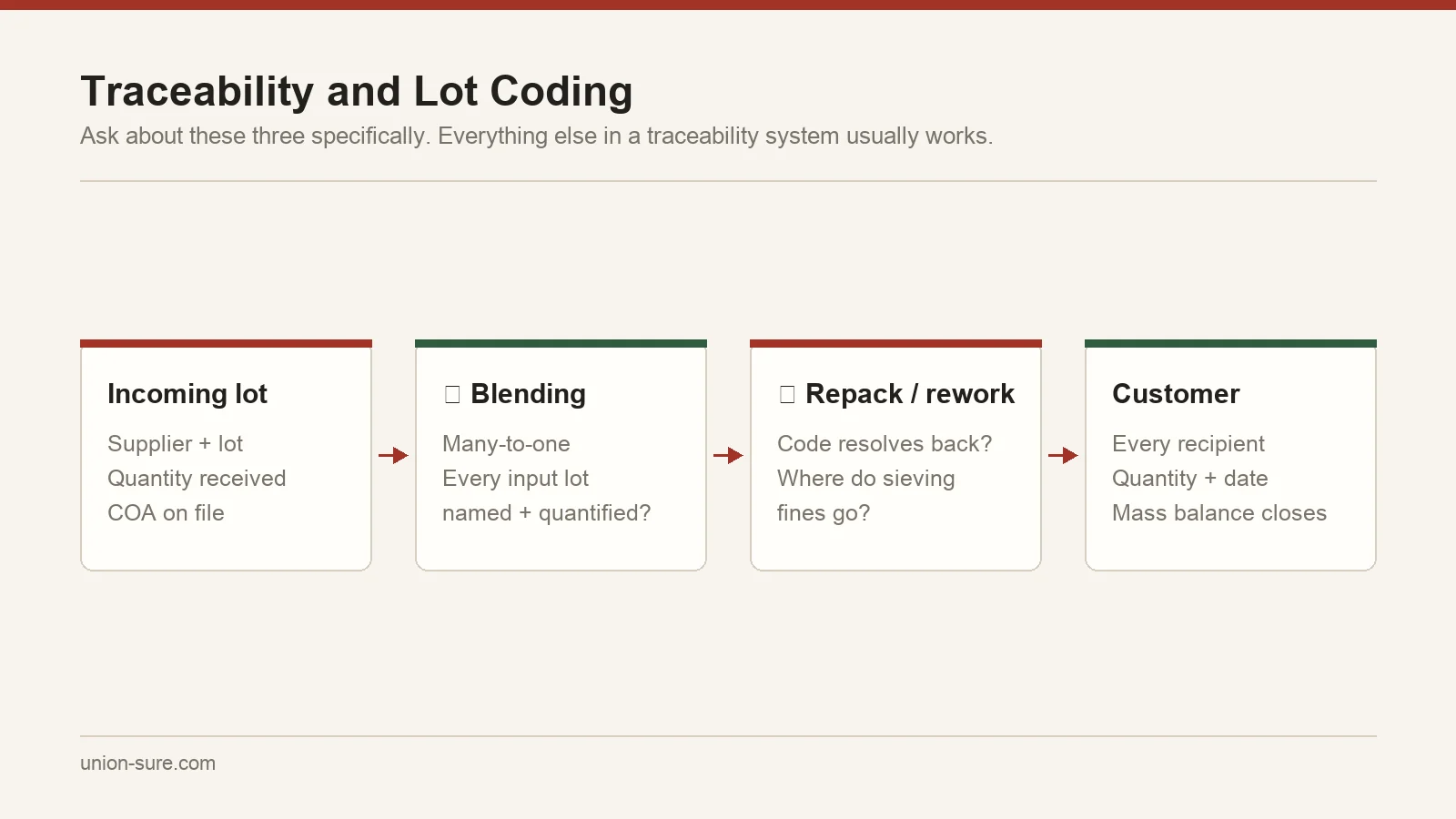
- The chain almost always breaks at blending, repacking and rework — the three points where lot identity is easiest to lose.
- A lot code that cannot be read from the physical bag is not a lot code. Test it on a bag, not on a spreadsheet.
- Mass balance is the honest test: quantity in, quantity out, quantity on hand. If it does not reconcile, the records are decorative.
- Run a mock recall on a real lot with a clock running. Four hours is a common target; the number matters less than the fact you have measured it.
The mock recall is where traceability systems go to die. Everything looks fine in the folder, then somebody picks a lot code off a bag, starts a stopwatch, and asks two questions: where did this come from, and where did all of it go.
Most systems can answer the first. It is the second that separates a real system from a filing cabinet.
One up, one down — but at lot resolution
There is an international standard for the design of traceability systems in the feed and food chain, and it is worth reading once even if you never certify to it, because it forces the questions that ad-hoc systems skip: what the traceable unit is, where the boundaries of the system are, and what information has to move with the product. (ISO 22005:2007)
The working definition is simple. For any lot you hold, you must be able to identify the immediate supplier and the material they sent, and every immediate customer who received any of it. Not the year. Not the shipment. The lot.
Two conditions make that harder than it sounds:
- it has to work in both directions — forward from an incoming raw material, backward from a finished pack;
- it has to work on demand, in hours rather than days, without the one person who knows the system.
Everything else is implementation detail.
Where the chain actually breaks
In the dried-ingredient trade there are three predictable failure points, and they are worth asking about individually rather than as one question.
Blending
The moment two incoming lots become one outgoing lot, one-to-one becomes many-to-one. That is fine if the blend record names every input lot and its quantity. It is not fine if the record says “carrot, 2 tonnes”.
Ask to see a blend record for a lot you pick. What you want to see is every input lot identified, each with a quantity, and the arithmetic reconciling to the output. What you often see instead is a total with the inputs named but not quantified, which means a recall of one input lot forces a recall of everything it might have touched.
Repacking
Bulk into retail, or 25 kg into 5 kg, is where the original lot code most often disappears. The new pack needs its own code that resolves back to the input lots, and the repack record has to carry the link.
The failure mode is mundane: an operator opens three bulk bags across a shift and the repack record captures the date but not which bags. The trace then resolves to a day rather than to a lot, and a day can be several tonnes.
Rework
Material that re-enters the process later is the hardest to track and the most common thing left out of records entirely. Sieving fines, off-specification material blended forward, product recovered from a stopped line — all of it has to appear somewhere.
If a supplier says they never rework, ask what happens to the fines from sieving. There is always an answer, and it is always a rework loop by another name.
What a usable trace record contains
| Field | Why it is needed |
|---|---|
| Traceable unit definition | Decides what a recall can isolate |
| Input lot IDs with quantities | Makes blending reconcilable |
| Process step and date/shift | Links the record to production data |
| Output lot ID and quantity | Closes the mass balance |
| Rework in, with source lot | The field most often absent |
| Customer, quantity, dispatch date | The downstream half of one-up one-down |
Ask about all three break points specifically during an audit. “Do you have traceability?” gets a yes from everyone; “show me the blend record for this lot” does not.
Design the code so it can be read
A lot code has one job: to be legible on the physical unit, months later, after handling. Things that break it:
- printing on a surface that scuffs, or under a label that gets torn off;
- codes that only exist on the outer carton, when the inner bags get separated;
- codes that encode information the customer cannot decode without a key nobody sent;
- date formats that are ambiguous between markets.
Whatever scheme you use, put the code where it survives, keep the same format across pack sizes, and make sure the COA, the packing list and the bag agree. Where the two disagree, the bag is the truth and the paperwork needs explaining.
Mass balance is the test that cannot be faked
Records can be tidy and still be fiction. Mass balance checks the arithmetic: for a given lot, does quantity received equal quantity used plus quantity shipped plus quantity on hand plus documented loss?
If it reconciles within a sensible tolerance, the records describe something real. If it does not, no amount of paperwork quality helps. This is also the cheapest fraud check available to a buyer — it costs one spreadsheet and it catches stories that certificates do not.
Do it on a lot you choose, not a lot the supplier offers.
Low-moisture products have their own hygiene logic
Where the ingredient is a low-moisture food, the traceability system is also the tool that bounds a contamination event. Codex maintains a code of hygienic practice specifically for this category, and one of the reasons it matters here is that low-moisture products are typically blended, stored long and distributed widely — so a slow trace turns a small event into a large one. (Codex CXC 75-2015)
The mock recall
Pick a lot from a bag in the warehouse. Start a clock. Require:
- the incoming lots that went into it, with quantities;
- the supplier and receipt date for each;
- every customer who received any of it, with quantities and dates;
- quantity still on hand;
- the release records and COA for the lot.
Four hours is a common internal target. The specific number matters far less than the fact that someone has actually run it and written down what went wrong. A supplier who has a mock recall record with corrective actions in it is in better shape than one whose record shows a flawless first attempt.
Score it honestly
Record four things at the end of the exercise: elapsed time, whether the quantities reconciled, what was missing, and what was changed as a result. A mock recall with no findings is usually a mock recall that was announced in advance and run by the person who designed the system.
Repeat it at a defined frequency and vary who runs it. A trace that only one person can produce is a single point of failure with a job title.
What to ask before approval
- Show me the blend record for a lot you did not choose.
- What happens to rework, and where does it appear in the records?
- How does a retail pack code resolve back to the bulk lots?
- When was your last mock recall, how long did it take, and what failed?
- Can you produce the trace without the person who normally does it?
The FDA’s foreign supplier verification framework evaluates supplier performance as well as the food itself, and traceability is a large part of what “performance” means in practice. (FDA FSVP rule)
Frequently asked questions
Is a batch number the same as a lot code?
Not necessarily. A batch number usually identifies a production run; a lot code identifies the material you can actually isolate and recall. When one production run is packed on three days into three pack sizes, one batch number may span several lots. Agree which one governs the recall unit.
Do I need traceability for a single-ingredient dried product?
Yes, and it is easier there. The chain is short, so there is no excuse for it not to work. The complexity arrives with blending and repacking, not with the number of ingredients.
How long should records be kept?
Long enough to cover the product’s shelf life plus a margin, and long enough to satisfy the destination market’s own record-keeping rules — which vary, so verify them per market rather than applying one number everywhere.
Where to go next
Traceability is verified at the supplier and evidenced on the certificate.
- what to verify at the supplier — blend, repack and rework records are audit findings, not a policy statement.
- matching a COA to the material in front of you — the lot code on the bag is where a trace starts.
- documents that travel with the shipment — lot identity has to agree across the bag, the COA and the packing list.
- ask us to run a trace — name a lot and we will show the chain behind it.
Published 18 November 2025. Last reviewed 15 August 2026 by the Union Sure technical team. Regulatory limits, standards and market requirements change — verify every legal limit against the current official source before it is used to approve a shipment.