
Key points
- “Flakes”, “granules”, “minced” and “powder” are category names, not acceptance criteria. Two suppliers can ship materially different products under the same word.
- A single mesh number is incomplete. Specify the standard (ISO/ASTM/Tyler), whether it is aperture or mesh count, and the percentage passing and retained.
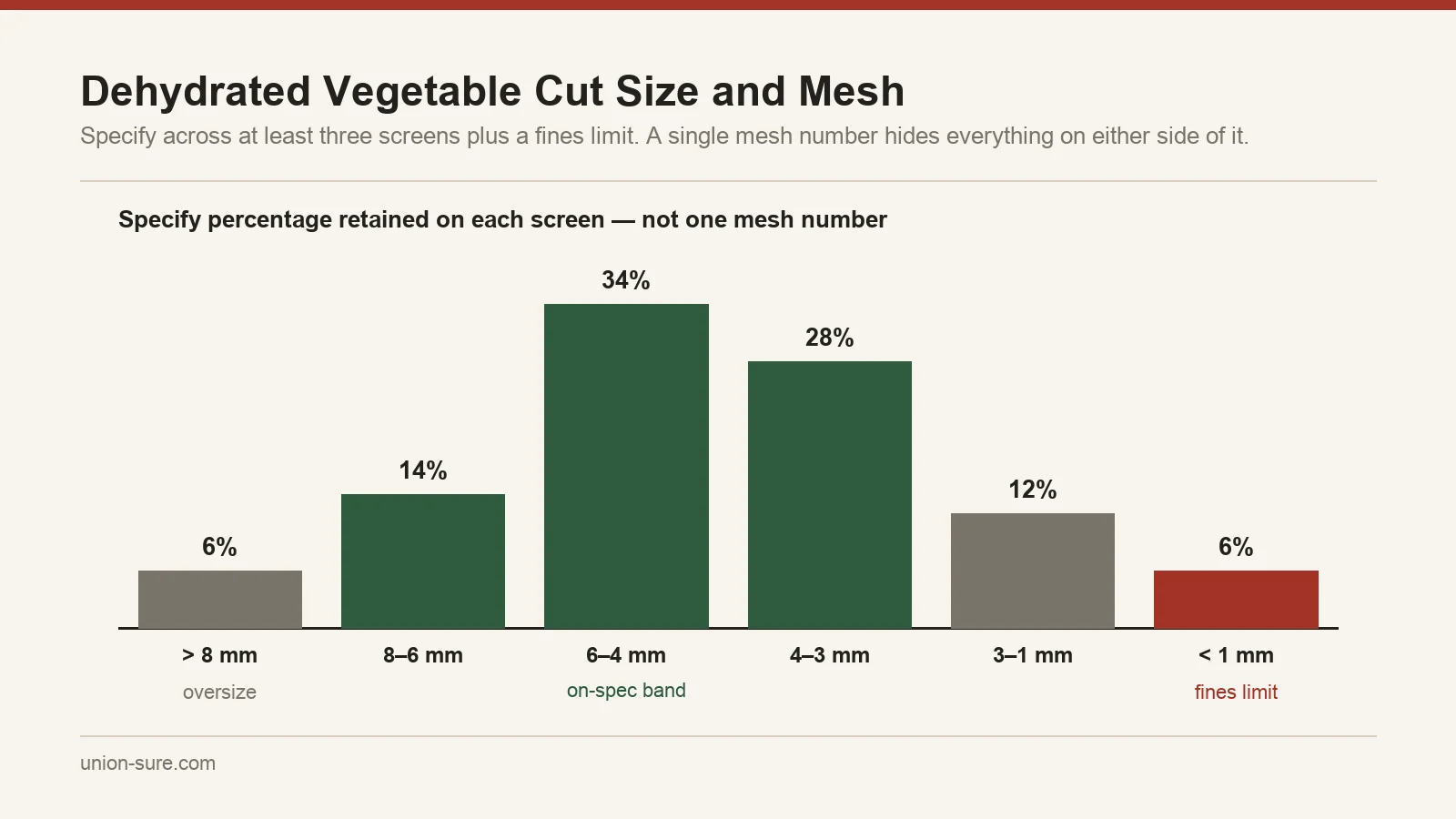
- Specify a distribution across at least three screens, plus a fines limit. One screen hides everything either side of it.
- Sampling error can exceed the specification tolerance. Agree sample size, splitting method and sieving time or the result is not reproducible.
- Size drives visual identity, dosing uniformity, dispersion, dust and flavour release — pick the target from the application, not from the price list.
Ask three suppliers for “dehydrated carrot granules” and you will get three genuinely different products, all correctly named.
Cut size is where dehydrated vegetable specifications tend to fall apart quietly. Not because anyone is cheating — the words are category labels, and acceptance criteria have to be numbers. This guide is about converting one into the other, including the sampling detail that decides whether your number means anything.
Start with the product style, then add dimensions
Codex places dried vegetables in a category that includes powders and flakes. Its current dried-garlic standard recognizes whole, cracked/broken and ground/powdered styles, while stating that particle size for pieces and ground product is determined by agreement between buyer and seller. (Codex CXS 347-2019)
That is the right procurement principle: the style names the form; the contract defines the size.
For a visible piece, state:
- botanical and plant part;
- cut style: dice, strip, ring, flake, minced or other agreed term;
- target length, width and thickness, with units;
- acceptable range, not merely a nominal target;
- maximum percentage below and above the range;
- treatment of fines, dust, clumps and broken pieces;
- test sample mass, number of subsamples and calculation basis;
- measurement method, including whether a sieve, calliper or image method is used.
“10 mm carrot dice” does not say whether 8–12 mm is acceptable, whether thickness also matters, or how much broken material can be present. Those omissions often become disagreements only after production starts.
Why “mesh” is incomplete
Mesh is commonly used as shorthand for powder fineness, but a purchase order such as “80 mesh vegetable powder” leaves several questions unanswered:
- Which sieve system or standard applies?
- Is the requirement an aperture size or a mesh designation?
- What proportion must pass the sieve?
- Is there a coarser control sieve or a fines limit?
- How is an agglomerated or moisture-sensitive sample prepared?
- How long and by what motion is it sieved?
ASTM E11-24 specifies requirements for woven-wire test sieve cloth and test sieves used to classify materials by particle size. It covers nominal apertures from 125 mm to 20 micrometres and defines different opening tolerances and sieve classes. (ASTM E11-24) ISO 3310-1:2016 covers technical requirements and testing for metal-wire test sieves over the same broad aperture range. (ISO 3310-1)
These standards show why a bare number is not enough: the physical aperture and the sieve’s conformity matter. ISO 565 provides nominal opening series and reports sizes at or above 1 mm in millimetres and smaller sizes in micrometres. (ISO 565)
Do not copy a universal “mesh equals microns” table into a contract without naming its source and edition. If a buyer thinks in mesh and a factory thinks in millimetres, agree the nominal aperture under one named standard and make that the controlling value.
Specify a distribution, not just one screen
A powder is a population of particles. “95% passes 250 µm” controls the coarse tail but says little about how much of the product is extremely fine. Two lots can both pass that clause while behaving differently in a ribbon blender, seasoning tumbler or liquid dispersion.
A practical sieve clause might contain:
| Control | Example structure—insert validated limits |
|---|---|
| Method | Named sieve standard plus agreed operating procedure |
| Coarse limit | No more than X% retained on aperture A |
| Main band | Y–Z% between apertures A and B |
| Fines limit | No more than X% passing aperture B |
| Sample | Defined composite mass and conditioning rule |
| Result | Mass percentage, rounding rule and lot acceptance plan |
The letters are intentional placeholders for the buyer’s validated limits; they are not Union Sure product data. ASTM has a separate practice for reporting particle-size characterization data, which reinforces the need to retain method and reporting context. (ASTM E1617)
For very fine, cohesive or irregular powders, sieve analysis may not be the best or only method. If laser diffraction or image analysis is used, identify the instrument principle, dispersion conditions, refractive assumptions where relevant and the reported statistics. Results from different measurement principles are not automatically interchangeable.
Sampling can dominate the result
This is the part that surprises buyers, so it is worth stating flatly: on a granular material, the difference between two operators sieving the same lot can be larger than the tolerance you wrote into the specification. Agree the sample mass, the splitting method, the sieve stack, the shaking time and the acceptance rule. Otherwise a rejection turns into an argument about technique rather than about the product. Size segregation occurs during conveying, filling and transport. Fines can settle while large light pieces remain near the top. A sample taken from one bag opening may therefore misrepresent a lot.
Define:
- the lot and number of packages sampled;
- locations within packages;
- incremental and composite sample sizes;
- sample reduction method;
- whether clumps are gently separated or counted as oversize;
- conditioning temperature and humidity, if relevant;
- replicate tests and the rule for discordant results.
Keep the retained sample long enough to investigate a complaint. A COA result without a sampling plan proves only what happened to the tested portion.
Match size to the finished application
We would rather ask what the finished product looks like than take a mesh number at face value. A visible carrot piece in a premium soup and a carrot that must disappear into a seasoning blend are opposite requirements, and buyers occasionally send us the mesh spec from the wrong one of their own products. One photograph of the target finished product settles more than a page of correspondence. Particle size can influence several buyer-visible outcomes, but direction and magnitude depend on the vegetable and process.
Visual identity
Soup, noodle and ready-meal applications may need recognizable pieces after cooking. Measure the dry cut and the rehydrated appearance. A dry flake that fits the target may fragment in mixing or fail to rehydrate within the customer’s cook time.
Dosing and blend uniformity
Large differences in particle size and density encourage segregation. Check the actual mixer, transfer distances and package-fill process. A tighter screen specification may reduce one source of variation, but it does not replace a blend-uniformity study.
Dispersion and dust
Finer powder can disperse faster in some systems, yet it may also create dust, agglomerate on wetting or bridge in a hopper. Test the order of addition, shear, liquid temperature and solids level. Do not promise “instant solubility” from mesh alone; most vegetable powders contain insoluble plant solids.
Flavour release and perception
Smaller particles create more exposed surface, but processing history, volatile retention, storage and formulation can be equally important. Include sensory and dosage checks with a representative sample.
Do not let size replace the rest of the specification
Codex’s garlic standard includes moisture and other chemical and physical criteria in addition to style. It also points to hygiene controls for low-moisture foods. A complete dehydrated-vegetable specification may need:
- species, cultivar or plant part where material;
- processing and any microbial-reduction step;
- moisture and water activity, with methods;
- colour, flavour and rehydration criteria;
- foreign and extraneous matter;
- microbiological limits appropriate to use;
- pesticides, contaminants and additives for the destination market;
- allergen and cross-contact status;
- packaging, net weight, storage and shelf-life evidence.
The cut-size clause answers only the physical-form question.
Copy-ready RFQ wording
Use this structure and replace each bracketed field after application trials:
Product form: [dice/flake/granule/powder]. Particle size shall be determined using [named standard and method]. For pieces, [X%] by mass shall fall within [dimensional range], with no more than [X%] fines and [X%] oversize. For powder, no more than [X%] shall be retained on [aperture] and no more than [X%] shall pass [aperture]. Report actual lot results and method on the COA. Sampling shall follow [plan]. Acceptance also requires passing the agreed application trial.
Ask the supplier to send:
- the current specification and method;
- three recent lot distributions, not only “conforms”;
- a representative sample made by the intended process;
- a retained reference sample from the approved lot;
- photographs with a scale, used only as supporting evidence;
- change-notification terms for mill, screen or process changes.
Final buyer checklist
- [ ] Product style and plant part are explicit.
- [ ] Piece dimensions or sieve apertures are stated in SI units.
- [ ] The sieve or particle-size standard and edition are named.
- [ ] Percentage passing, retained and fines limits are defined.
- [ ] Sampling, preparation and calculation are reproducible.
- [ ] COA reports actual results, not only pass/fail.
- [ ] Rehydration, dosing, dust and finished-product appearance were tested.
- [ ] Moisture, water activity, microbiology and packaging are controlled separately.
- [ ] Supplier changes to milling or screens require notice.
The most reliable specification is not the one with the most familiar trade term. It is the one that another trained person can repeat and that predicts performance in the buyer’s real process.
Frequently asked questions
Is a mesh number the same as a particle size in millimetres?
No. A mesh number describes a screen, not a particle, and the aperture it corresponds to depends on which standard is used. Always state the standard and the aperture in millimetres or micrometres alongside the mesh count, and specify the percentage passing or retained.
How many screens should a particle size specification use?
At least three: an oversize screen, the on-specification band, and a fines screen with its own limit. A single screen tells you nothing about what sits either side of it, which is where most rejections come from.
Why do two laboratories report different results for the same lot?
Usually sampling and sieving technique rather than the material. Sample mass, splitting method, sieve stack, shaking time and endpoint all change the result. Agree those in the specification, or the numbers are not comparable between sites.
Where to go next
Cut size is one line of a dehydrated vegetable specification. These are the lines around it.
- the dehydrated vegetable range — current cuts and forms, by vegetable.
- moisture content versus water activity — smaller cuts have more surface area, and surface area changes stability.
- choosing between air drying, freeze drying and vacuum frying — cut size only becomes the deciding specification once the process is settled.
- send a target sample or photograph — a picture of the finished product resolves size questions faster than a mesh number.
Published 25 November 2025. Last reviewed 15 August 2026 by the Union Sure technical team. Regulatory limits, standards and market requirements change — verify every legal limit against the current official source before it is used to approve a shipment.