
Key points
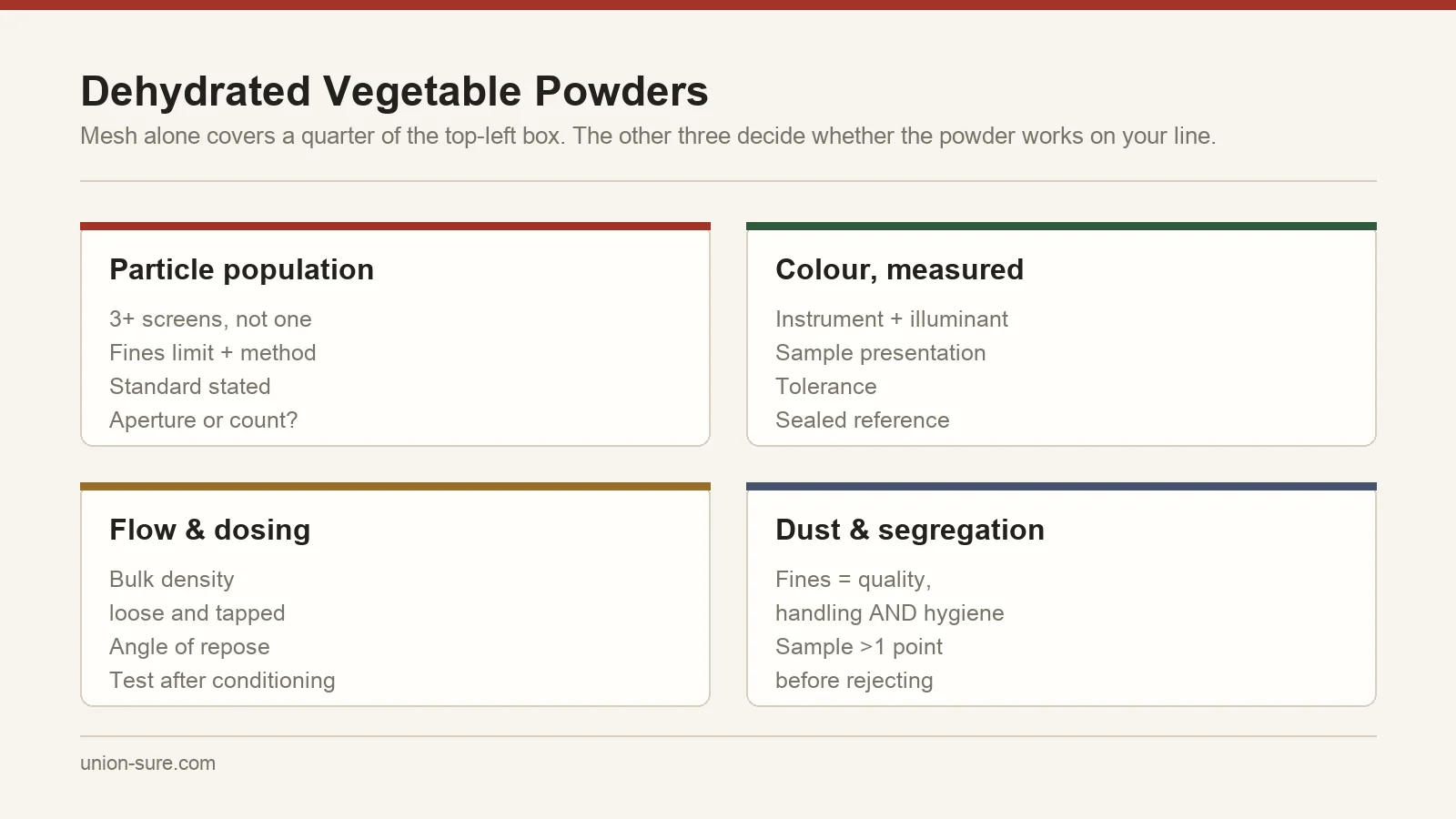
- A powder is a population of particles, so a single mesh number describes almost nothing about how it will behave.
- Colour is the reason most powders are bought and the least well specified. Describe it with an instrument and a reference, not an adjective.
- Flow, bulk density and angle of repose decide whether it doses accurately at your addition rate — these belong in the specification.
- Fines and dust are a handling and hygiene issue, not only a quality one. Set a limit and a measurement method.
- Segregation in transit can undo a perfect blend. Sample from more than one point in the load before rejecting a lot.
Vegetable powders get bought for colour and flavour, and get specified on mesh. That mismatch causes most of the disputes in this category.
Mesh tells you something about how the powder was screened. It tells you very little about how it will disperse, how it will flow through your dosing equipment, whether it will hold colour through your process, or how much of it will end up as airborne dust on the line.
Specify a distribution, not a screen
Name the sieve standard, not just the number
A mesh count is only meaningful alongside the standard it belongs to, because the aperture a given count corresponds to differs between systems. There are two widely used references for woven-wire test sieves and their nominal openings, and they are not interchangeable in the detail. (ISO 3310-1:2016) (ISO 565:1990) (ASTM E11-24)
So write the line as: standard, count or aperture, and which one is governing. ≥ 95% passing 180 µm (ISO 3310-1) is enforceable. 80 mesh is not.
Report the analysis the same way twice
Particle size results are only comparable between laboratories if the reporting convention is fixed as well as the method — which fraction is reported, on what basis, to what precision, and with which descriptive statistics. There is a standard practice for exactly this reporting problem, and citing it in the specification saves a category of argument. (ASTM E1617)
Two powders that both pass an 80-mesh screen can have completely different particle populations underneath. What matters is the shape of the distribution:
- percentage retained on at least three screens, not one;
- a fines limit at the bottom end, with its own method;
- an oversize limit at the top;
- the sieving conditions — stack, sample mass, shaking time and endpoint;
- and how a result between two screens is assigned.
This is the same discipline that applies to cut sizes on pieces, just at a finer scale, and it fails the same way: one number in the specification, two operators, two answers, and an argument about technique rather than about the material.
A worked specification block for size
| Screen | Requirement | Method |
|---|---|---|
| Retained on 250 µm | ≤ 2% (oversize) | ISO 3310-1 stack, stated mass and time |
| Passing 250 / retained 150 µm | 20–40% | as above |
| Passing 150 / retained 75 µm | 45–70% | as above |
| Passing 75 µm | ≤ 15% (fines) | as above |
Four numbers instead of one, and every rejection becomes checkable rather than negotiable. The bands are illustrative — set yours from what the application needs and what the process can reproducibly deliver.
Colour, measured
“Bright red”, “natural green” and “vibrant” are not acceptance criteria. Two things make colour specifiable:
- an instrumental measurement with the instrument, illuminant, aperture and sample presentation stated;
- a physical reference standard, sealed and dated, stored dark and cool.
Sample presentation matters more than people expect for powders. The same material measured loose, tapped and pressed will give different readings, so fix the presentation in the method or the numbers are not comparable between sites.
Then agree a tolerance, and agree what happens when a lot sits inside the numeric tolerance but looks wrong against the reference. Colour is the attribute where that gap opens most often.
Colour is also a storage question
A colour specification describes the material at a point in time. Vegetable powders with residual sugars or pigments drift in storage, faster when moisture or oxygen gets in.
That means two things for the specification: state whether the colour requirement applies at release, at receipt, or through shelf life; and store the reference standard so it does not drift too — sealed, dark, cool, and replaced on a defined schedule rather than when someone notices it has faded.
Flow and dosing
If the powder is dosed automatically, flow properties are functional requirements, not nice-to-haves:
- bulk density, loose and tapped;
- angle of repose or another agreed flow measure;
- moisture and water activity, which drive caking;
- whether an anti-caking agent is present, declared and permitted in your market.
A powder that flows well in the supplier’s warehouse can bridge in your hopper after four weeks in a humid container. If dosing accuracy matters, test flow after conditioning, not on arrival.
Test flow after conditioning, not on arrival
Flow measured on freshly produced powder in a dry room is the best case and not the case you will meet. If dosing accuracy matters, condition the sample to a realistic humidity and time before measuring, or measure both and specify which governs.
Caking is the failure that follows, and it is driven by water activity rather than by moisture content alone — a powder can sit inside its moisture limit and still cake if the water in it is available. Specify water activity with a temperature alongside moisture, or the flow requirement has no physical backing.
Dust, fines and segregation
Fine fractions cause three separate problems and they get conflated. They are a quality issue where they change appearance or dispersion; a handling issue where they generate airborne dust; and a hygiene issue where dust accumulates in equipment.
Set a fines limit with a method. Then separate the question of segregation: a well-blended powder can separate by particle size during transport and handling, so fine material concentrates in one part of the load. Before rejecting a lot on a fines result, sample from more than one point — the result may be describing the top of one bag rather than the lot.
Dispersion in your matrix
The functional test is not “does it dissolve” but “does it disperse without lumping at my addition rate, temperature, shear and order of addition”. Fine powders can hydrate at the surface and form lumps with dry cores. If that is a risk, agree a dispersion protocol as part of qualification rather than discovering it in production.
A copy-ready specification block
- Vegetable, variety where relevant, and process (air-dried, freeze-dried).
- Particle size distribution across three screens plus fines limit, with standard and method.
- Colour: instrument, illuminant, presentation, target and tolerance, plus reference standard.
- Bulk density loose and tapped; flow measure and method.
- Moisture and water activity, each with method and, for water activity, temperature.
- Anti-caking or processing aids: present or absent, declared, permitted in destination.
- Microbiological panel appropriate to the risk and to whether a kill step follows.
- Foreign matter, defect and sieve-residue limits.
- Pack, liner, barrier and pallet; storage conditions.
- Sampling plan and the point at which acceptance is judged.
Frequently asked questions
Does a finer powder always disperse better?
No. Very fine powders can hydrate at the surface and form lumps with dry centres, which is worse than a slightly coarser grade that wets through. Test dispersion in your own matrix at your own addition rate rather than assuming finer is easier.
Why did my powder darken between arrival and use?
Usually moisture pickup or oxidation during storage rather than anything wrong at dispatch. Check the pack barrier, the storage humidity and the time in a partly used bag. A reference standard stored dark and cool lets you separate lot variation from storage change.
Is anti-caking agent normal in vegetable powders?
It is common, and it is a declaration and a permission question rather than a quality question. Confirm whether one is present, what it is, and whether it is permitted for your product and market before you specify the powder.
Where to go next
A powder specification is the fine-scale version of a cut-size specification.
- cut size and mesh for dehydrated vegetables — the same discipline at piece scale, including the sampling trap.
- moisture content versus water activity — the pair of numbers that decide caking and flow.
- the dehydrated vegetable range — current vegetables, cuts and powder forms.
- send a target reference — a sealed colour reference resolves more than a paragraph of description.
Published 24 February 2026. Last reviewed 15 August 2026 by the Union Sure technical team. Regulatory limits, standards and market requirements change — verify every legal limit against the current official source before it is used to approve a shipment.