
Key points
- “Crystallized ginger” describes a process, not a formula. Sugar type, infusion level, free surface sugar and residual moisture all vary between suppliers.
- Ask for the composition breakdown, including free coating sugar, before comparing a price per kilogram.
- Specify a slice distribution — thickness, diameter range and a broken-piece limit — not a nominal diameter.
- Tenderness and fibre must be defined against the intended use. A slice that works in a snack pack can be wrong in a chocolate centre.
- Sulphites are a three-part decision: used or not, declared or not, and verified at what reporting limit.
A photograph of amber ginger dusted in sugar tells you almost nothing that a buyer needs to know.
It does not show the infusion level, the free surface sugar, how much of the weight you are paying for is coating, how thick the slices run, how fibrous the root was, or how the pieces will behave once they meet a chocolate enrober. Crystallized ginger is a process description, and two products made by that process can differ enough that comparing their prices is meaningless until the specification is written down.
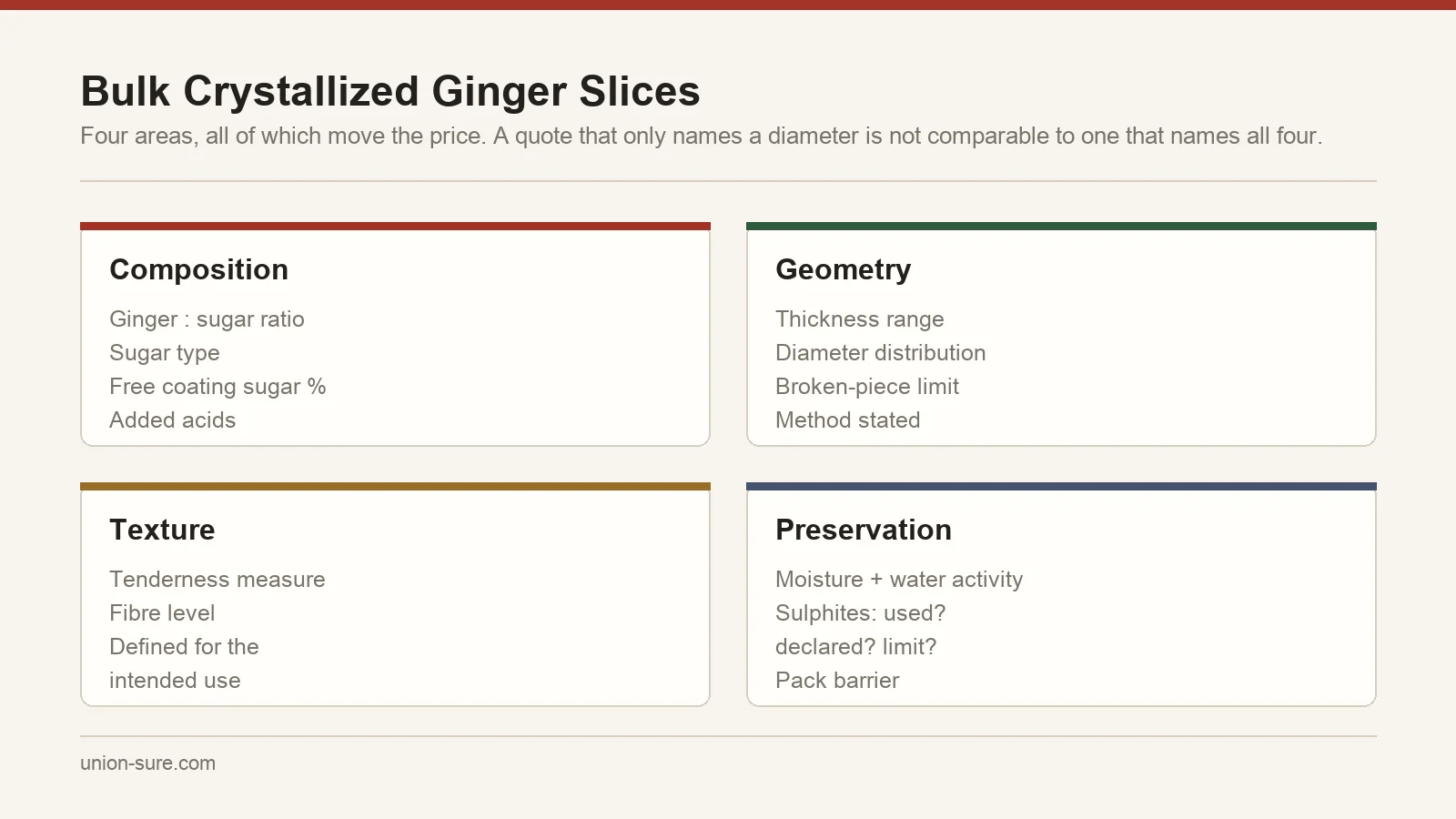
Define crystallized ginger before requesting price
Codex’s food-additive category for candied fruit distinguishes three related processes:
- glazed fruit is treated with sugar solution and dried;
- candied fruit is dried glazed fruit immersed in sugar solution and dried to form a candy-like shell;
- crystallized fruit is dried glazed fruit rolled in icing or granulated sugar and dried.
(Codex GSFA category 04.1.2.7)
Supplier usage is not always consistent, so state which structure you need. Ask for a process flow covering peeling, cutting, cooking/blanching, syrup stages, draining, drying, coating and packing.
The Codex standard for dried/dehydrated ginger identifies the botanical source as Zingiber officinale Roscoe and recognizes whole, pieces and ground/powdered styles. (CXS 343-2021) That standard is useful for raw ginger identity and quality context, but it does not define the complete sugar-preserved formulation.
Composition must be transparent
The number worth asking for first is the free coating sugar. It is legitimate and it is also the easiest place for two quotes to diverge without anybody saying anything untrue, because you are buying that sugar by the kilogram at the ginger price. Ask for it as a percentage with a method, and the price comparison becomes honest. Request a quantitative or otherwise decision-useful composition covering:
- ginger species and country/region of origin;
- ginger content on the agreed basis;
- sugar(s) used in syrup and outer coating;
- any glucose syrup, invert syrup or other carbohydrate source;
- preservatives, colours, acidity regulators, flavours or processing aids;
- sulphiting agents and purpose;
- anti-caking or release agents;
- carrier ingredients in compound materials;
- allergen and cross-contact status.
Do not assume all “sugar” is sucrose or all crystallized slices have the same ginger-to-sugar ratio. No universal ratio is recommended here. Choose it by sensory target, label, nutrition calculation, cost and application.
The supplier’s ingredient list should reconcile with the technical data sheet, allergen statement, COA and finished-label input.
Specify slice distribution, not a nominal diameter
Ginger rhizomes are irregular. Circular slices can vary in diameter, thickness, fibre direction and centre holes. Define:
- style: full cross-section, half slice, irregular slice or piece;
- thickness range;
- diameter or longest-dimension range where material;
- percentage within range by mass;
- maximum undersize/oversize;
- maximum broken pieces and crumbs;
- definition of a broken slice;
- clumps/doubles;
- stem, peel and other physical defects;
- sample mass and measurement method.
If appearance is critical, use a calibrated image method or a sorting screen plus manual defect assessment. A supplier photo is a visual reference only and may show hand-selected pieces.
Define tenderness and fibre in the intended use
“Soft” and “tender” depend on who bites the product and at what temperature. Build a sensory method:
- condition samples at a defined temperature and humidity;
- blind-code the approved and trial lots;
- define bite resistance, fibrousness, chew length, ginger heat and aftertaste scales;
- assess enough pieces to capture rhizome variation;
- test directly and in the finished application;
- set an acceptance range around the approved reference.
Instrumental texture can help if the fixture, slice orientation and thickness are controlled. Do not publish an arbitrary force limit without internal correlation to sensory acceptance.
For chocolate coating, check moisture migration, sugar bloom/adhesion and cut-piece handling. For bakery, test heat exposure, colour, flavour and syrup leakage. For trail mix or direct snacking, check free crystals, dust, stickiness and package stability.
Control the coating
Define the coating condition at receipt:
- crystal type/particle appearance;
- minimum/maximum coating or total sugar by the agreed method;
- free sugar in the package;
- bare patches;
- wet/sticky surfaces;
- hard syrup agglomerates;
- colour uniformity;
- acceptable crystal loss after transport simulation.
“Heavily crystallized” can increase package free sugar without improving ginger coverage. Evaluate after vibration and temperature cycling representative of transport.
Use both moisture and water activity where they answer different questions
Moisture content measures how much water is present. Water activity measures the water available for reactions and microbial growth. FDA’s technical guide explains that these are not the same parameter. (FDA water activity guide)
In crystallized ginger:
- moisture relates to mass balance and often texture;
- water activity helps assess microbial growth potential and moisture migration;
- sugar composition and solids influence their relationship;
- an acceptable value for one formulation may produce a different texture in another.
Specify both with methods if the product and shelf-life study show both are critical. Do not copy limits from plain dried ginger.
Low water activity is not a microbial kill step. Codex notes that Salmonella can persist in low-moisture foods even when it cannot grow. (Codex CXC 75-2015) Review raw-material controls, process lethality where used, post-process hygiene and package protection.
Sulphites require a three-part decision
Some ginger processors may use sulphiting agents for colour or preservation. Ask:
- Was an agent intentionally used and which one?
- What is the actual lot result, expressed by an agreed method?
- What additive permission and declaration apply in the destination market?
FDA Import Alert 99-21 explains that an added sulphiting agent with a technical effect must be declared by its common/usual name under the U.S. logic, regardless of level; different logic applies to incidental residues. (FDA Import Alert 99-21) EU additive and allergen-information rules must be checked separately.
Define “no added sulphites” as a controlled process claim. Do not translate it automatically into absolute zero or “SO2 free.” Ensure the laboratory reporting limit supports any numeric claim.
Microbiology and foreign matter
Set criteria from intended use, risk assessment and destination/customer rules. Consider:
- Salmonella and other relevant pathogens;
- hygiene indicators;
- yeasts and moulds, particularly for a sugar-rich intermediate-moisture product;
- foreign material, stones, metal, insects and mouldy pieces;
- environmental controls after the final heat/microbial-reduction step.
The Netherlands CBI dried-ginger guide discusses European buyer expectations for contamination, microbiology and packaging, but it focuses on dried spice ginger. Use it as upstream context, not as the crystallized-product specification. (CBI market-entry guide)
Packaging is part of the texture specification
Crystallized ginger can absorb or lose moisture, become sticky, harden, cake or shed crystals. Define:
- food-contact primary liner;
- moisture-barrier target based on shelf-life evidence;
- seal method and leak check;
- carton/drum strength and net weight;
- maximum headspace/settling where material;
- storage temperature/humidity;
- pallet and container moisture controls;
- opening/reclosure instructions for factory use.
Approve shelf life in the exact commercial pack. A small laboratory pouch does not validate a bulk carton with repeated opening.
Sample approval plan
Approve on the process, not the bag. Ginger that eats well from a sample pouch can behave differently after tumbling, enrobing or four weeks at ambient in a warm market. Ask for enough sample to run the real step, and specify the water activity you need it to hold once it is in your pack. Request three levels:
Development sample
Used to select composition, bite and appearance. It may be pilot-scale and is not shipment evidence.
Pre-production sample
Made on the intended line with the proposed raw material and packaging. Confirm specification and application.
Shipment lot sample
Representative composite linked to production and export lot. Test the release criteria and retain a sealed portion.
Compare blind against the approved reference. Record deviations rather than accepting a new standard through informal email.
Copy-ready specification fields
- product name and Codex/trade category;
- ginger species, origin and content;
- full ingredient/additive declaration;
- slice thickness/dimension distribution;
- broken/crumb and defect limits;
- coating/free-sugar criteria;
- sensory/texture reference;
- moisture and water activity with methods;
- sulphite process statement and residual limit;
- microbiology and foreign matter;
- pesticide/contaminant controls;
- packaging, net weight and storage;
- lot COA, sampling and retained sample;
- application approval and change notification.
Bulk crystallized ginger is consistent only when composition, process, physical distribution and stability are controlled together. Price comparison should begin after those fields match—not before.
Frequently asked questions
Why do two crystallized ginger quotes differ so much per kilogram?
Usually composition. Sugar type, infusion level and especially free surface coating sugar all change what proportion of the weight is ginger. Ask for the free coating sugar as a percentage with a method before comparing prices.
Is a nominal slice diameter enough to specify?
No. Specify a thickness range, a diameter distribution and a broken-piece limit, each with the measurement method. A single nominal figure hides the variation that causes rejections.
Do crystallized ginger slices need sulphites?
Not necessarily, and it is a three-part decision: whether they are used, whether they must be declared in the destination market, and at what reporting limit the result will be verified. Settle all three in the specification.
Where to go next
Ginger sits across three specifications: composition, texture and preservation.
- sulphites in dried fruit — the declaration decision that most often applies to this product.
- moisture content versus water activity — the pair of numbers that decide whether the texture survives the pack.
- the dried fruit range — current dried and preserved fruit lines.
- ask for a specification sheet — send the application and the finished-product defect you need to avoid.
Published 17 February 2026. Last reviewed 15 August 2026 by the Union Sure technical team. Regulatory limits, standards and market requirements change — verify every legal limit against the current official source before it is used to approve a shipment.