
Key points
- No polyol is a one-for-one sucrose substitute. Sucrose also supplies solids, bulk, water activity control, browning and texture.
- Compare on cost per unit of delivered sweetness and per unit of solids, not on price per kilogram.
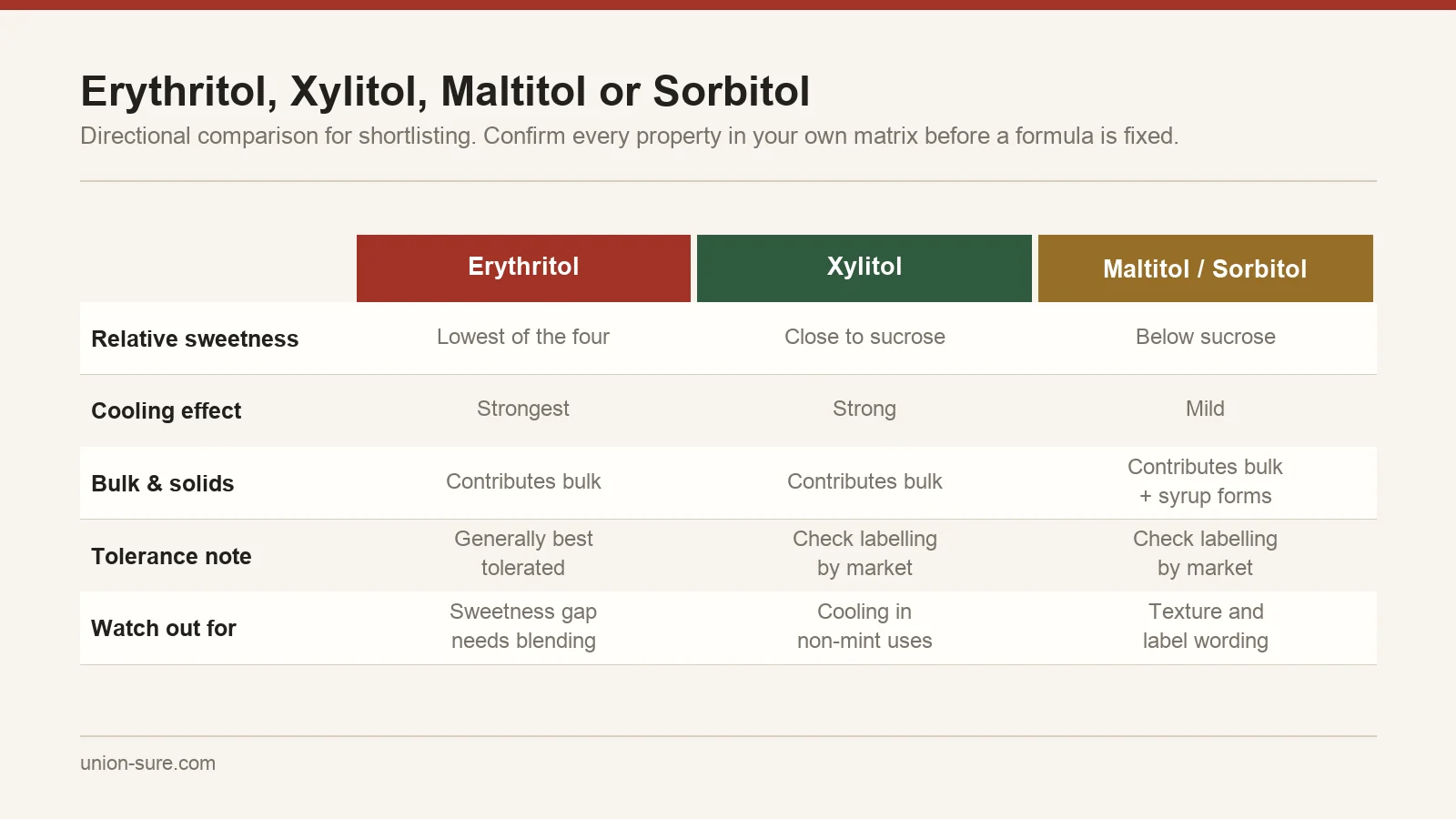
- Cooling effect varies sharply between them and is a formulation feature in mint applications and a defect elsewhere.
- Digestive tolerance and its labelling consequences differ by polyol and by market. Check both before finalising a formula.
- Specify particle size and moisture as carefully as identity — they decide handling, caking and dissolution.
The request usually arrives as “we want to replace the sugar”, and the honest first answer is that sugar is doing more jobs than sweetening.
It provides bulk, solids, water activity control, browning, freezing-point depression and mouthfeel. Swap it for a polyol on sweetness alone and something else in the formula will move — usually texture, sometimes shelf life, occasionally the label. This page compares the four we are asked about most, on the axes that actually decide the choice.
What belongs in this comparison
FDA lists sorbitol, xylitol, lactitol, mannitol, erythritol and maltitol as sugar alcohols and says the class ranges broadly from 25% to 100% of sucrose sweetness. (FDA sweeteners overview) That broad range is useful only as orientation. It is not an individual specification.
This guide compares:
- crystalline erythritol;
- crystalline xylitol;
- crystalline maltitol;
- crystalline sorbitol and sorbitol syrup as distinct purchase forms.
Maltitol syrup is also distinct from crystalline maltitol and requires its own composition. Never approve “maltitol” or “sorbitol” without stating solid/syrup form and grade.
Material identity and functions
Erythritol
JECFA describes erythritol as white, odourless, non-hygroscopic, heat-stable crystals with sweetness approximately 60–80% that of sucrose. It lists flavour enhancer, humectant, carrier and sweetener functions. (JECFA erythritol)
The specification gives an assay of at least 99% after drying plus loss-on-drying, ash, reducing-substance and contaminant criteria. Use the complete current applicable standard; do not copy only assay and relative sweetness.
Formulation questions:
- Is cooling sensation acceptable?
- Does it dissolve at the process solids and temperature?
- Will it recrystallize during storage?
- Does it produce the required bulk and texture?
- Is a high-intensity sweetener blend needed to reach the target sweetness?
These outcomes are formula-dependent and must be tested.
Xylitol
JECFA’s xylitol monograph provides identity, assay and purity methods for the crystalline material. (JECFA xylitol)
Procurement questions:
- crystal/particle-size distribution;
- assay, water and reducing sugars under the governing standard;
- solubility and crystallization in the formula;
- sensory profile and cooling;
- source/process, allergen and GMO documentation where relevant;
- destination authorization and label.
Do not make pet-safety or dental/health claims in a B2B ingredient article without a dedicated, current claim review. Keep the selection focused on food formulation and compliance.
Maltitol
JECFA defines crystalline maltitol with assay and purity criteria and lists it as a sweetener, humectant, stabilizer and bulking agent. (JECFA maltitol)
It can be shortlisted when a formula needs both sweetness and solids, but that is not a promise of sucrose equivalence. Test:
- glass/crystal behaviour in confectionery;
- moisture pickup and texture;
- sweetness profile;
- process temperature;
- interaction with fat, cocoa, starch or protein;
- shelf-life migration.
For maltitol syrup, request the polyol/saccharide distribution, dry solids and water—not the crystalline monograph alone.
Sorbitol and sorbitol syrup
JECFA defines sorbitol syrup as an aqueous material formed by hydrogenating glucose syrup and composed of D-sorbitol, D-mannitol and other hydrogenated saccharides. It lists sweetener, humectant, sequestrant, texturizer and bulking functions. (JECFA sorbitol syrup)
The monograph allows substantial water and defines composition on an anhydrous basis. Therefore:
- a kilogram of syrup is not a kilogram of dry polyol solids;
- freight and dosing comparison must use dry solids and delivered water;
- microbial, pumpability and storage controls differ from crystalline powder;
- hydrogenated-saccharide profile may affect performance.
For crystalline sorbitol, use its separate JECFA or destination specification. Do not label syrup COA values “sorbitol powder specification.”
Screening matrix
| Question | Erythritol crystal | Xylitol crystal | Maltitol crystal | Sorbitol crystal/syrup |
|---|---|---|---|---|
| Primary source basis here | JECFA monograph | JECFA monograph | JECFA monograph | Separate crystal and syrup specs |
| Material form risk | Recrystallization/solubility must be tested | Crystallization and cooling must be tested | Crystal/glass and moisture behaviour must be tested | Syrup water and composition must be normalized |
| Sourced functions | Sweetener, carrier, humectant, flavour enhancer | Check applicable monograph/authorization | Sweetener, humectant, stabilizer, bulking | Sweetener, humectant, texturizer, bulking, sequestrant for syrup |
| Key RFQ data | Assay, particle size, reducing substances | Assay, water, particle size | Assay, water, reducing sugars | Crystal grade or syrup solids/composition |
| Final decision | Formula and shelf-life trial | Formula and shelf-life trial | Formula and shelf-life trial | Formula and shelf-life trial |
This table screens questions; it does not rank the polyols.
Normalize cost before comparing quotes
Buyers routinely compare polyol quotes per kilogram, and it is close to meaningless. If one material is materially less sweet than another, you will use more of it, and the cheaper kilogram can be the more expensive formula. Convert to cost per unit of delivered sweetness and per unit of solids first, then look at the price. For crystalline materials:
cost per kg active polyol = delivered price per kg ÷ assay fraction
For syrup:
cost per kg dry product solids = delivered price per kg syrup ÷ dry-solids fraction
Then model the required formula dose, any added high-intensity sweetener, process changes, water removal, yield, packaging and shelf-life loss.
Example only: if a syrup is 70% dry solids, one tonne supplies 700 kg dry solids and 300 kg water before considering the detailed saccharide profile. This is arithmetic, not a Union Sure product specification.
Do not compare sweetener cost only “per sweetness unit.” Bulk, texture and water management may dominate.
Build a method-based specification
Common fields
- exact chemical/product name and INS/E number where applicable;
- crystalline or syrup form;
- governing JECFA, EU, U.S., FCC or customer edition;
- assay and calculation basis;
- water/loss on drying;
- reducing sugars/substances;
- ash and relevant ions;
- nickel/catalyst residues and heavy metals where applicable;
- particle size and bulk density for powder;
- colour, clarity and pH for syrup where material;
- microbiology appropriate to the form/use;
- source/process, allergen and GMO documents;
- packaging and storage.
Syrup-only fields
- refractometric/dry solids with method;
- polyol and hydrogenated-saccharide distribution;
- viscosity/pumpability at temperature;
- crystallization limit;
- preservative status;
- tanker/IBC hygiene and food-contact controls.
Require actual lot results and method references on the COA.
Regulatory status is use- and market-specific
FDA says companies are responsible for the regulatory status and safety of ingredients before U.S. marketing and identifies CFR, GRAS Notice and Substances Added to Food resources. (FDA sweetener regulation overview) Check the exact polyol, food and intended use.
In the EU, authorization under the food-additives framework is separate from label requirements. Regulation 1169/2011 requires statements accompanying foods with sweeteners, and Annex III requires foods containing more than 10% added polyols to state: “excessive consumption may produce laxative effects.” (Regulation 1169/2011, Annex III)
Check:
- permitted food category and use level;
- additive name/E number in ingredients;
- “with sweetener(s)” wording near the food name where applicable;
- the >10% added-polyol statement;
- nutrition declaration treatment;
- claims such as sugar-free, reduced sugar or no added sugar;
- national language and placement.
Do not infer U.S. label treatment from the EU rule.
EFSA published a re-evaluation of erythritol E968 in 2023. (EFSA summary) Product development and exposure assessment should use the current full opinion and legislation, not social-media summaries or a procurement matrix.
Application trial protocol
We will send samples for all four if it helps, and we would rather you ran a proper trial than took a comparison table, including this one, as a formulation decision. Cooling effect and tolerance in particular behave differently in a real matrix than in a solution. One controlled trial settles arguments that no amount of specification correspondence will. Blind-code candidate grades and hold everything else constant.
- Define sucrose control and target attributes.
- Calculate formula on dry solids and water.
- Record addition order, temperature, shear and hold.
- Measure dissolution/crystal residue.
- Measure water activity, moisture and relevant rheology.
- Assess sweetness onset/aftertaste, cooling and mouthfeel.
- Check bake/cook/freeze performance.
- Pack in the commercial barrier.
- Run real-time and justified accelerated stability.
- Repeat with multiple production lots before full approval.
For confectionery, evaluate crystallization, hardness, stickiness and bloom. For bakery, evaluate volume, spread, browning and staling. For beverages, evaluate solubility, clarity, flavour and microbial system. For fillings, evaluate water migration and syneresis.
Supplier qualification
Review:
- named manufacturing site and product form;
- feedstock and hydrogenation/fermentation process at a disclosure level adequate for risk review;
- catalyst and purification controls;
- crystallization/drying or syrup concentration;
- rework and cross-contamination;
- contaminant and microbiological plans;
- traceability and mass balance;
- packaging/transport;
- recent lot trends;
- change notification.
A trader’s COA must preserve manufacturer and lot identity. “European standard” or “USP grade” without edition and full evidence is not enough.
Final selection checklist
- [ ] Product problem and target attributes are defined.
- [ ] Crystal and syrup forms are not compared on wet weight alone.
- [ ] Governing identity/purity specification is named.
- [ ] Relative sweetness is treated as screening, not dose certainty.
- [ ] Delivered cost is normalized to assay/dry solids and formula dose.
- [ ] Destination authorization and label statements are reviewed.
- [ ] Formula and commercial-pack shelf-life trials pass.
- [ ] COA methods and actual results are complete.
- [ ] Manufacturer/site and change controls are approved.
- [ ] No unsupported health or one-for-one replacement claim is used.
The right polyol is a formulation-and-market decision. Procurement should make the material comparable; R&D and regulatory review decide whether it belongs in the product.
Frequently asked questions
Can a polyol replace sucrose one for one?
No. Sucrose also contributes bulk, solids, water activity control, browning and mouthfeel. Replacing it on sweetness alone will move something else in the formula, most often texture and sometimes shelf life.
How should polyol quotes be compared?
Convert to cost per unit of delivered sweetness and per unit of solids before looking at price per kilogram. A less sweet material used at a higher dose can make the cheaper kilogram the more expensive formula.
Which polyol has the strongest cooling effect?
Erythritol has the most pronounced cooling effect of the four, with xylitol close behind. That is a feature in mint applications and a defect in most others, so it should be assessed in a real matrix rather than in solution.
Where to go next
A sweetener decision runs through the formula, the cost model and the label.
- the sweetener range — the polyols and sweeteners we supply, with forms and pack sizes.
- food-grade xanthan gum specification — the other additive line where method-based specification decides comparability.
- the RFQ fields that make additive quotes comparable — additives need identity, purity and method lines that food RFQs often omit.
- ask for a four-way sample set — tell us the application and target sweetness and we will send matched samples.
Published 10 March 2026. Last reviewed 15 August 2026 by the Union Sure technical team. Regulatory limits, standards and market requirements change — verify every legal limit against the current official source before it is used to approve a shipment.