
Key points
- Every limit needs a method and a unit. A number without them cannot be enforced and cannot be disputed fairly.
- Mark each line mandatory or target. Otherwise a supplier’s typical value quietly becomes a contractual promise.
- The specification describes the material. Who does what, and what happens on a failure, belongs in the quality agreement.
- Revision control is the line auditors check first: number, date, approver, and which revision governs the open order.
- Do not copy a competitor’s specification. You inherit limits whose basis you cannot explain when challenged.
There is a quick way to tell whether a specification was written or assembled. Look at any limit and ask how it would be measured. If the document does not say, it was assembled.
That sounds harsh, but it is the practical test. A specification’s whole purpose is to make acceptance decidable by two parties who disagree. A limit without a method is not decidable — it is an invitation to argue about technique when a lot is already on the ground.
The five-part line
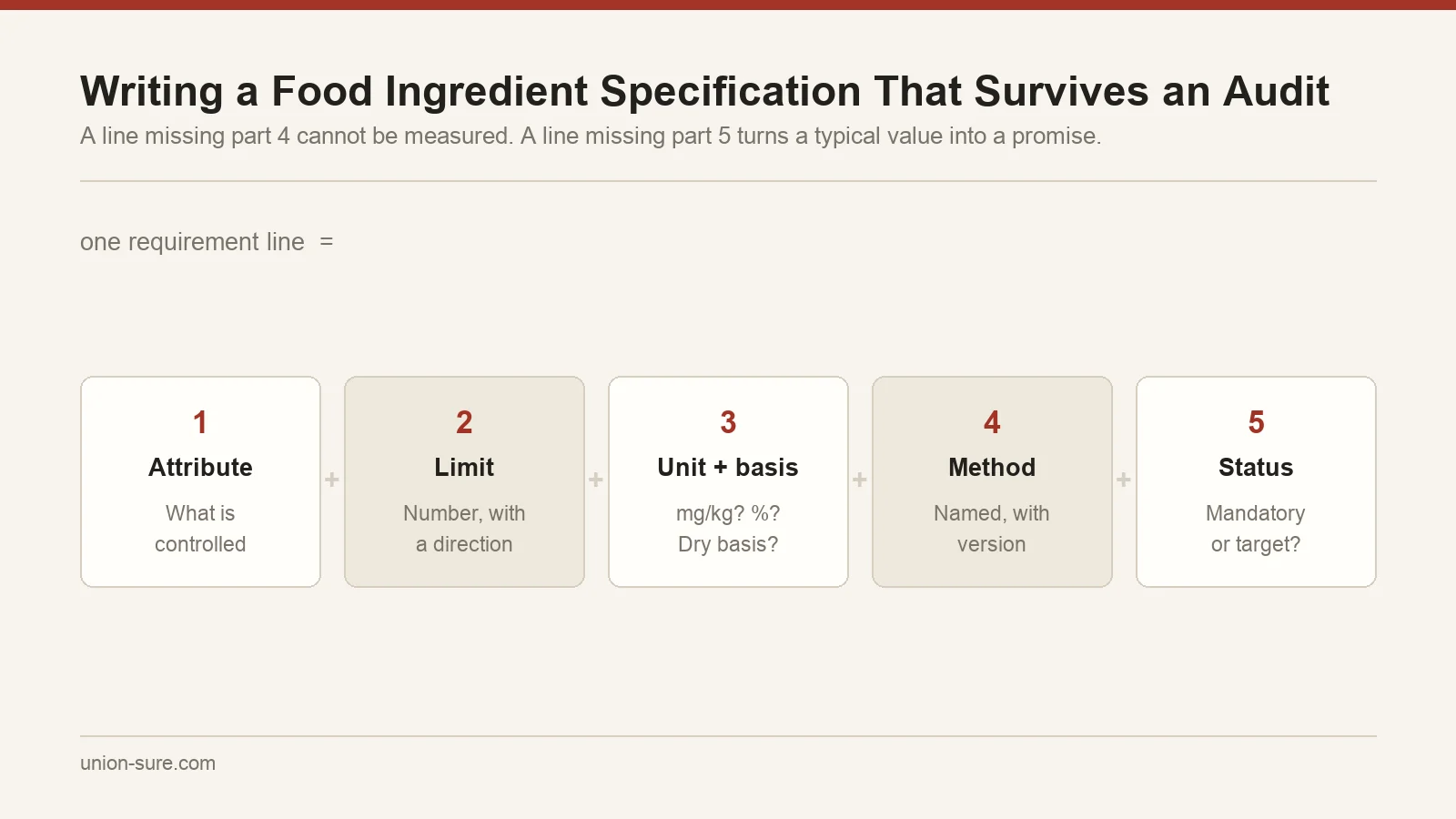
Every requirement line should carry:
- the attribute — what is being controlled;
- the limit or range — the number, with a direction;
- the unit and basis — mg/kg or %, as-is or dry basis, per what portion;
- the method — named, with version or reference where it matters;
- the status — mandatory, target, or for information.
Point five is the one most often missing and the one that causes the most commercial damage. When a supplier’s typical values sheet is pasted into a specification without status markings, every number on it becomes a promise. Suppliers then either refuse to sign or sign and hope, and neither is a good starting position.
Worked example of a five-part line
Bad:
Moisture: 8% max
Better:
Moisture: ≤ 8.0% m/m, as-is basis, by [named method], mandatory
The second version can be measured by two laboratories and produce the same verdict. The first cannot, because it does not say by which method, on what basis, or whether it is a limit you will reject against or a value you would like.
Apply the same treatment to every line, including the ones that feel obvious. “Free from foreign matter” is not measurable; “no foreign matter > 2 mm in a 500 g examined portion, by visual inspection under stated lighting” is.
What belongs in the specification
- identity: name, species where relevant, grade, and the standard behind the grade;
- origin and process, at the level of detail the claim requires;
- physical: form, cut or particle size distribution, colour, defects, foreign matter;
- chemical: moisture, water activity, residues, contaminants, additives, as applicable;
- microbiological: organisms, limits, units, analytical portion, sampling plan;
- allergens: presence, site profile, cross-contact controls;
- packaging: pack, liner, label content, lot format, pallet;
- storage and transport conditions, and shelf life with its basis;
- revision control block.
Borrow structure from a published standard where one exists
Where a Codex commodity standard covers your material, it is worth reading before writing your own document — not to copy the limits, but to borrow the structure and the vocabulary. The dried fruit standard, for example, is explicit about styles and about naming that does not mislead as to condition or treatment, which is exactly the section most in-house specifications handle loosely. (Codex CXS 360-2020)
For low-moisture foods the corresponding code of hygienic practice is the reference for what the process controls should look like, and it is the document to point at when a specification line needs a rationale. (Codex CXC 75-2015)
What does not belong in it
Plenty of things end up in specifications because there was nowhere else to put them. They belong elsewhere:
| Often mis-filed in the spec | Where it belongs |
|---|---|
| Who samples, when, and who pays | Quality agreement |
| What happens on an out-of-specification result | Quality agreement |
| Change notification duties | Quality agreement |
| Price, MOQ, lead time, payment | Commercial contract |
| Delivery term and named place | Commercial contract |
| Audit frequency and access rights | Quality agreement |
Keeping them apart is not bureaucracy. It means the specification can be updated when the material changes without reopening commercial terms, and the quality agreement can be updated when responsibilities change without touching the material description.
Name the method properly
A method reference should be specific enough that a laboratory can execute it without asking: the issuing body, the designation, the year or edition, and any option within the method that changes the answer.
Where you accept alternatives, say so and say on what basis — “or an equivalent method demonstrated to correlate, agreed in writing in advance” is a workable clause. What does not work is silence, because a supplier will use their routine method, get a legitimately different number, and both parties will be right.
Where accreditation matters to the result, check the laboratory’s scope for that specific method rather than accepting the accreditation as a general endorsement. {cite(‘iso17025’)}
Revision control
This is the first thing an auditor looks for and the easiest thing to get right:
- a revision number and date on every page;
- the name and role of whoever approved it;
- a change log saying what changed and why;
- an explicit statement of which revision governs an open order.
That last line prevents the most common real-world dispute: goods produced against revision 3 arriving after the buyer issued revision 4.
Handle the sensory and visual lines deliberately
Colour, aroma, texture and appearance resist numeric limits and are usually the attributes a customer actually complains about. Three ways to make them enforceable, best first:
- instrumental, with instrument, conditions and presentation stated;
- against a retained physical reference, sealed, dated and replaced on a schedule;
- a described scale with defined anchor points and trained assessors.
What does not work is an adjective. “Bright natural colour” transfers the decision to whoever is holding the bag on the day.
Set limits you can justify
Two failure modes, opposite directions.
Copied limits. Taking a competitor’s or a customer’s specification wholesale means inheriting numbers whose basis you cannot explain. When a supplier proposes a justified alternative, or an auditor asks why the limit is what it is, you have nothing.
Aspirational limits. Setting every limit at the best result you have ever seen guarantees regular marginal failures on acceptable material, and trains everyone to treat failures as noise. That is a worse outcome than a slightly wider limit that means something.
Set limits from what the application actually requires and from what the process can reproducibly deliver. Where you do not know, say the line is provisional and review it after a defined number of lots.
Where a public standard genuinely applies, cite it by number and edition rather than paraphrasing it — Codex maintains the current list of its own texts, and citing the specific standard is more durable than describing it. (Codex standards list) Where laboratory competence matters to a limit, the relevant scope of an accreditation is what to check, not the logo. (ISO/IEC 17025)
Before you issue it
- [ ] Every limit has a unit, a basis and a named method.
- [ ] Every line is marked mandatory, target or for information.
- [ ] Nothing in the document is a responsibility rather than a property.
- [ ] Revision number, date, approver and change log present.
- [ ] Limits are justified by application or process capability, not copied.
- [ ] Sampling plan stated or referenced.
- [ ] The supplier has been asked to mark deviations rather than sign silently.
Frequently asked questions
Should the buyer or the supplier write the specification?
The buyer should own it, because it describes what the buyer needs. The supplier should be required to return it with every deviation marked in a separate table rather than buried, which turns the document into an agreement rather than a wish.
How often should a specification be reviewed?
At a defined interval — annually is common — and immediately on any change to origin, process, treatment, formulation, packaging or destination market rules. Write the trigger list into the document so review is not left to memory.
Can one specification cover several pack sizes?
It can if the pack section handles them explicitly, including any differences in barrier, shelf life or labelling. It cannot if the shelf-life basis was established for only one of them.
Where to go next
The specification is one of three documents. These are the other two and the evidence behind it.
- what belongs in a quality agreement — the responsibilities that should not be inside the specification.
- reading the COA that reports against it — a certificate is only assessable if the specification named the methods.
- the RFQ fields that feed it — the enquiry and the specification should use the same vocabulary.
- send us a specification to mark up — we will return it with deviations in a separate table rather than a silent signature.
Published 24 March 2026. Last reviewed 15 August 2026 by the Union Sure technical team. Regulatory limits, standards and market requirements change — verify every legal limit against the current official source before it is used to approve a shipment.