
Key points
- A mixed container saves freight. It also multiplies document, traceability, contamination and claims risk — the saving has to survive all four.
- Approval stays ingredient- and site-specific. Consolidating shipments never consolidates supplier approval.
- Cargo compatibility is a specification, not a loading preference. Odour transfer, moisture migration and allergen carry-over are the usual failures.
- Build one master document set covering every line, and a load plan agreed before goods reach the consolidation point.
- Do not consolidate when one line is regulated differently, is allergen-bearing, or is the reason the whole container clears customs.
The arithmetic that starts most of these conversations is simple: you need two tonnes of dehydrated carrot, one tonne of freeze-dried strawberry and 800 kg of xylitol, and none of them fills a container on its own.
The arithmetic that ends the conversation is less simple. A mixed container can genuinely cut freight per kilo. It can also turn one delayed certificate into a hold on everything else in the box. We load mixed containers regularly and the honest answer is that they suit some combinations and quietly punish others.
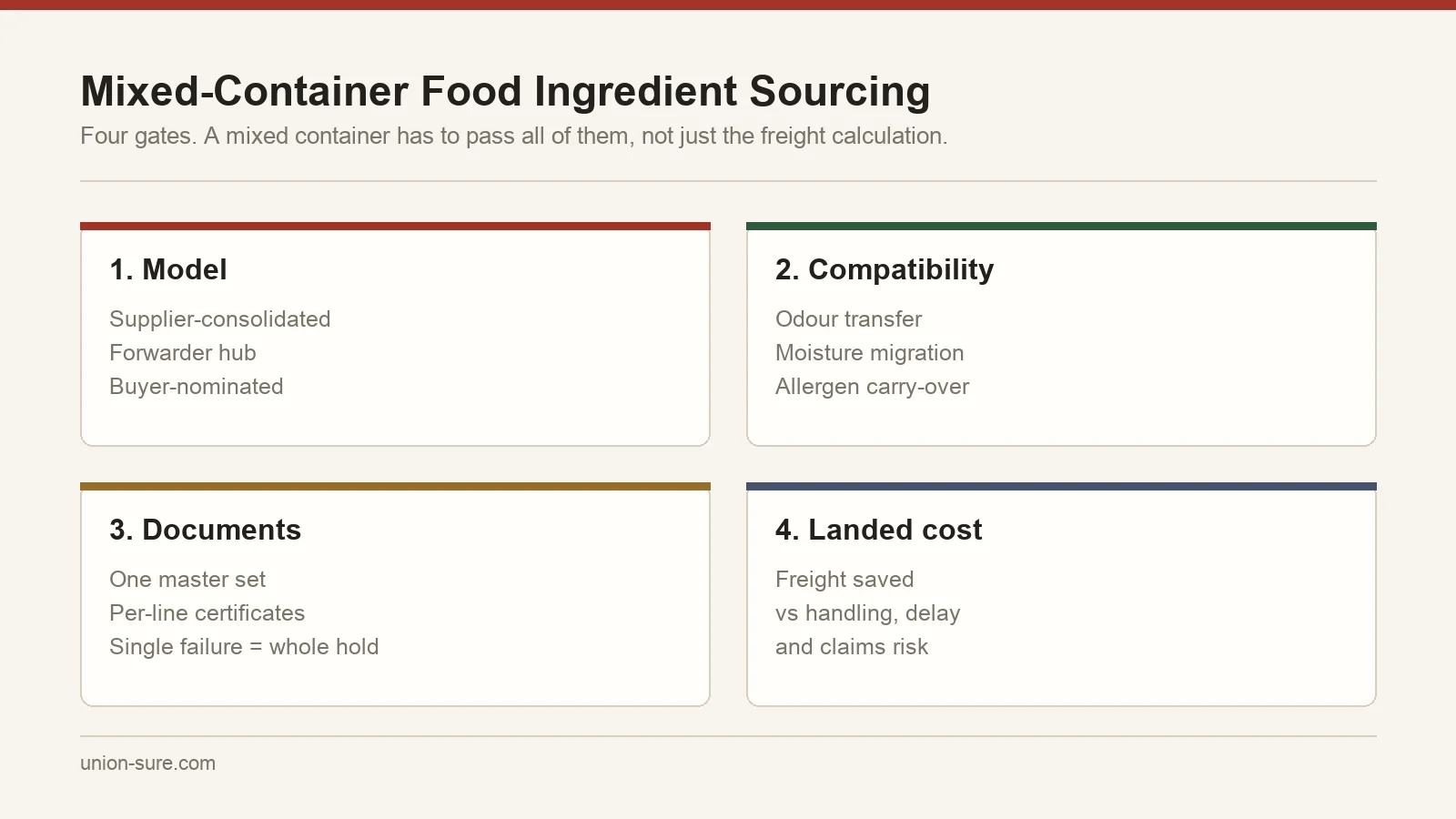
Choose the consolidation model first
One supplier, multiple products
One contracting supplier manufactures or sources several ingredients and loads them together. Commercial coordination is simpler, but the buyer still needs transparency about each manufacturing site and lot.
Multiple suppliers, one forwarder warehouse
Factories deliver approved goods to a consolidation warehouse. The forwarder checks packages and loads a single export container. This creates a new node for custody, identity and potential damage.
Lead supplier or consolidator
One entity purchases from sub-suppliers and sells the combined order. Clarify whether it is merely a trader or also repacks, relabels, samples, stores or releases food. Manufacturer approval must not disappear behind the consolidator.
LCL groupage
The buyer’s pallets share transport equipment with unrelated shippers. This can suit small volumes, but handling and cargo-compatibility visibility are lower. Compare it with a dedicated FCL plan rather than treating all “consolidation” as equivalent.
Approval remains ingredient- and site-specific
FDA’s FSVP framework, where applicable, requires evaluation for each food and foreign supplier; putting several foods in one container does not merge their hazards. (FDA FSVP overview) Maintain a matrix:
| Product | Manufacturer/site | Specification | Lot/COA | Release status | Packs/pallets |
|---|---|---|---|---|---|
| Ingredient A | Site A | Rev. X | Lot A1 | Approved | Defined |
| Ingredient B | Site B | Rev. Y | Lot B1/B2 | Hold/approved | Defined |
| Ingredient C | Site C | Rev. Z | Lot C1 | Approved | Defined |
Do not load an unreleased lot because the rest of the container is ready. Define whether a late or rejected product is removed, replaced or causes the sailing to move.
Qualify the consolidation point
Map what the warehouse actually does:
- receives sealed pallets only;
- stores under controlled conditions;
- opens cartons or primary packs;
- samples product;
- adds or changes labels;
- replaces damaged packaging;
- builds new pallets;
- fumigates, treats or uses pest control near food;
- records container and seal numbers.
If it opens, repacks or relabels food, its hygiene, food-contact materials, traceability and legal status deserve deeper review. For EU-bound product, packaging and other food-contact materials must meet the applicable framework and GMP requirements. (European Commission FCM overview)
At minimum, review site cleanliness, pest control, allergen/chemical segregation, damage handling, lot controls, CCTV or loading records where lawful, and recall support.
Cargo compatibility is a specification
The one we get asked about most is odour. Put a strongly aromatic line, star anise is the usual culprit, next to a neutral porous product like freeze-dried fruit and four weeks in a sealed box will do exactly what you would expect. Barrier packaging helps, separation helps more, and the only reliable answer is to decide compatibility at quotation stage rather than at the loading dock. Create a compatibility grid for every pair of products.
Moisture
Do not combine moisture-sensitive freeze-dried pieces or powders with wet pallets, leaking cargo or materials carrying high inherent moisture. UNECE’s CTU guidance advises against packing moisture-susceptible cargo with wet or leaking cargo and warns against wet timber or packaging. (CTU packing guidance)
Odour and volatiles
Xanthan gum, fruit powders and dried vegetables can absorb external odours. Keep them away from strong spices, chemicals, perfumed goods and contaminated containers unless validated barriers and segregation provide adequate protection.
Allergens and chemicals
Sealed packs reduce exposure but do not erase risks from damaged bags, dust or prior cargo. Review allergen profile, cleaning and load history where relevant. Never co-load food with incompatible dangerous goods merely because the outer packaging fits.
Temperature and oxidation
One route condition must suit all products. A crisp freeze-dried inclusion may be more humidity-sensitive than a crystallised ginger slice; a fat-containing vacuum-fried product may be more oxygen-sensitive than a plain vegetable powder.
Physical loading
Heavy drums can crush cartons. Sharp pallets can puncture bags. Powders can shift; fragile pieces can break. The joint IMO/ILO/UNECE CTU Code provides a global, non-mandatory framework for suitability, packing and securing. (UNECE CTU Code)
Design one master document set
Use a master shipment reference plus product annexes.
Product annex for every lot
- manufacturer and product code;
- specification revision;
- lot and manufacture/expiry or best-before dates;
- COA and required test reports;
- net weight, pack count and pallet IDs;
- origin and controlled claims;
- release approval.
Master shipment documents
- consolidated commercial invoice or agreed invoice set;
- packing list showing product, lot, pallet and package count;
- transport document instructions;
- container inspection and loading plan;
- container and seal record;
- origin, organic, health, plant-health or other product-specific certificates where required;
- responsibility and escalation contacts.
The packing list must preserve lot visibility. “500 cartons assorted food ingredients” is not enough for receipt or recall.
Use a load plan before goods arrive
Draw the container by pallet position. Assign weight, dimensions, stackability and product. Put heavy, stable loads low; protect fragile cartons; keep labels visible where practical; preserve ventilation or space required by the chosen system; and document blocking/bracing.
Set rules for:
- maximum floor and axle loads;
- pallet heights and overhang;
- mixed-lot palletisation;
- desiccants or protective sheeting;
- photos at empty-container inspection, partial load and final load;
- seal application and custody;
- rejected/damaged pack handling.
Calculate total landed cost
Compare:
Total landed cost = product + factory collection + consolidation receiving/storage + handling/repacking + export documents + main freight + insurance + destination charges + duty/tax + broker + inspection/testing + finance/inventory + expected exception cost
Then compare service metrics: total lead time, variability, minimum order, expiry remaining, number of handoffs and probability that one late lot delays the whole order.
Do not count freight savings twice. If the consolidator’s quote includes collection or export handling, remove the same cost from the supplier-level comparison.
When a mixed container is a good candidate
- products have compatible storage and cargo profiles;
- all sites and lots can be approved before a common cut-off;
- the order is too fragmented for efficient direct containers but stable enough to plan;
- the consolidation point is transparent and controlled;
- lot-level documents can be reconciled;
- the landed-cost model shows a benefit after handling and delay risk;
- one coordinator owns the schedule and discrepancy resolution.
When not to consolidate
We would rather turn down a consolidation than ship one that creates a problem at the border. If one line needs a certificate the others do not, or carries an allergen the others must stay clear of, the freight saving is usually smaller than the cost of the first hold. Ask your supplier to say so plainly, and be suspicious of one who never does.
- one ingredient requires a different temperature or strict odour isolation;
- products or lots cannot be released before loading;
- organic or other identity-preserved status cannot be maintained;
- the warehouse must open food without adequate controls;
- heavy and fragile packs cannot be safely combined;
- certificate timing or destination entry routes conflict;
- the savings disappear after warehouse, testing and delay costs;
- a new high-risk supplier is being hidden inside an otherwise approved load.
Contract the handoffs
Use a responsibility table covering factory release, collection, warehouse receipt, damage inspection, relabelling authority, sampling, loading, seal, export documents, late lot, rejected lot, demurrage and claims.
Name the delivery rule and place for each commercial leg. ICC publishes Incoterms 2020, but the rules do not replace this quality-and-consolidation matrix. (ICC Incoterms)
A go/no-go gate
Do not authorise loading until:
- every product/site is within approval scope;
- every lot is released;
- documents and pack labels reconcile;
- compatibility is approved;
- the consolidation site and actions are defined;
- the load and securing plan is approved;
- the container passes inspection;
- claims and origin status are preserved;
- responsibility for discrepancies is accepted;
- the landed-cost and schedule case remains valid.
Frequently asked questions
Does mixed-container sourcing weaken traceability?
It need not, but it adds handoffs. Use pallet IDs and a packing list that links product, manufacturer, lot, COA and position. Never allow consolidation to replace manufacturer identity with a generic house code.
Is FCL always safer than LCL?
A dedicated container gives more control over compatible cargo and sealing, but safety still depends on approved products, sound packs, a suitable clean container and correct loading.
Can organic and conventional ingredients share a container?
Possibly when they remain securely packaged, identified and protected under the applicable organic control system. Confirm with the certification/control body and destination rules before planning the load.
Where to go next
Consolidation is a logistics decision built on top of three technical ones.
- bulk packaging, liners and pallet design — compatibility in a mixed load is decided by the pack before it is decided by the stow.
- the document set for a shipment from China — one master document set has to satisfy every line in the container.
- the RFQ fields that keep multi-line quotes comparable — consolidation only pays if each line was priced properly first.
- ask us to price a mixed load — send the lines, quantities and destination and we will say whether consolidating is worth it.
Published 27 January 2026. Last reviewed 15 August 2026 by the Union Sure technical team. Regulatory limits, standards and market requirements change — verify every legal limit against the current official source before it is used to approve a shipment.