
Key points
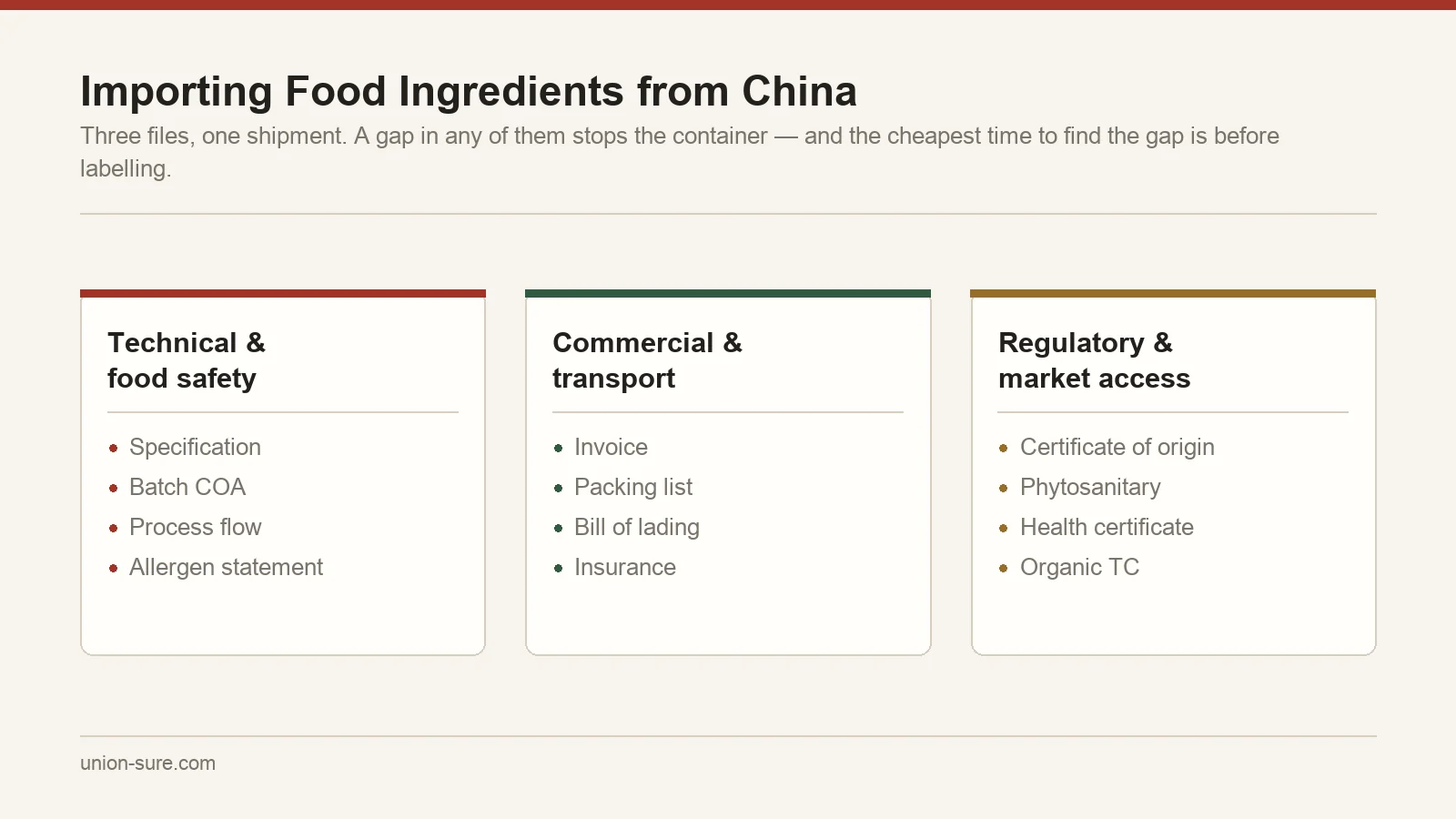
- Documents fall into three connected files: technical/food-safety, commercial/transport, and regulatory/market-access. A gap in any one of them stops the container.
- The document list is decided by the product, the destination market and the intended use — never copied from another commodity.
- Incoterms allocate cost and risk, not regulatory responsibility. DDP does not make the seller your compliance department.
- Agree the document set before production and before labelling, not before loading. Label errors are the most expensive class to fix.
- Run a pre-shipment document gate: draft copies reviewed and approved while the goods can still be re-worked.
Once a container is sitting at a border, every remaining option is expensive: demurrage, re-labelling under supervision, re-export, or destruction.
Almost every document problem we have watched unfold was fixable weeks earlier, at a point where fixing it cost one email. So this guide is organised by that window rather than by document type — what to settle before production, before labelling, and before loading.
Define the product before listing documents
We get asked for “the standard export documents” more often than for a specific list, and there is no such thing. Dried goji into Germany, xanthan gum into the UAE and freeze-dried mango into Malaysia share an invoice and a packing list and almost nothing else. Tell your supplier the destination and the intended use first; the document list falls out of those two facts. Write a shipment identity sheet with:
- common and scientific name where relevant;
- ingredient composition and additives or processing aids;
- physical form: whole, diced, granulated, powder, liquid or syrup;
- production process and any microbial-reduction treatment;
- intended food use and whether it is ready-to-eat;
- country and, where material, region of origin;
- manufacturing, packing and trading entities;
- destination country and importer of record;
- proposed customs code, with the broker’s confirmation;
- organic, allergen, GMO or other controlled claims;
- packaging configuration and net/gross weights.
Small wording differences can change the file. “Dried ginger,” “crystallised ginger with sugar” and “ginger powder” are not necessarily classified or regulated identically. A product name on the invoice must also agree with the specification, packing list, label and any certificate.
Maintain three connected document files
1. Technical and food-safety file
| Document | Minimum review |
|---|---|
| Buyer-approved specification | Identity, composition, limits, methods, packaging and revision |
| Process flow | All manufacturing, treatment, rework and subcontracted steps |
| Hazard analysis / supplier approval | Product-specific risks and who controls them |
| Batch COA | Lot, actual results, methods, units and authorised release |
| Test reports where required | Laboratory, sample identity, scope, reporting limits and dates |
| Allergen statement | Product and site basis; cross-contact controls |
| Traceability records | Link raw material, production lot, COA, bags and pallets |
| Shelf-life support | Pack, conditions, tested attributes and study basis |
| Change notification | Site, source, process, formulation, method and packaging changes |
The COA is not a substitute for the specification or hazard analysis. It reports selected results for a selected sample. For higher-risk attributes, define independent confirmation and sampling before shipment.
2. Commercial and transport file
The usual core is:
- signed sales contract or purchase order;
- pro forma invoice before payment where used;
- final commercial invoice;
- packing list with package count, lot, net and gross weight;
- bill of lading, sea waybill or air waybill;
- insurance document when the agreed arrangement requires it;
- container and seal number;
- pallet or wood-packaging evidence when applicable;
- certificate of origin when required for customs or preference;
- inspection or weight certificate if contractually required.
Check arithmetic across the pack count, bag weight, net weight, gross weight and invoice quantity. Confirm the company names and addresses use consistent legal forms. A one-character lot mismatch can break traceability even when customs clearance succeeds.
3. Regulatory and market-access file
Possible records include food-facility registrations, importer identifiers, prior notice or entry data, foreign-supplier verification, health or sanitary certificates, phytosanitary certificates, import licences, official-control documents, organic transaction certificates and compliant labels.
Do not request all of them by default. The European Commission’s plant-health page describes inspections and certificates for regulated plants and plant products; it does not mean every processed or dried botanical requires the same plant-health document. (EU plant-health import controls) Ask the competent authority or licensed broker about the exact commodity and process.
U.S. and EU examples
United States
An importer covered by FDA’s Foreign Supplier Verification Programs rule needs a programme for the food and foreign supplier, with hazard analysis, supplier evaluation, verification activities, corrective action and records. (FDA FSVP guidance) Entry paperwork does not replace that programme, and the Chinese exporter cannot take over the U.S. importer’s legal role merely by supplying a certificate.
Confirm separately whether the facility must be registered, whether prior notice applies, who is the FSVP importer, and whether any product-specific FDA, USDA or other agency requirement applies. FDA maintains a current import-guidance index. (FDA import resources)
European Union
EU imports are subject to risk-based official controls, with certain animals, goods and food/feed of non-animal origin subject to specific border procedures or increased controls. (European Commission overview) Check the destination Member State, current control lists, commodity code, origin and whether entry through a border control post is required.
For organic product, treat the organic import certificate as a shipment document that must match the lot and operator chain—not as a generic annual certificate.
Incoterms do not settle food compliance
ICC’s Incoterms 2020 rules allocate named delivery tasks, costs and transfer of risk under the sales contract. (ICC Incoterms 2020) They do not, by themselves, define:
- the food specification or acceptance method;
- who approves labels and claims;
- who performs FSVP or other importer duties;
- ownership transfer in every legal system;
- corrective action for a failed COA;
- responsibility for demurrage caused by a quality-document error;
- product recall and indemnity.
Write those responsibilities into the contract and quality agreement. Do not assume “DDP” means the buyer has no regulatory duty or that “FOB” makes the exporter responsible for every pre-shipment document.
The pre-shipment document gate
This is the single cheapest control in the whole chain and it is the one most often skipped under time pressure. Ask for draft scans — invoice, packing list, COA, certificates, and above all the artwork and the label — while the goods can still be re-worked. We would far rather redo a label in the factory than watch a customer redo it in a bonded warehouse. Use a controlled review before the goods are loaded.
- Commercial match: purchase order, invoice, packing list, quantities, values, currency and Incoterm agree.
- Identity match: product names, codes, origin, manufacturer and lot agree across all documents and packs.
- Quality release: specification, COA, deviations and required independent tests are approved.
- Regulatory release: importer, broker or regulatory reviewer confirms admissibility and current certificates.
- Label and mark review: non-retail and retail information, languages, lot and storage marks are correct.
- Physical check: packaging, pallet condition, container condition, seal and loading record are documented.
- Final archive: the approved dossier is stored under one shipment reference.
No shipment should rely on a promise to “send the original later” unless the importer and broker have confirmed that the planned process is lawful and operationally safe.
Common document failures
- The invoice names a trader while a certificate names an undisclosed factory.
- The COA lot differs from the bags or was issued for a sample batch.
- Net weight and bag count do not reconcile.
- A certificate of origin identifies the shipping country, not the production origin.
- The organic certificate, scope or product description does not cover the shipment.
- A laboratory report uses a limit from the wrong destination market.
- The product name is shortened until sugar, carrier or treatment disappears.
- An old phytosanitary, health or inspection template is reused without checking current scope.
- The bill of lading instruction contains a spelling or address mismatch that reaches the final document.
A buyer’s request package
Send the supplier one consolidated instruction containing product specification, destination, documents, exact consignee/notify-party wording, bag and pallet marks, testing plan, draft invoice/packing-list fields, certificate originals required, document deadlines and approval contacts.
For a first order, use a document draft review before production and another before loading. That small control is cheaper than changing a certificate after departure.
Frequently asked questions
Does every dried plant ingredient need a phytosanitary certificate?
No universal rule should be assumed. Requirements depend on the plant product, processing, origin and destination. Confirm the live rule for the exact commodity with the competent authority or broker.
Is a certificate of origin the same as proof of manufacturing origin?
Not necessarily. Review the issuing basis, product transformation and applicable customs rules. For marketing claims such as regional origin, maintain a separate traceability and substantiation file.
Who should approve the final document set?
Use named roles: procurement for commercial terms, quality for specification/COA, regulatory or importer for market access, and the broker or logistics function for entry and transport details. One checklist should show every approval.
Where to go next
Documents are the last gate. These cover the specification and packaging decisions that determine what those documents have to say.
- the RFQ fields that pin down identity and origin — half the document problems start as a vague product description in the enquiry.
- how to read the COA that travels with the shipment — the certificate is a document and a technical record — it has to satisfy both.
- bulk packaging, liners and labelling — pack format and label content are where market-access rules become physical.
- tell us the destination market — we will confirm which certificates we can issue for that market and which have to come from a third party.
Published 13 January 2026. Last reviewed 15 August 2026 by the Union Sure technical team. Regulatory limits, standards and market requirements change — verify every legal limit against the current official source before it is used to approve a shipment.