
Key points
- Incoterms rules allocate cost, risk and specified obligations for delivery. They do not allocate food-safety or regulatory responsibility.
- Always write the full formulation: rule + named place + “Incoterms 2020”. “FOB price” on its own is not a delivery term.
- DDP does not make the seller your compliance department. Import compliance duties in your market attach to the importer, whoever pays the duty.
- The point where risk transfers and the point where cost stops are not always the same point. Read both.
- Two quotes on different terms are not comparable until you normalise to the same named place with the same inclusions.
Most Incoterms mistakes in this trade are not really about Incoterms. They are about someone assuming that choosing a three-letter rule settled a question the rule never addressed.
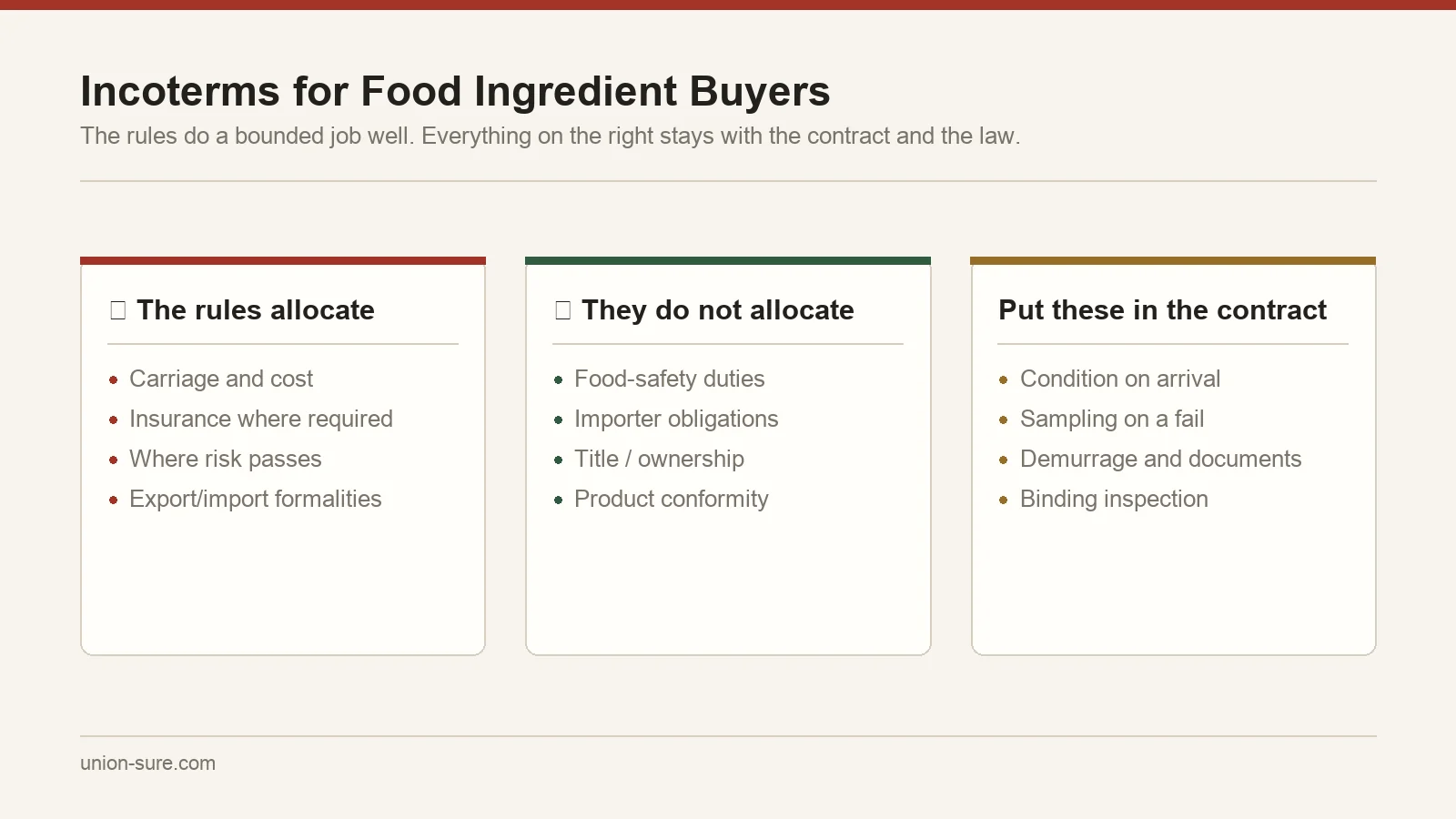
The rules are published by the International Chamber of Commerce and they do a specific, bounded job: they allocate cost, risk and a defined set of obligations between seller and buyer for the delivery of goods. (ICC Incoterms 2020) Everything outside that boundary stays where the contract and the law put it.
The rules in two families
The 2020 edition contains eleven rules, and the first useful thing to know is that they fall into two groups. (ICC Incoterms 2020)
| Group | Applies to | Practical note for containerised food |
|---|---|---|
| Any mode of transport | Road, rail, air, sea, multimodal | Designed for handover at a terminal or premises — fits container shipments |
| Sea and inland waterway only | Bulk and break-bulk on vessels | Written around handover at or over the ship’s rail |
Most dried food ingredients move in containers, handed over at an inland depot or a terminal — not at a ship’s rail. That makes the any-mode family the better structural fit, and it is why a maritime term quoted for a container is worth one clarifying question.
Write the term properly or it does not mean anything
The full formulation is the rule, the named place, and the version:
FCA Yinchuan, China, Incoterms 2020 CIF Rotterdam, Incoterms 2020
Not “FOB price”. Not “CIF”. The named place is where the rule actually does its work, and without a version you have left it open which edition applies.
One recurring error worth naming: the maritime-only rules are written for goods handed over at a ship’s rail or alongside. Using them for containerised cargo that is actually handed over at a terminal creates a gap between where risk transfers on paper and where the seller genuinely loses control. For containers, the rules designed for any mode of transport fit the physical reality better. If your supplier quotes you a maritime term for a container, it is worth one question about where handover actually happens.
The named place is the operative part
The three letters set out a pattern of obligations; the named place decides where that pattern lands. “FCA” without a place does not say whether the seller’s obligation ends at their own loading dock or at a terminal fifty kilometres away, and those are materially different prices.
Be specific enough that a third party could stand in the right spot: a named terminal, a named depot, a named port, or a street address. “FCA China” is not a delivery term, it is a region.
Risk and cost do not always stop at the same point
For several rules the seller pays for carriage to a destination but risk passes to the buyer much earlier, at handover to the first carrier. This surprises buyers regularly, and it matters most exactly when something has gone wrong: goods damaged in transit on a term where the seller booked and paid the freight may still be the buyer’s loss.
Read both the cost line and the risk line for whichever rule you use, and if the answer is uncomfortable, that is an insurance conversation rather than a reason to change the term.
What the rules do allocate
- who arranges and pays for carriage, and to which point;
- who arranges and pays for insurance, where the rule requires it;
- where risk of loss or damage passes;
- who handles export and import formalities as an obligation of the sale;
- who bears which costs at terminals and on delivery.
That is a lot, and it is genuinely useful. It is also all.
Three things buyers wrongly assume are covered
Food-safety and regulatory responsibility. In most markets, obligations attached to the importer follow from import law, not from who paid the freight. A seller quoting DDP is agreeing to bear cost and clear customs; that does not transfer your own verification and compliance duties as an importer. The FDA’s foreign supplier verification framework, for example, places obligations on the importer irrespective of the commercial term. (FDA FSVP rule)
Title. Incoterms rules do not transfer ownership. Title passes when the contract says it passes. Assuming risk transfer and title transfer are the same event has surprised more than one buyer during an insurance claim.
Product conformity. The delivery term says nothing about whether the goods meet the specification. That is the specification’s job, and the quality agreement’s.
Insurance: who, and to what level
Only some rules oblige a party to insure, and where none does, cargo is uninsured unless somebody separately arranged it. Two practical points:
- where insurance is required by the rule, check the level of cover required and whether it matches your exposure — the default may be a minimum rather than what you would choose;
- where it is not required, decide explicitly and write it into the contract. “We assumed the seller had it covered” is a conversation that only happens after a loss.
For food ingredients, also check whether the policy responds to the failure modes that actually occur in this trade: condensation damage, temperature excursion, and rejection at the border are not always covered on the same basis as physical loss.
The importer duty does not follow the freight
This is the misconception worth stating twice. A seller quoting a delivered term is agreeing to bear cost and complete formalities. In most markets the substantive obligations attached to importing food — verification of the supplier, record-keeping, notification — attach to the importer under food law and do not move because of a commercial term. The FDA’s foreign supplier verification framework is a clear example: the obligations sit with the importer, defined by the rule rather than by who paid for carriage. (FDA FSVP rule)
Where the term meets the specification
A few practical intersections that belong in the contract, not in the three letters:
- Condition on arrival. If the specification has an arrival requirement — water activity, temperature, seal integrity — say who samples, when, and what happens on a fail. The delivery term will not answer it.
- Loading and stowage responsibility, especially for condensation-sensitive dried goods.
- Demurrage and document errors, which the rules do not allocate in the detail a food shipment needs.
- Inspection, and whether a third-party result at origin is binding.
Normalise before you compare
The practical buyer move is boring and effective. Convert every offer to one basis:
- Same named place, usually your destination.
- Add freight, insurance, terminal and handling to the terms that exclude them.
- Add duty and tax explicitly, and say who is the importer of record.
- Add inspection, certificate and testing costs where they differ.
- Only then compare, and adjust for usable yield if the products differ.
A supplier quoting a lower unit price on a term that leaves four cost lines with you is not cheaper. They are quoting a shorter journey.
Frequently asked questions
Is DDP always the easiest option for a buyer?
It is the least work at the point of delivery and it is not always the cheapest or the safest. The seller prices in the risk of an unfamiliar import regime, and in many markets you remain the importer with your own obligations regardless. Compare it on landed cost and check who is named as importer of record.
Does the delivery term decide who insures the cargo?
Only for the rules that require insurance; for the rest it is silent, which means nobody has arranged it unless someone has arranged it. Where the rule is silent, decide explicitly and write it into the contract.
Can I use the same term for every supplier?
You can, and normalising terms across suppliers makes comparison much easier. Just make sure the term suits the physical handover — a container handed over at an inland depot is not the same event as goods loaded on a vessel.
Where to go next
A delivery term is one line of a commercial offer. These are the lines it interacts with.
- the RFQ fields that make quotes comparable — the named place belongs in the enquiry, not in the negotiation.
- import documents from China — the term allocates cost and risk; the document set is separate.
- mixed-container sourcing — consolidation changes who controls the goods and where.
- ask for a landed-cost quote — tell us the destination and we will quote to one named place.
Published 16 December 2025. Last reviewed 15 August 2026 by the Union Sure technical team. Regulatory limits, standards and market requirements change — verify every legal limit against the current official source before it is used to approve a shipment.