
Key points
- Moisture content = how much water is in the product (% by mass). Water activity (aᵥ) = how much of that water is available to microorganisms and spoilage reactions.
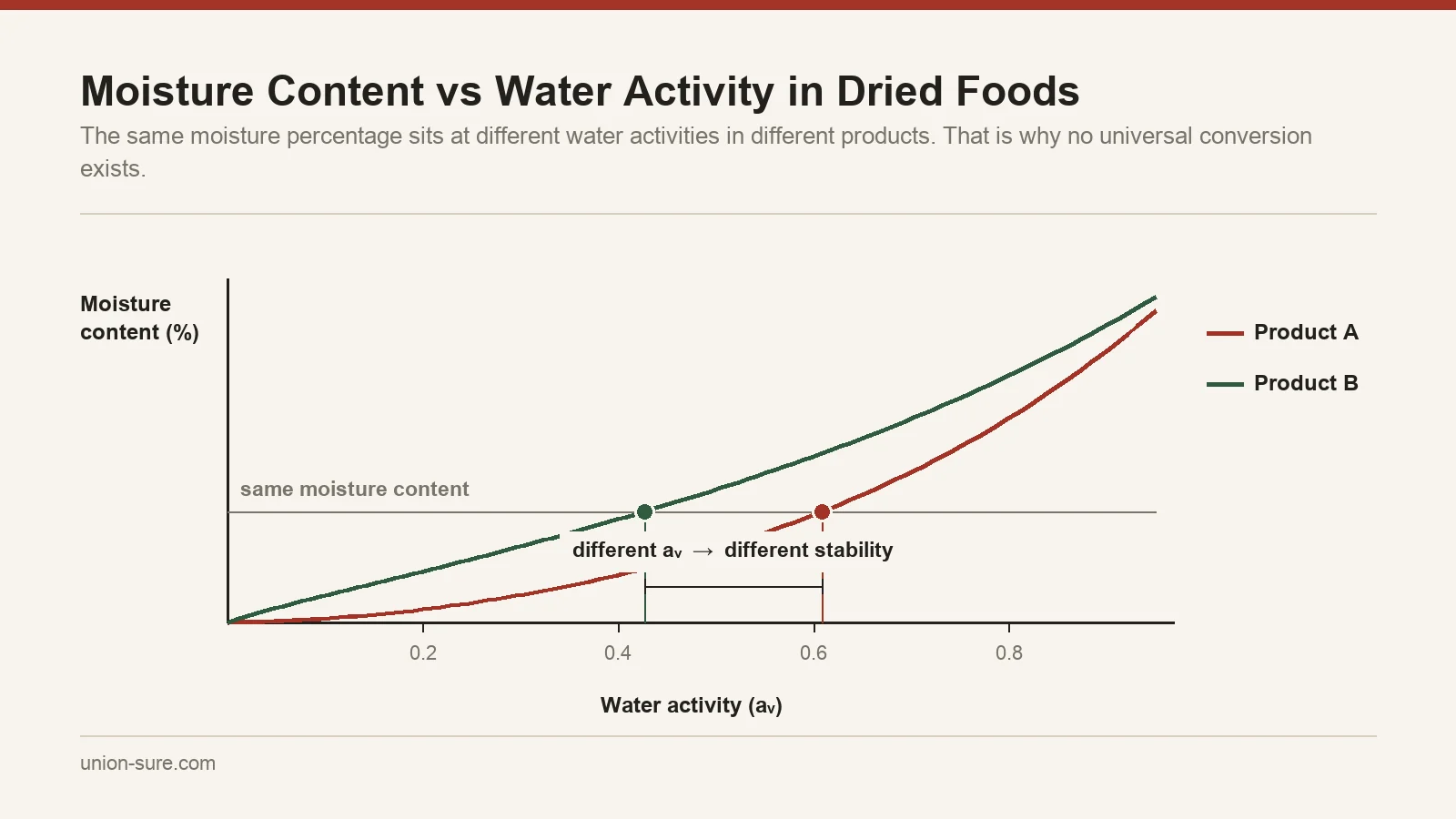
- There is no universal conversion between the two. The relationship is a sorption isotherm specific to the product, its composition and its temperature.
- You can meet your moisture specification and still grow mould. The two numbers fail independently.
- Controlling aᵥ limits growth; it is not a kill step. Pathogens can survive for months in low-aᵥ foods without multiplying.
- Quality usually fails before microbiology does — caking, browning, loss of crispness and oxidation all have aᵥ thresholds of their own.
Short version, because it is the part that matters: moisture content tells you how much water is in the product. Water activity tells you how much of that water is available — to microorganisms, and to the reactions that quietly ruin texture, colour and flavour. You can hit your moisture specification exactly and still grow mould.
That last sentence is the reason this distinction is worth twelve hundred words rather than one line in a glossary.
What moisture content tells you
Moisture is usually reported as a percentage. It is valuable for:
- drying yield and mass balance;
- compliance with a product standard;
- texture and piece condition;
- commercial solids comparison;
- process endpoint and trend control;
- formulation calculations.
The method matters. Oven temperature, vacuum, time, grinding, volatile compounds and reporting basis can change the result. “Loss on drying” may include volatile material other than water. A COA should identify the method and wet/as-is or dry basis where relevant.
Moisture alone does not show how strongly water is bound by sugars, salts, proteins or other solids.
What water activity tells you
FDA defines water activity as the ratio of the food’s vapour pressure at equilibrium to that of distilled water under the same conditions. Equilibrium relative humidity is approximately aᵥ × 100. (FDA technical guide)
Water activity is useful for:
- assessing whether microorganisms can grow under defined conditions;
- predicting the direction of moisture migration between components;
- understanding crispness, caking or stickiness transitions;
- setting packaging moisture-barrier needs;
- validating drying or formulation controls;
- comparing stability at a specified temperature.
Water activity is not percent water. A result of 0.30 is dimensionless; it does not mean 30% moisture.
Why there is no universal conversion
We are asked for a conversion factor perhaps once a month, usually by a buyer building a specification template that has one column for water. There is no factor to give. A 12% moisture goji berry and a 12% moisture xanthan gum are not equally stable, and neither is the same berry after the sugar profile shifts with the season. If a supplier offers you a conversion, they are describing one product at one temperature and calling it a rule. The relationship between moisture content and aᵥ is a moisture sorption isotherm. It changes with:
- food composition;
- physical state and porosity;
- temperature;
- whether the product is gaining or losing water;
- processing history;
- ingredient interactions.
Sugar-rich fruit, a protein powder and a vegetable flake can bind water differently. Even two strawberry products can differ after osmotic pretreatment, grinding or addition of carriers.
To convert for process control, develop an experimental isotherm for the product and temperature range. Do not use a generic online equation.
Safety: growth control is not a kill step
FDA’s older technical guide says food controlled to aᵥ 0.85 or less is outside specific U.S. regulations named on that page. That is a jurisdiction-specific boundary, not a universal target for every dried ingredient, pathogen, claim or quality attribute.
FDA’s 2026 draft guidance uses broad groupings—above 0.85, 0.60–0.85 and below 0.60—to discuss moist, intermediate-moisture and low-moisture foods. (FDA draft chapter) It is draft, nonbinding guidance and does not turn 0.60 into a universal purchase specification.
Codex warns that pathogens such as Salmonella cannot multiply in sufficiently low-aᵥ food but can remain viable for extended periods. (Codex low-moisture code) Drying therefore does not automatically make contaminated raw material safe. Hazard analysis, hygienic design, validated microbial reduction where needed and post-process protection still matter.
Quality can fail before microbial growth begins
A freeze-dried fruit piece may lose crispness after modest moisture pickup while remaining at aᵥ too low for pathogen growth. A powder may cake; a cereal may soften; a dried fruit may become sticky. Oxidation can also proceed at low aᵥ and depends on fat, oxygen, temperature and packaging.
Set a quality limit from measured texture, flow, colour or sensory performance, not only from a microbial table.
Moisture migration in multi-component foods
When two components share a sealed pack, water tends to move toward equilibrium in water activity. It does not necessarily move from the component with higher moisture percentage to the one with lower moisture percentage.
Consider a crisp freeze-dried fruit inclusion in a softer cereal cluster. If their aᵥ values differ, the fruit may gain water and lose crispness while the surrounding matrix changes too. The solution may involve:
- choosing a better-matched inclusion;
- applying a compatible barrier coating;
- changing the formula or inclusion timing;
- improving package barrier;
- separating components;
- shortening or validating shelf life.
Peer-reviewed packaging literature discusses aᵥ across cereal and confectionery systems, but published ranges cannot replace a finished-product study. (Open-access review)
Measurement controls
For moisture
Specify method, sample preparation, basis, instrument/oven conditions and number of replicates. Protect the sample from ambient humidity before analysis.
For water activity
Specify instrument principle or method, calibration checks, sample equilibration, test temperature, grinding or intact-piece condition and acceptance rule. Temperature matters because aᵥ can change with temperature.
For heterogeneous pieces, decide whether to test a composite, worst-case piece or multiple portions. A single cup may not represent a large lot without a defensible sampling plan.
How to write the specification
Our own view, having argued this with buyers and with our own QC: put both numbers in the specification, name the method and the temperature for the aᵥ reading, and state which one is the release criterion. Two limits with no hierarchy just moves the disagreement to the day a lot passes one and fails the other. Avoid:
Moisture: standard. Water activity: low.
Use:
Moisture: [buyer limit], [named method], as-is basis. Water activity: [buyer limit] at [temperature], [named method/instrument principle]. Sampling and release according to [plan].
The actual values must be established for the product and application by a qualified team. Do not copy a target from a different food.
Include both parameters when they answer different risks. For example:
| Buying decision | Moisture | Water activity |
|---|---|---|
| Compare solids/yield | Primary | Supporting |
| Control microbial growth | Indirect | Primary, within full hazard analysis |
| Predict moisture migration | Not sufficient | Primary |
| Manage texture/caking | Useful | Useful; validate against quality endpoint |
| Design barrier packaging | Useful for mass balance | Useful with sorption and shelf-life data |
COA review questions
- Does the COA show actual results?
- Are method and temperature included?
- Does the lot match the shipment?
- Was the sample protected from ambient humidity?
- Does the method measure intact pieces or ground composite?
- Are limits buyer-approved or supplier-typical?
- Is the result near a known quality transition?
- Does packaging validation maintain the limit through distribution?
Frequently asked questions
Is aᵥ below 0.60 always safe?
It commonly prevents microbial growth, but it does not prove pathogens are absent or dead, does not cover toxins already formed, and does not replace product-specific hazard analysis.
Can I predict shelf life from one water-activity result?
No. Shelf life also depends on temperature, oxygen, light, package barrier, initial contamination, formulation and the chosen quality endpoint.
Should every dried ingredient COA include water activity?
Only when it is material to the hazard, quality, formulation or contract. If it is important, define the method and temperature. Moisture may still be required separately for identity, standards or mass balance.
Where to go next
Both numbers appear on the certificate and both are decided by the pack. These cover each side.
- reading these rows on a COA — the two most commonly misread lines on a dried-ingredient certificate.
- barrier, liners, vacuum and nitrogen — a water activity specification is only meaningful if the pack can hold it.
- cut size and mesh for dehydrated vegetables — particle size changes surface area, and surface area changes how fast aᵥ moves.
- ask for lot-specific figures — we will send the method and temperature alongside the number.
Published 14 April 2026. Last reviewed 15 August 2026 by the Union Sure technical team. Regulatory limits, standards and market requirements change — verify every legal limit against the current official source before it is used to approve a shipment.