
Key points
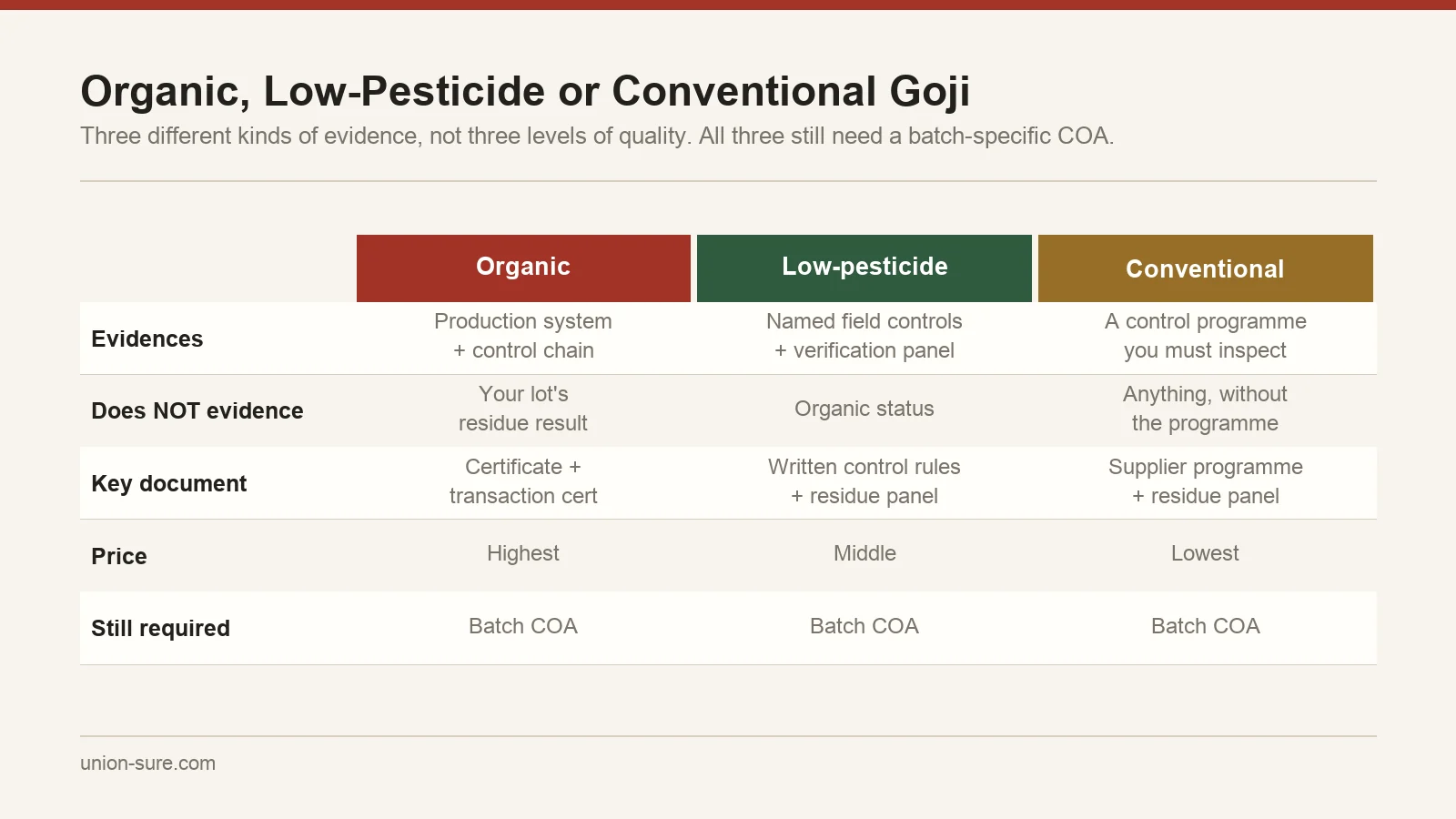
- Organic certification evidences a production system and a control chain — not a residue result for your lot. Both still matter.
- “Low-pesticide” means nothing until someone defines it: which analytes, against which limits, at what frequency, verified by whom.
- Conventional is a control programme too. Judge it on the programme, not on the absence of a certificate.
- The three routes differ in price, supply reliability and evidence type — pick on what your customer actually requires.
- Whichever route you choose, the release decision still rests on a batch-specific COA against your specification.
These are not three points on a single scale running from worst to best. They are three different kinds of evidence, and buyers get into trouble when they treat one as a substitute for another.
Organic tells you about a system. A residue panel tells you about a lot. A low-pesticide programme tells you about a set of field controls — but only if someone has written down what it means. We run a low-pesticide line alongside conventional and organic material, so this comparison is one we have to make honestly rather than sell one way.
What organic evidence actually covers
USDA explains that organic certification allows a farm or processing facility to sell, label and represent products as organic, while accredited certifying agents verify compliance. (USDA organic certification) EU Regulation 2018/848 similarly establishes organic production, control and labelling rules. (Regulation 2018/848)
The claim should connect every relevant operation:
- farm or producer group;
- collector or storage site;
- dryer/processor;
- sorter and packer;
- exporter;
- importer and any relabeller;
- product and activity within each certificate’s scope.
A farm certificate does not automatically cover a separate non-certified packing factory. A processor’s certificate does not prove that the particular lot came from certified fields.
Certification is not a “zero pesticide” promise
Organic standards govern which inputs and practices are allowed and how integrity is controlled. Residue findings can still require investigation for drift, contamination, commingling or prohibited use. The lot also remains subject to destination pesticide MRLs and other food law.
Do not publish “pesticide free” merely because a product is organic. Support any residue claim separately with a defined analytical program.
EU organic goji imported from China
The European Commission lists countries with organic equivalence or trade arrangements. China is not in the equivalence/trade lists shown on the Commission’s current trade page. For products originating in other countries, certification is handled by control bodies or authorities recognized and supervised by the Commission. (EU trade in organics)
Before contracting:
- identify the certifier/control body for China and verify that its recognition covers the product category and country;
- verify every operator certificate, activity and validity period;
- confirm the product appears within scope, not merely “agricultural products” in a sales attachment;
- map farm lots through processing and export mass balance;
- agree who creates and endorses the electronic certificate of inspection;
- reconcile certificate quantities, CN codes, exporter, importer, lot and shipment documents.
The Commission states that all organic products imported into the EU require the appropriate electronic certificate of inspection (e-COI) in TRACES and without it products will not be released from the port as organic. (EU organic import certification)
Check for current additional-control working documents before shipment; the page’s 2025 document is not automatically a 2026 requirement.
U.S. organic goji imports
USDA’s Strengthening Organic Enforcement implementation changed shipment documentation. After 19 March 2024, each shipment of organic agricultural products imported into the United States must be associated with an electronic NOP Import Certificate issued through the Organic INTEGRITY system by an accredited certifier. (USDA NOP Import Certificates)
The exporter/final handler requests the certificate and provides it to the U.S. importer for entry through the Customs and Border Protection ACE system. USDA says one certificate is issued per commodity/product or HTS code, although a certifier’s oversight may permit it to cover defined shipments or a time period.
Verify:
- exporting operation and final handler certification;
- certificate issuer and current accreditation;
- NOP Import Certificate data and ACE entry;
- HTS/commodity alignment;
- product category and label claim;
- audit trail from certified farm lot to shipped packages.
The public USDA Organic INTEGRITY Database is valuable for checking operations, but database presence alone is not the shipment certificate or mass-balance file.
Define “low-pesticide” before using it
Ours is defined by the production rules, chiefly a prohibition on spraying in the month before harvest and growing against a specific EU commodity classification, and by the residue panel that verifies it. That is what the phrase should mean anywhere: a named set of controls plus the testing that checks them. Where a supplier cannot produce both halves, the phrase is decoration. The cited EU and U.S. organic frameworks do not create a general “low-pesticide goji” certification category. If a buyer uses the term, it should be an internal commercial program with a precise name, not an imitation organic seal.
A defensible program states:
- destination-market MRL baseline;
- customer limits, for example a defined fraction of MRL only where legally and scientifically approved;
- named analyte list and legal residue definitions;
- prohibited/not-approved substance list;
- laboratory methods and reporting limits;
- sampling plan and frequency;
- field spray and input records;
- supplier/farm approval rules;
- action for a detection, even below MRL;
- label language reviewed for the market.
Avoid “low pesticide” as an unqualified consumer claim. A 500-analyte “pass” may omit a relevant metabolite, use reporting limits above a buyer threshold or test a sample unrelated to the shipped lot.
Conventional is a control program too
Conventional does not mean untested or untraceable. The base specification should include:
- approved farm and processor identities;
- crop-protection records;
- legal MRL review for each market;
- risk-based residue panel;
- lot-level COA and independent verification;
- sulphites, contaminants and microbiology;
- traceability and mass balance;
- change notification.
The EU pesticide database is a useful search interface for current/historical MRLs, but the Commission says it is informational and the Official Journal is legally controlling. (EU Pesticides Database) Use the same dated substance-by-substance workflow for organic, low-pesticide and conventional lots.
Evidence matrix
| Control | Certified organic | Buyer-defined low-pesticide | Conventional |
|---|---|---|---|
| Production rules | Destination organic regulation and approved plan | Buyer contract plus law | Law plus supplier farm program |
| Claim authority | Accredited/recognized certifier | Buyer-owned specification; no organic implication | No organic claim |
| Operator certificates | Required across certified scope | Optional unless another claim applies | Optional unless another claim applies |
| Shipment certificate | EU e-COI or U.S. NOP Import Certificate as applicable | Not an organic document | Not an organic document |
| Pesticide testing | Risk-based; does not create certification | Central defined evidence | Risk-based legal/customer verification |
| MRL compliance | Required | Required | Required |
| Mass balance | Organic integrity requirement | Strongly recommended | Strongly recommended for traceability |
| Label | Organic category and logo rules | Carefully substantiated wording | Ordinary product label rules |
Price and supply comparisons
Do not publish a generic organic premium. Request comparable quotes for the same:
- species and size grade;
- crop year and defect limits;
- residue and sulphite specification;
- packaging and quantity;
- certification scope and transaction documents;
- testing frequency;
- Incoterm and delivery period.
Organic cost can reflect certified field supply, segregation, audits, control-body fees, transaction documentation, lower flexible sourcing and testing. A buyer-defined residue program can also be expensive if it requires farm isolation and broad lot testing. Compare total compliant landed cost and claim value, not price per kilogram alone.
Approval sequence
For certified organic
- verify certifier recognition/accreditation;
- verify each operator and product scope;
- audit segregation, cleaning, labels and mass balance;
- review residue risk and test plan;
- approve label/category;
- approve e-COI or NOP Import Certificate workflow;
- reconcile the shipment before release.
For low-pesticide
- rename the program in precise internal terms;
- define substances, limits and methods;
- approve farms and crop-protection plan;
- run representative pre-harvest and lot testing as justified;
- investigate every result under written rules;
- prohibit organic-style claims.
For conventional
- approve supplier/farm risk controls;
- map current destination MRLs;
- set risk-based lot verification;
- control safety, defects and traceability;
- do not describe conventional as a lower-quality grade merely because it lacks an organic claim.
RFQ questions
- Which claim and destination standard should the lot meet?
- Which legal entities farm, process, pack and export it?
- Who certifies each organic operation, under what scope and validity?
- Can the certifier issue the required shipment certificate?
- How are organic lots segregated and reconciled by mass balance?
- What substances were applied to the crop?
- What residue definition, method and reporting limit apply to every analyte?
- Is the test from the actual shipment lot?
- What happens after drift, prohibited-substance or documentation findings?
- What origin/process/certifier changes trigger buyer approval?
Final decision rule
Our own advice, even when it costs us the organic premium: buy the route your customer’s specification actually requires, and put the money you save into a better test panel. An organic certificate on a lot you never tested is weaker evidence than a conventional lot with a residue panel matched to the destination market. Choose organic when the regulated claim is commercially required and the complete certified chain can support it. Choose a buyer-defined residue program when specific analytical/farm controls—not an organic claim, are the business requirement. Choose conventional when it meets product and market needs through a controlled, fully compliant supply chain.
None of the three labels replaces lot identity, current MRL review, representative testing, supplier approval or accurate finished-product labelling.
Frequently asked questions
Does an organic certificate prove there are no pesticide residues?
No. Organic certification evidences a production system and its control chain. It is not a residue result for your lot, and organic material can still show traces from drift or carry-over. Both the certificate and a batch-specific panel have a role.
What makes a ‘low-pesticide’ claim credible?
Two halves, both written down: a named set of field controls (for example a defined no-spray window before harvest and a stated commodity classification the limits are set against), and the residue panel that verifies them. A claim with only one half is decoration.
Which route should a first-time buyer choose?
Whichever one your customer’s specification actually requires. If it does not require organic, a conventional or low-pesticide lot with a residue panel matched to the destination market is usually better evidence than an organic certificate on an untested lot.
Where to go next
Choosing a route is step one; verifying the lot is still step two.
- EU pesticide MRLs and goji classification — the limits every route has to clear, whatever the certificate says.
- what the grade number does and does not cover — size grading is independent of production route.
- verifying a Ningxia origin claim — origin, production route and residue status are three separate claims.
- ask which routes we can supply — send the destination market and the claim your customer needs on pack.
Published 21 July 2026. Last reviewed 15 August 2026 by the Union Sure technical team. Regulatory limits, standards and market requirements change — verify every legal limit against the current official source before it is used to approve a shipment.