
Key points
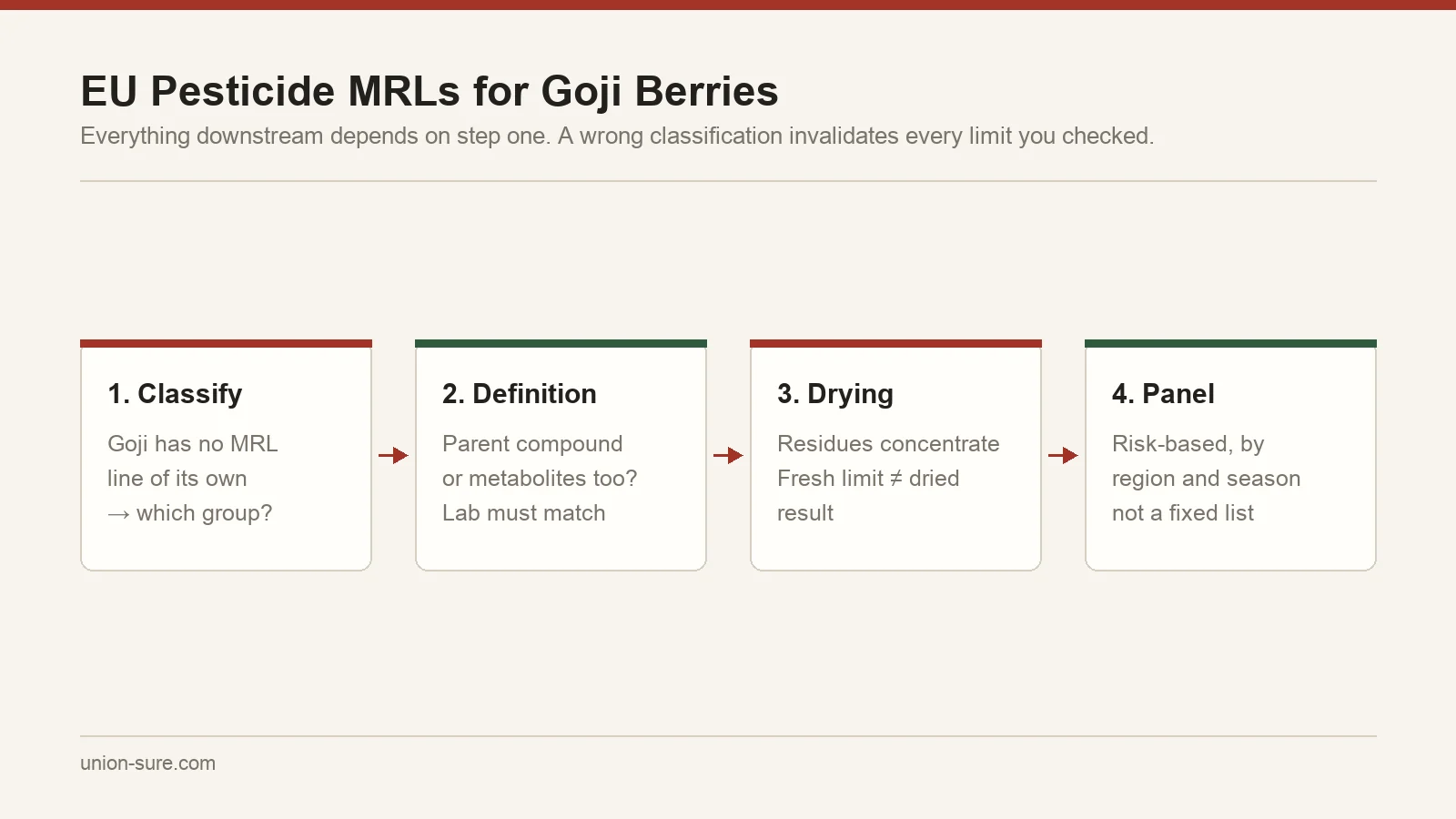
- Goji has no MRL line of its own in the EU. It is assessed under the commodity group it is classified into — get that classification wrong and every limit you checked was the wrong limit.
- Check the residue definition, not the trade name. Many definitions include metabolites, and the laboratory must report against the definition.
- Where no specific MRL exists, a default limit applies — and it is low enough that trace carry-over matters.
- Drying concentrates residues. A limit set for fresh produce is not the number to compare a dried result against without accounting for it.
- MRL compliance and increased border control listings are separate regimes. Passing one does not exempt you from the other.
Here is the detail that catches out more first-time goji importers than anything else: the European Union does not publish a maximum residue level for goji berries as such.
Goji is assessed under the commodity group it falls into, and that classification, not the berry, is what decides which numbers apply. Our own low-pesticide line is grown against that classification, with no spraying permitted in the month before harvest, precisely because the limits that govern it are not the ones most suppliers assume. If you check the wrong group, every limit you verified was the wrong limit — and you will not find out until a border does.
Step 1: classify goji correctly
Do this first and do it in writing. We put the classification basis in the specification rather than leaving it implied, because it is the single assumption that everything downstream depends on. If your supplier cannot tell you which group their limits were checked against, they have not checked them. EU pesticide rules organize foods in a legal crop classification. EFSA has explained that EU MRLs established for tomatoes also apply to minor crops in that entry, including goji berries. (EFSA 2018) Its 2024 scientific support paper again states that goji berries are listed under tomatoes in Part B of the EU food classification. (EFSA 2024)
This classification is easy to miss if a buyer searches only for the word “goji.” Record:
- scientific identity, normally Lycium barbarum and/or other accepted species as applicable;
- product form: fresh, dried whole berry, powder or compound ingredient;
- country of origin;
- intended EU entry and use;
- food classification and code used for the MRL search.
Do not substitute a Codex classification or a non-EU crop group without verifying how EU law treats it.
Step 2: query every residue definition, not only trade pesticide names
The European Commission’s pesticide database lets users search active substances, food products and current or historical MRLs. It also warns that the database is informational, may not be timely or complete, and has no legal value; official information is published in the Official Journal. (EU Pesticides Database)
Use the database as the working interface, then retain the legal source and effective date for approval.
For each target:
- search the pesticide residue, not merely a commercial formulation name;
- read the enforcement residue definition, including named metabolites or sums;
- select tomatoes/goji under the correct food entry;
- record the current MRL, footnotes and effective dates;
- check pending or recently applicable amendments;
- map the legal residue definition to what the laboratory actually measures;
- save a dated export or screenshot plus the Official Journal reference.
A laboratory may report the parent compound while the legal definition requires a sum. That apparent “pass” is incomplete.
Step 3: understand the 0.01 mg/kg default
The Commission’s MRL legislation overview states that a general default of 0.01 mg/kg applies where a pesticide is not specifically mentioned. (EU MRL legislation overview)
Do not turn this into “every goji pesticide limit is 0.01 mg/kg.” Many substances have specific values, residue definitions or footnotes. Some values marked with an asterisk are at a limit of quantification. Check each substance in the current law.
The 2024 EFSA paper gives a useful cautionary example: for one Codex proposal, the paper compared a 0.6 mg/kg Codex value for goji with a 0.01 mg/kg EU default at that time, and separately discussed a Codex value for dried goji. That is evidence about one pesticide-policy discussion—not a reusable goji limit. (EFSA CCPR support, Table 125)
Step 4: account for drying
The Commission says EU MRLs apply to the listed fresh products and to those products after processing, adjusted to take account of concentration or dilution. Drying removes water and can concentrate a residue, but the factor is not safely assumed from moisture loss alone.
For a dried-goji decision, document:
- whether a processed-product-specific MRL exists;
- fresh-to-dry mass balance for the actual process;
- available valid processing-factor evidence for the pesticide/commodity;
- whether washing, degradation or other processing changes the residue;
- the legal treatment of the processing factor under Article 20 and current guidance;
- who approved the calculation.
Do not apply one generic “drying factor” to every pesticide. A factor from another fruit, another process or only a theoretical solids calculation may not be accepted.
Where uncertainty remains, set the raw-material and finished-dried-product controls with a qualified EU regulatory specialist and an experienced laboratory.
Step 5: design a risk-based panel
A high analyte count is not the same as adequate coverage. Build the panel from:
- substances used or possible at the named farms;
- crop-protection records and approved-input lists;
- historical results for the site, region and product;
- EU non-approved substances relevant to the origin;
- RASFF and official-control findings;
- customer/retailer restricted lists;
- metabolites required by EU residue definitions;
- laboratory multi-residue method scope and single-residue gaps.
For every analyte, map:
| Field | Required evidence |
|---|---|
| Legal residue definition | Parent/metabolites/sum and expression |
| Current MRL | Value, food entry, source and effective date |
| Laboratory method | Multi- or single-residue method and matrix validation |
| Reporting limit | At or below the decision level with adequate margin |
| Result | Numeric value, units and uncertainty/decision rule |
| Disposition | Pass, hold, investigate or reject |
If the method’s reporting limit is above the applicable MRL, “not detected” cannot support release.
Step 6: use representative sampling
Agricultural residues can vary among fields, harvest days and dryer batches. Define the commercial lot so it does not hide heterogeneity. The sampling plan should identify:
- number of packages and increments;
- positions and randomization;
- composite and laboratory sample mass;
- prevention of contamination during sampling;
- chain of custody and seals;
- retained samples;
- re-test and dispute rules.
Do not allow a pre-season field sample or a hand-selected “golden sample” to stand in for the export lot. Reconcile the lab sample lot with the COA, packing list and traceability records.
Step 7: distinguish MRL compliance from increased border controls
Regulation (EU) 2019/1793 lists certain origin/product/hazard combinations for temporarily increased controls or special conditions. The original 2019 schedule included goji berries from China for pesticide residues with a 20% frequency of identity and physical checks. (Original Regulation 2019/1793)
That historical 20% figure should not be copied into a 2026 guide as current. We downloaded and text-searched the consolidation dated 30 June 2026; “goji” and “Lycium” were absent from that version’s annex text. (30 June 2026 consolidation)
This negative finding is time-limited. The schedules are amended regularly. Check the live annex, CN/TARIC code, origin and hazard immediately before shipment. Absence from the list does not waive ordinary MRL compliance, general official controls, importer due diligence or customer requirements.
Step 8: build the release file
Keep one lot dossier containing:
- supplier, farm/group, processor and lot traceability;
- harvest and drying records;
- crop-protection application records;
- current specification revision;
- dated EU MRL review and legal sources;
- analyte-to-residue-definition mapping;
- sampling plan and chain of custody;
- complete laboratory report and accreditation scope;
- processing-factor assessment where required;
- COA and independent verification;
- current 2019/1793 schedule check;
- reviewer name, decision and date;
- deviation or investigation records;
- shipment/lot document reconciliation.
A one-page COA can summarize release. It cannot replace this evidence chain.
When a result exceeds the decision level
A number over the limit is the start of an investigation, not automatically a rejection or automatically a pass. Measurement uncertainty, the residue definition, the drying factor and the sampling plan all bear on what the result means. What matters commercially is agreeing in advance, in the quality agreement, who investigates, on what timetable and who carries the cost. Doing that after the first exceedance is far more expensive. Hold the lot. Verify identity, units, residue definition, method, reporting limit and legal effective date. Ask the laboratory about confirmation and measurement uncertainty. Investigate farm records, spray drift, shared drying/storage, mixing and carry-over. Assess whether other lots share the source.
Do not dilute or blend a non-compliant lot into compliance. Do not change the commodity classification after seeing the result. Escalate legal reporting, customer notice and shipment disposition to the responsible EU food-law and quality teams.
Final importer checklist
- [ ] Goji is mapped to the correct EU tomato/goji food entry.
- [ ] Every analyte maps to the current enforcement residue definition.
- [ ] MRLs and footnotes are captured with an effective date and legal source.
- [ ] The default 0.01 mg/kg is used only where it truly applies.
- [ ] Drying and any processing factor are assessed, not guessed.
- [ ] The laboratory scope and reporting limits support each decision.
- [ ] Sampling represents the export lot.
- [ ] Historical control rates are not presented as current.
- [ ] Regulation 2019/1793 is rechecked before shipment.
- [ ] Release links field, lot, test and shipping records.
“EU compliant” becomes defensible only when it is the conclusion of this dated, substance-by-substance file—not a phrase printed on a generic supplier certificate.
Frequently asked questions
Does the EU publish a maximum residue level specifically for goji berries?
Goji does not have its own MRL line. Limits are applied through the commodity group the berry is classified into, which is why confirming the classification in writing is the first step and not a formality.
Should a dried result be compared directly with a fresh-produce limit?
No. Drying concentrates residues, so a processing factor has to be applied before a dried result is compared with a limit set for the fresh commodity. Agree how that factor is derived and documented before a dispute arises.
Is passing the MRL enough to clear EU import?
Not always. Maximum residue levels and increased border control listings are separate regimes. A consignment can meet every residue limit and still be subject to intensified checks under the border control rules.
Where to go next
Residue control is one part of a goji evidence file. These are the others.
- organic, low-pesticide and conventional goji compared — the three sourcing routes and what evidence each one actually provides.
- verifying a Ningxia origin claim — origin and residue control are separate claims needing separate evidence.
- reading the residue rows on a COA — a residue result is only meaningful with its method and reporting limit.
- ask about our low-pesticide line — tell us the destination market and we will send the control basis and a recent batch COA.
Published 7 July 2026. Last reviewed 15 August 2026 by the Union Sure technical team. Regulatory limits, standards and market requirements change — verify every legal limit against the current official source before it is used to approve a shipment.