
Key points
- A process flow diagram is the cheapest document in a supplier pack and the most informative — request it before you travel.
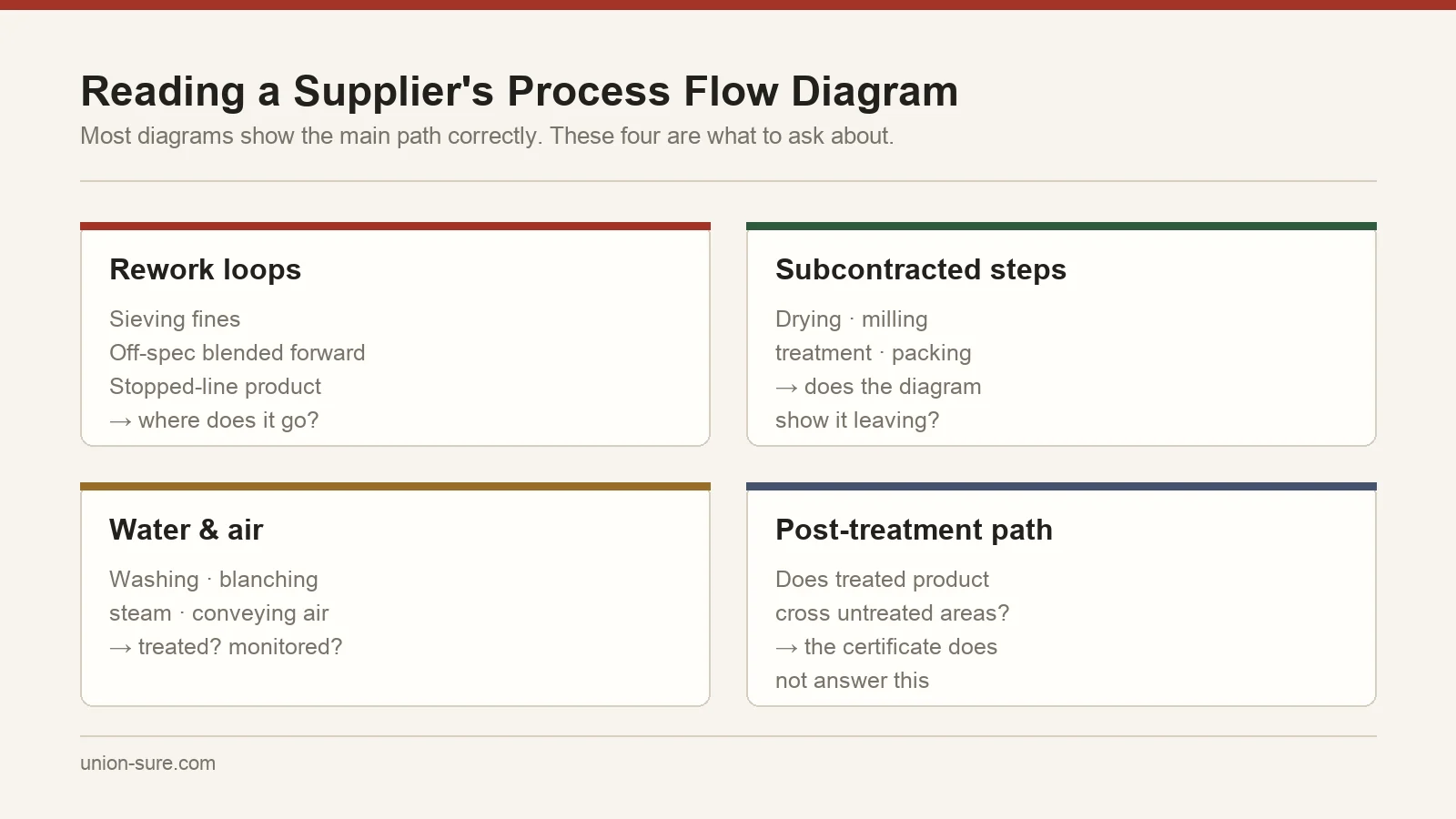
- Four things are missing from most diagrams: rework loops, subcontracted steps, water and air contact, and the post-treatment path.
- Every input needs an arrow. Processing aids, water, packaging and returned material all enter somewhere.
- A diagram with no control points marked has not been used for hazard analysis, whatever the folder says.
- Compare the diagram against what you see on the floor. The gap between them is the real audit finding.
If a supplier will send you one document before an audit, ask for the process flow diagram. It costs them nothing, it arrives in a day, and it will tell you more about how the operation actually thinks than any certificate.
A good one is a map of every step from incoming material to dispatch, with every input and output shown. A poor one is a row of boxes with arrows between them. The difference is visible in about thirty seconds.
What a complete diagram contains
- every processing step in sequence, named specifically rather than generically;
- every input — raw material, water, steam, air, processing aids, packaging, rework;
- every output — product, waste, effluent, and material diverted for other uses;
- storage and holding steps, with conditions where they matter;
- transfer and conveying steps, which is where fragile products get damaged;
- control points marked, with what is controlled at each;
- the boundary of the site, so subcontracted steps are visible as leaving and returning.
The last one is easy to miss and important. If a step happens somewhere else, the diagram should show the material leaving and coming back.
The four gaps to look for first
Rework loops. Material that re-enters the process later — sieving fines, off-spec that gets blended forward, product from a stopped line. This is nearly always absent from a first-draft diagram, and it is exactly where traceability and allergen control get complicated. Ask directly: what happens to the fines, and where do they go?
Subcontracted steps. Drying, milling, microbial treatment, packing and even testing are commonly outsourced. If a step leaves the site, the diagram should say so, and your audit rights should reach it.
Water and air. Water contacts the product in washing, blanching, steam treatment and cleaning. Compressed air contacts it in conveying and packing. Neither shows up on most diagrams, and both are routes for contamination. Ask about treatment and monitoring for each where they contact product.
The post-treatment path. Where a microbial reduction step exists, the single most important thing on the diagram is what happens after it. If treated product travels back through the same area, on the same equipment, or is packed in a space that also handles untreated material, the treatment has bought much less than the certificate suggests.
Reading the marked control points
A diagram with control points marked tells you hazard analysis has been done and the diagram was part of it. For each marked point, ask:
- what is the hazard being controlled;
- what is the limit, and where does it come from;
- how is it monitored, at what frequency, by whom;
- what is the corrective action when it deviates;
- where is the record for the last month.
The answers matter less than whether the person walking you through can give them without going to look. A diagram with no points marked is not necessarily a bad operation, but it means the diagram is documentation rather than a working tool.
Verify it on the floor
The diagram is a claim about the process. The audit is where you check it. Walk the flow in order, physically, and look for:
- steps on the floor that are not on the diagram;
- steps on the diagram that no longer happen;
- material moving in a direction the diagram does not show;
- people or equipment crossing between zones the diagram implies are separate;
- storage that appears in practice but not in the drawing.
The gap between the drawing and the floor is the finding. It is usually not deception — diagrams go stale — but a diagram that has not been updated since the line changed also tells you how the document system is maintained.
What to send back
After the visit, send the diagram back with your annotations and ask for a corrected version. It is a small request that produces a genuinely useful artefact: a shared, current map that both sides agree on and that the next audit can start from.
Frequently asked questions
Should the diagram show cleaning steps?
Cleaning is not a processing step in the product’s path, but wet cleaning in a dry environment is a significant hazard, so the diagram should at least indicate where wet cleaning occurs and how the area is released back to production afterwards.
Is a generic diagram acceptable if the supplier makes many products?
A family diagram can work if the products genuinely share a path, but it must show where individual products diverge. If your product has a step the others do not, that step needs to be visible.
What if a supplier will not send a diagram before an audit?
Treat it as information. The diagram is not confidential in the way a formulation is, and reluctance to share it usually means it does not exist in usable form — which is itself worth knowing before you book travel.
Where to go next
The diagram is the map; the audit and the certificate are the verification.
- the risk-based supplier audit checklist — the diagram is what you walk during the visit.
- steam versus ethylene oxide — the post-treatment path is the part of the diagram that matters most.
- traceability and lot coding — rework loops are where both the diagram and the trace break.
- ask for our process flow — tell us the product and we will send the flow for that line.
Published 19 May 2026. Last reviewed 15 August 2026 by the Union Sure technical team. Regulatory limits, standards and market requirements change — verify every legal limit against the current official source before it is used to approve a shipment.