
Key points
- A shelf life is a claim about a product in a specific pack under specific storage — not a property of the ingredient.
- Decide the failure mode first. Most dried ingredients fail on texture, colour, aroma or caking long before they fail microbiologically.
- “24 months” with no study behind it is a convention, not data. Ask what was measured, at what intervals, in which pack.
- Accelerated testing shortens the timeline but changes the chemistry. Use it to rank options, then confirm the winner in real time.
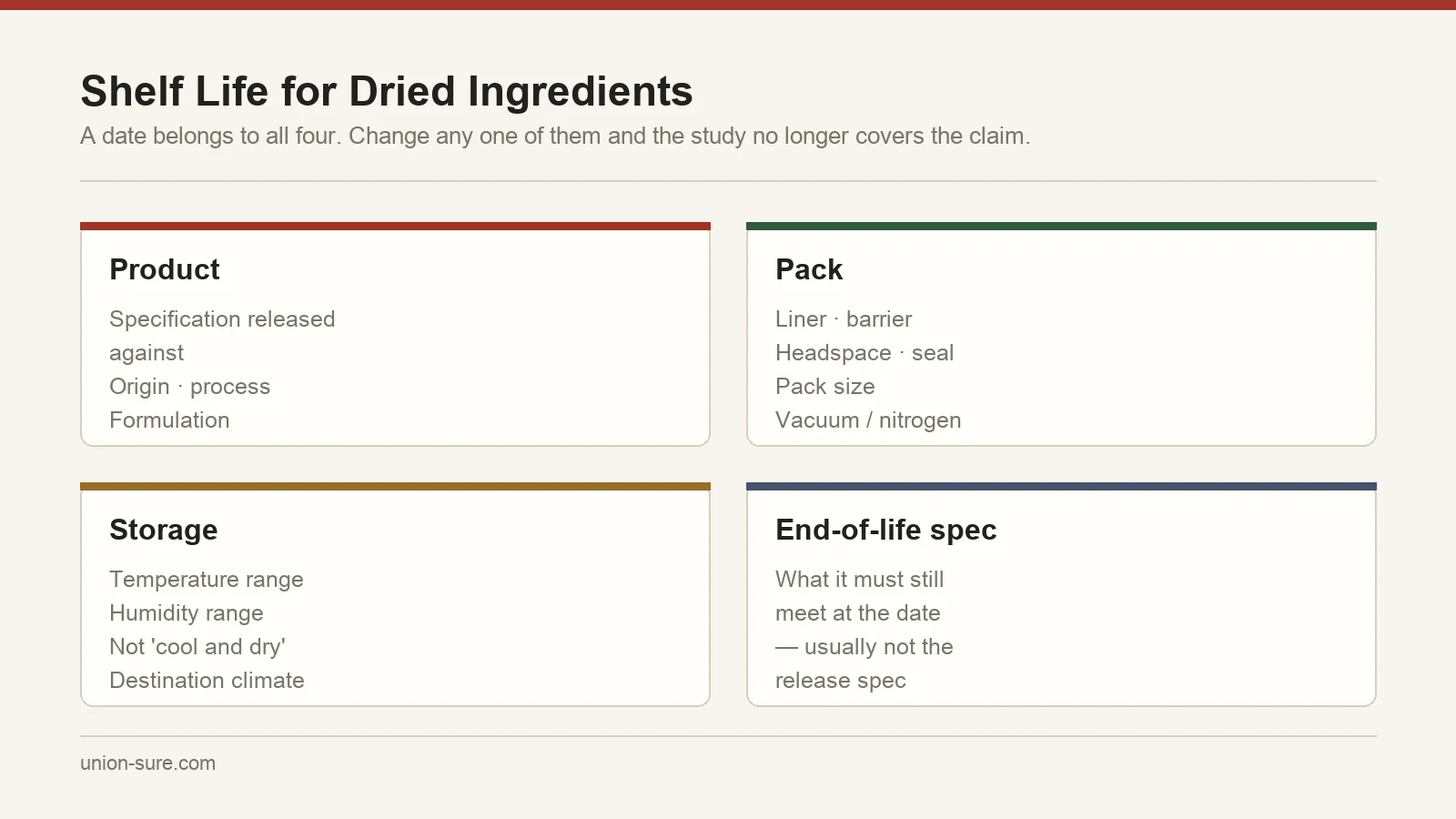
- The date belongs to the product–pack–storage system. Change the liner, the pack size or the destination climate and the study no longer covers you.
Ask five suppliers for the shelf life of dried goji and you will get “24 months” five times. Ask what was measured to arrive at it and the conversation usually stops.
That is not necessarily dishonesty. Twenty-four months is an industry convention, and for a lot of well-packed dried product it happens to be about right. But a convention is not a study, and if a customer ever challenges the date — or a lot goes off inside it — the convention is not something you can defend.
What a shelf-life date actually claims
The date claims that a defined product, in a defined pack, stored under defined conditions, will still meet its specification at that point. Every one of those four elements is load-bearing:
- the product, at the specification it was released against, not a better lot;
- the pack, including liner, barrier, headspace, seal and outer;
- the storage, as a temperature and humidity range, not “cool and dry”;
- the specification it must still meet, which is often not the release specification.
That last point catches people out. A product can legitimately drift within its shelf life — colour can deepen, aroma can soften — provided it stays inside the limits the parties agreed for end of life. If you never wrote down end-of-life limits, the date has nothing to be measured against.
Decide the failure mode before you design the study
Dried ingredients rarely fail microbiologically first. Low water activity holds growth back, so what actually ends the useful life is usually one of these:
| Failure mode | Where it shows up first | What to measure |
|---|---|---|
| Moisture pickup | Caking, loss of crispness, clumping | Water activity, moisture, flow |
| Oxidation | Rancid or flat aroma, colour drift | Sensory, peroxide value where fat is present |
| Non-enzymatic browning | Darkening, especially in sugar-bearing fruit | Colour by instrument, sensory |
| Physical breakdown | Fines, breakage, dust | Particle size, fines percentage |
| Pack failure | Any of the above, in one bag not the lot | Seal integrity, residual oxygen |
Pick the one or two that will actually end your product’s life and design around them. A study that measures only microbiology on a product that dies of caking will pass every timepoint and tell you nothing.
Real-time is the study; accelerated is the shortlist
Real-time testing means storing the actual product in the actual pack under the intended conditions and testing at intervals until it fails or reaches the target. It is slow and it is the only thing that directly supports the claim.
Accelerated testing raises temperature — and sometimes humidity — to make the failure arrive sooner. It is genuinely useful, with one caveat that matters: raising the temperature does not speed every reaction by the same factor. It can change which reaction dominates, so the product may fail in the accelerated study by a mechanism it would never have failed by on a real shelf.
The practical way to use both: run accelerated to rank pack options or formulations against each other, choose the winner, then run real-time on the winner and let the real-time data carry the claim. We would rather tell a customer “real-time data to twelve months, study continuing” than quote a longer number we cannot show.
Sampling and intervals
A study needs enough units to test at every timepoint without opening the same bag twice, plus retains. Test at intervals that will actually catch the curve — clustering everything at the end tells you the product failed but not when.
Include a zero timepoint. It sounds obvious and it is routinely skipped, and without it you cannot separate “changed in storage” from “was already like that at release”.
The date does not transfer
This is the part that quietly invalidates more shelf lives than any laboratory error. A study belongs to the system it was run on. Change any of these and it no longer covers you:
- a different liner or barrier structure;
- a different pack size, because surface-area-to-mass changes;
- vacuum or nitrogen added, removed or changed;
- a different destination climate;
- a formulation, origin or process change upstream.
Repacking bulk material into retail packs is the most common version. The bulk study says nothing about the retail pack, and the retail pack is usually the weaker barrier.
What to ask a supplier
- What is the claimed shelf life, in which pack, under which stated conditions?
- Is it supported by real-time data, accelerated data, or convention?
- Which attributes were measured, at which intervals, and what were the end-of-life limits?
- Was there a zero timepoint?
- Does the study cover the exact pack I am buying?
- What happens to the claim if I repack?
None of these are unreasonable and none require confidential information. A supplier who can answer them has done the work; a supplier who cannot has given you a number to write on a label.
Frequently asked questions
Is best-before the same as a shelf life?
No. Best-before is a label declaration governed by the rules of the destination market; shelf life is the technical basis you hold to support it. The declaration must be justifiable, and the market decides the wording, format and any exemptions — verify those separately for each destination.
Can accelerated data alone support a shelf-life claim?
It can support a provisional claim while real-time work continues, provided everyone knows that is what it is. It is weak on its own because raised temperature can change which reaction dominates, so the accelerated failure may not be the failure that happens on a real shelf.
Does a longer shelf life mean a better product?
Not by itself. It usually means a better barrier, a lower water activity, or a more conservative end-of-life limit. Compare the pack and the limits before treating a longer number as a quality signal.
Where to go next
A shelf life is decided by the pack and verified on the certificate.
- bulk packaging, barrier, vacuum and nitrogen — the pack is the variable that most often decides where the date lands.
- moisture content versus water activity — the two numbers that predict which failure mode arrives first.
- reading the COA the claim is built on — release data and end-of-life limits are different sets of numbers.
- ask what our study covers — tell us the pack and destination and we will say what data we hold for it.
Published 16 September 2025. Last reviewed 15 August 2026 by the Union Sure technical team. Regulatory limits, standards and market requirements change — verify every legal limit against the current official source before it is used to approve a shipment.