
Key points
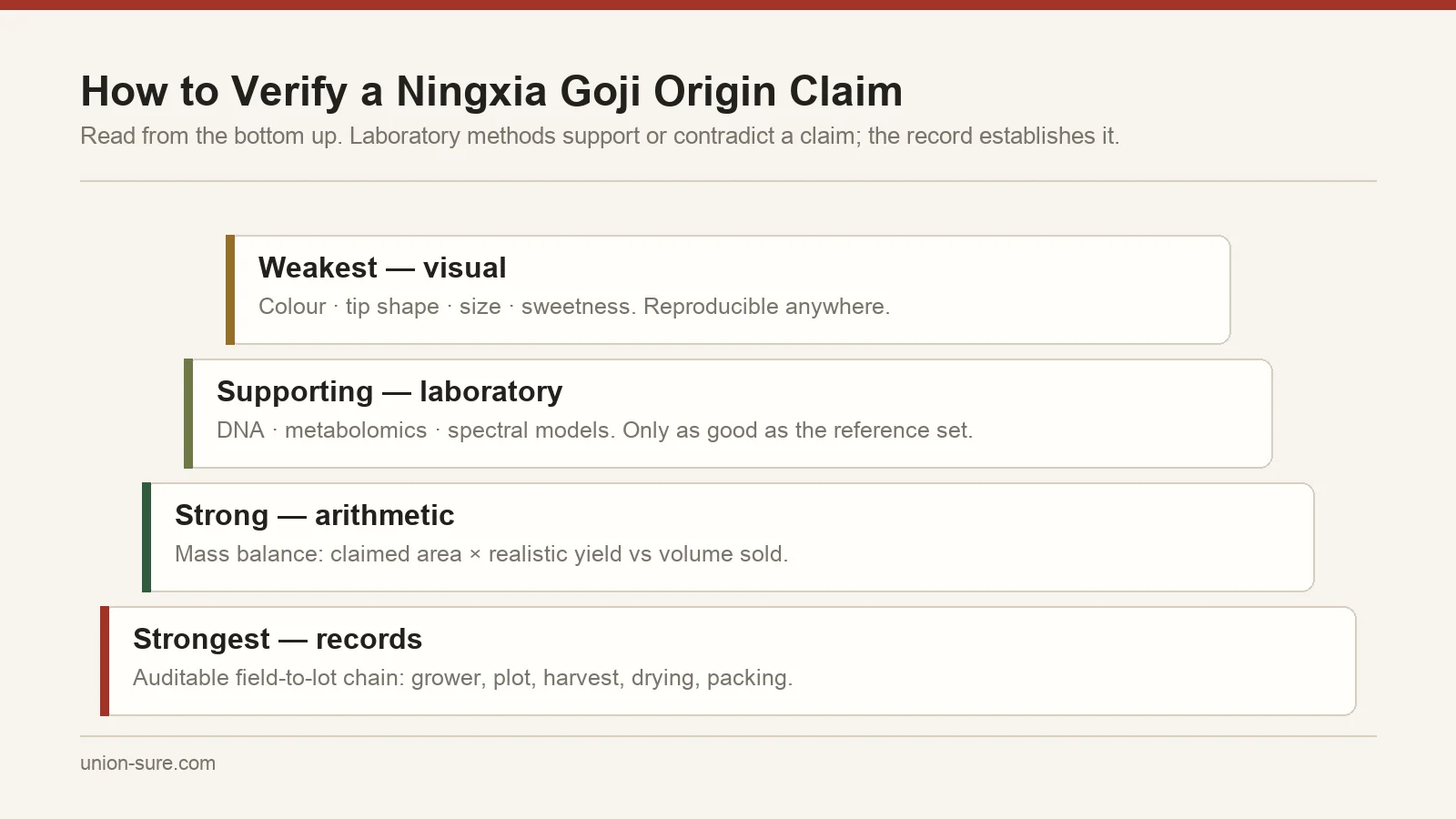
- No visual test proves origin. Colour, tip shape, size and sweetness all vary with cultivar, field, season, maturity and drying.
- The strongest ordinary evidence is a documented field-to-lot chain — grower, plot, harvest date, drying batch, packing lot — that survives an audit.
- Mass balance is the cheapest fraud check there is: compare claimed plot area and yield against the volume being sold.
- Ningxia as a region and a specific geographical-indication authorisation are different claims. Do not accept one as proof of the other.
- Laboratory methods can support or contradict a claim; none of them replaces the paper chain.
Red colour, a pointed tip and a sweet taste prove nothing about where a goji berry grew. Those characteristics move with cultivar, plot, harvest timing, weather, drying method and storage, and every one of them can be reproduced somewhere else.
That is worth saying plainly, because we sell on a Ningxia origin and it would be commercially convenient to pretend otherwise. Origin is established by records that can be audited and by mass balance that cannot be faked cheaply — not by anything you can see in the bag.
Define the claim before verifying it
These claims are not equivalent:
- grown in Ningxia;
- processed in Ningxia;
- packed in Ningxia;
- sourced from Zhongning County;
- authorized to use a Zhongning geographical-indication/certification mark;
- Lycium barbarum species.
A berry grown in Gansu and packed in Ningxia does not become Ningxia-grown. A Ningxia-grown berry is not automatically authorized for a narrower Zhongning mark.
Write the claim as a testable sentence:
All berries in shipment lot [ID] were harvested from approved fields located within [defined geographic boundary] during [harvest period], kept segregated through [named processor/packer], and are covered by the attached lot and mass-balance records.
If a regulated geographical indication or certification mark is used, add the authorization, operator and product scope.
Why visual tests are weak
Origin-research teams do not rely on one visual feature. A 2023 metabolomics study used 199 Lycium barbarum samples from Ningxia, Gansu, Qinghai and Xinjiang and combined chemical profiling with multivariate analysis. (metabolomics study) A 2024 study fused visible/near-infrared and near-infrared spectral/image data to distinguish several Ningxia production zones. (Twin-Tower model study)
The need for high-dimensional models is itself a warning against folklore. Do not publish rules such as “Ningxia berries are always brighter, sweeter or larger.” Those may be sample observations, not unique origin markers.
Use visual inspection for lot consistency and defects—not geographic certification.
Build the field-to-lot record
ISO 22005 sets general principles and requirements for food-chain traceability, and Codex recognizes product tracing as a tool against deceptive marketing and for accurate product description. (ISO 22005; Codex CXG 60-2006)
For origin, record these critical tracking events:
Approved field
- farm/operator legal name;
- field identifier and coordinates/boundary;
- land tenure or grower contract;
- cultivar/species planting record;
- crop year and expected yield;
- audit date and neighbouring-crop risk.
Harvest
- date and field;
- harvest crew or grower;
- fresh weight and container IDs;
- transport vehicle and seal/control;
- receipt destination and time.
Processor intake
- supplier/field lot;
- fresh weight accepted/rejected;
- intake quality result;
- dryer batch assignment;
- any commingling authorization;
- yield and waste.
Drying, sorting and packing
- dryer batch and process date;
- output dry weight;
- sort/grade transfers and losses;
- rework and carry-over;
- storage bin and pack line;
- finished lot and package IDs.
Export
- finished-lot quantity;
- COA and origin claim;
- commercial invoice and packing list;
- container/seal and shipment reference;
- any certificate of origin or geographical-indication evidence.
A certificate of origin may support customs documentation, but its title alone does not prove field-level segregation. Review how it was issued and what evidence underlies it.
Use mass balance to find impossible stories
This is the check we would run first if we were buying, and it costs nothing. Take the claimed plot area, apply a realistic yield per hectare, and compare the result with the volume being offered. When the arithmetic does not work, no certificate will fix it. We would rather a customer ran that check on us than took the origin claim on trust. For each period and grade, reconcile:
opening inventory + verified Ningxia inputs − documented loss/waste − verified Ningxia outputs = closing inventory
Then test yield plausibility against the actual process, moisture and grade—not a universal internet ratio.
Red flags include:
- export quantity greater than supported field/processor output;
- the same input lot allocated to multiple customers in full;
- round-number records created after the event;
- unexplained transfer from non-origin storage;
- rework with no original identity;
- grade output impossible after recorded sorting loss;
- lots produced outside harvest/storage capacity;
- certificate quantities that do not match invoice or packages.
Perform a backward trace from finished package to field and a forward trace from one field lot to all outputs. Time the exercise and investigate every broken link.
Ningxia is not the same as Zhongning authorization
Zhongning County published updated rules in 2026 for use of its geographical-indication certification mark. The rules attach the mark to a defined geographic and production/packing framework and reference product-safety/quality conditions. (Zhongning rules)
If a quotation uses “Zhongning” or displays a certification mark, request:
- mark-use authorization holder;
- validity and covered product;
- approved producer/packer;
- lot relationship to that operator;
- label/artwork approval;
- current governing rules.
Do not use a farm address in Ningxia as a substitute for Zhongning mark authorization. Conversely, do not reject a truthful broader Ningxia-origin lot merely because it does not carry the narrower mark; it is a different claim.
What DNA can prove
A DNA study developed morphological and molecular tools to distinguish closely related Lycium species in commercial goji products. (Goji Who?) This can be valuable when the specification requires Lycium barbarum rather than Lycium chinense or another species.
Species DNA does not normally encode “harvested in Ningxia.” The same species can be grown in several regions. Use DNA for botanical identity, not as standalone geographic proof.
Processed powders or extracts may also yield degraded or mixed DNA. The laboratory must validate the method for the product form and reference material.
What metabolomics can prove
The 199-sample study found 148 differential metabolites and reported 21 with high sensitivity/specificity as potential biomarkers in its model. That is promising research, but “potential biomarker” is not the same as a globally standardized test.
Before using it commercially, ask:
- Does the reference database cover the claimed and alternative origins?
- Does it include multiple years, cultivars, farms and processes?
- Was an independent blind validation performed?
- Are the 2026 crop and your drying method within scope?
- What false-positive/false-negative rates apply?
- Is the decision model locked before testing?
- Can the lab preserve raw data and chain of custody?
Use the result as corroboration or forensic evidence under an agreed protocol. Do not let it replace missing field records.
What spectral and imaging models can prove
Vis-NIR, NIR and hyperspectral approaches can be fast and non-destructive. The 2024 Twin-Tower study developed a model for Zhongning, Guyuan, Tongxin and Huinong samples; another 2023 study explored hyperspectral imaging for Ningxia goji origin. (2023 hyperspectral study)
Model performance is conditional. Instrument calibration, sample moisture, crop year, lighting, preprocessing and reference population can shift results. A headline accuracy from a research dataset must not be applied to a different supplier lot without transfer and independent validation.
Evidence hierarchy
Be wary of anyone who leads with laboratory evidence. A spectral model or a metabolomic fingerprint is only as good as the reference set behind it, and reference sets for goji are not universal. These methods are genuinely useful for flagging an inconsistency; the paper chain is what establishes the claim.
| Evidence | Best use | Main limitation |
|---|---|---|
| Field/harvest records | Direct lot history | Can be fabricated if not audited |
| Processor intake and mass balance | Tests physical plausibility | Needs complete, timely records |
| Audit and trace exercise | Tests system operation | Snapshot and sampling limits |
| GI/mark authorization | Supports a specific protected claim | Scope and lot link must match |
| Species DNA | Botanical identity | Not geographic proof |
| Metabolomics | Corroboration/forensics | Reference-model dependence |
| NIR/hyperspectral model | Screening/corroboration | Calibration and domain shift |
| Appearance/taste | Quality screening | Not unique to origin |
The strongest file combines independent layers rather than asking one document or test to carry the claim.
Audit checklist
- [ ] Origin wording and geographic boundary are defined.
- [ ] Farm, field and harvest records predate the sale.
- [ ] Fresh inputs link to dryer and finished lots.
- [ ] Mass balance reconciles by period and grade.
- [ ] Non-Ningxia material is physically/systemically segregated.
- [ ] Rework and carry-over retain identity.
- [ ] Backward and forward traces succeed.
- [ ] Zhongning mark evidence is checked separately where claimed.
- [ ] Laboratory method answers species or origin—not both by assumption.
- [ ] Model/reference limitations are recorded.
- [ ] Shipment quantity and package IDs reconcile.
- [ ] Changes in farms, processor or claim require approval.
Origin verification is not a beauty contest between berries. It is a documented, quantitatively plausible chain supported, when the risk justifies it, by a laboratory method validated for the precise claim.
Frequently asked questions
Can origin be confirmed by looking at the berries?
No. Colour, size, tip shape and sweetness vary with cultivar, plot, harvest timing, weather and drying, and all of them can be reproduced elsewhere. Visual assessment is the weakest form of origin evidence.
What is the cheapest useful origin check?
Mass balance. Take the claimed plot area, apply a realistic yield per hectare and compare the result with the volume being offered. When the arithmetic does not work, no certificate resolves it.
Is ‘from Ningxia’ the same as a geographical-indication authorisation?
No. Being grown in the region and being authorised to use a protected geographical indication are different claims with different evidence. Do not let one stand in for the other in a specification.
Where to go next
Origin is one claim in a goji file. These are the ones it is most often confused with.
- EU pesticide MRLs and how goji is classified — residue compliance is independent of where the berry grew.
- organic, low-pesticide and conventional compared — production route is a separate claim from origin.
- what the grade number measures — size grading says nothing about provenance.
- ask for the origin record — we will send the field-to-lot chain for the lot you are considering.
Published 4 August 2026. Last reviewed 15 August 2026 by the Union Sure technical team. Regulatory limits, standards and market requirements change — verify every legal limit against the current official source before it is used to approve a shipment.