
Key points
- Low moisture is not pathogen-free. Salmonella can survive for months in dry products without multiplying.
- “Sterilised” is almost always the wrong procurement word. Commercial processes deliver a validated reduction, not sterility.
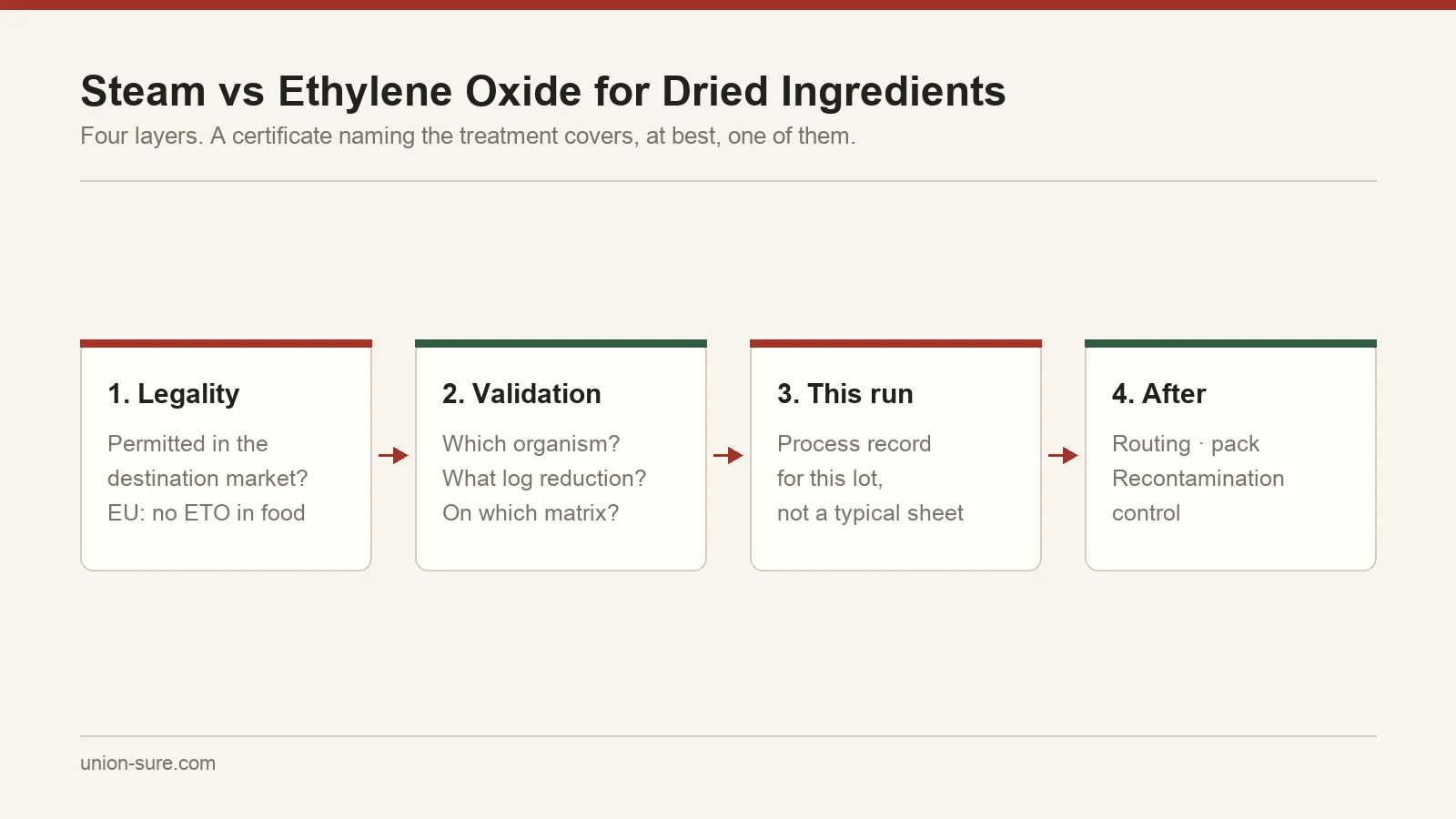
- Ethylene oxide is not permitted for food use in the EU and residues have triggered large recalls. Treat market permissibility as the first question, not the last.
- A treatment name is not a control. Ask for the validation basis, routine process record and post-treatment protection.
- Recontamination after treatment is the failure nobody specifies against. The pack and the handling after the process are part of the control.
If you take one thing from this page, take this: the treatment name on a certificate tells you almost nothing about whether the risk was controlled.
“Steam treated” and “ETO treated” are process labels. What decides whether a lot is safe is the validation behind the process, the record for that specific run, and whether anything touched the product afterwards. And before any of that, there is a question of law — because one of these routes is not permitted for food in the European Union at all.
Low moisture is not the same as pathogen-free
Codex defines low-moisture foods in its code as foods with water activity of 0.85 or below. Under such conditions, Salmonella may be unable to multiply, yet viable cells can remain for extended periods. Codex also notes that microorganisms can become more heat tolerant in food matrices at reduced water activity. (Codex CXC 75-2015)
That distinction matters. A low water-activity COA result can support stability assessment, but it is not evidence that Salmonella is absent or that a kill step worked.
Begin with a hazard analysis covering:
- commodity and agricultural environment;
- historical supplier and category findings;
- raw versus ready-to-eat use;
- whether the customer’s process contains a validated later kill step;
- serving population and severity of harm;
- expected incoming load and target organism;
- handling after any reduction step.
A dried onion added before a validated retort is not the same control problem as parsley flakes added after cooking.
“Sterilized” is usually the wrong procurement word
We get RFQs asking for “sterile” dried vegetables, and we always push back on the word rather than quietly agreeing to it. A commercial reduction process is not sterilisation, and writing “sterile” into a specification creates a requirement nobody can meet or verify. Specify the log reduction, the organism, the validation basis and the release testing instead. Commercial steam processes for spices and dried vegetables are better described as validated microbial reduction. Sterility is a much stronger state and should not be inferred from a supplier’s marketing phrase.
Ask for the defined performance objective, organism or validated surrogate, product/process scope and critical operating limits. Do not insert a log-reduction number copied from another ingredient. Codex says the necessary target should reflect the expected pathogen level and that the control must be validated for the type of low-moisture food at operational scale.
Steam treatment
Steam is a thermal process that introduces heat and moisture. Codex lists steam treatment followed by a drying step as a commonly used microbial-reduction measure for low-moisture foods. (Codex low-moisture code)
Evidence to request
- validated product family and worst-case rationale;
- target organism or surrogate and target reduction;
- process flow and equipment type;
- critical limits such as time, product temperature, steam conditions and product depth, where relevant;
- load configuration and coverage evidence;
- monitoring records and deviation rules;
- post-treatment drying endpoint;
- validation of moisture, water activity and product quality after treatment;
- revalidation/change-control triggers.
Product questions
Steam can affect colour, volatile aroma, texture, bulk density, particle integrity, hydration and caking. The outcome depends on product, severity and equipment; avoid universal loss percentages. Run an application trial on a sample produced by the intended commercial route, not a hand-treated laboratory sample.
Process questions
Because the step introduces moisture, confirm complete drying before the product returns to a dry, high-hygiene area. Condensate, wet equipment or a poorly separated post-process zone can undermine the control.
Ethylene oxide treatment
Ethylene oxide is an antimicrobial fumigant. A supplier may offer it because it can reduce microorganisms without the same heat/moisture exposure as steam. That description does not settle whether the treatment is acceptable.
The buyer must evaluate at least three separate issues:
- Legal status: Is the use authorized for this food and origin/destination chain?
- Residues: Which residue definition and limits apply, and can the analytical method support the decision?
- Customer policy: Does the brand, retailer or manufacturing standard prohibit the route even if a legal pathway appears available?
An older European Commission scientific opinion records that ethylene oxide was no longer permitted in the EU for decontaminating spices at that time. (SCF opinion) The current decision must still be checked against live EU legislation, including the pesticide-residue framework and latest amendments—not against a 2002 paper alone. (Regulation 396/2005, 2026 consolidation)
The large EU ethylene-oxide incident demonstrated why the issue extends beyond the treated raw material: a residue finding in an additive or ingredient can affect many downstream foods. (European Commission E410 incident summary) Recent monthly EU reports still list individual suspicions involving the substance; those entries are warning signals, not prevalence estimates. (January 2026 report)
For EU-bound dried ingredients, do not treat “ETO sterilized” as a selling point. Escalate it to regulatory review and require substance-specific evidence under the current rule set.
Irradiation and other routes
Codex also lists irradiation and antimicrobial fumigation among commonly used non-thermal measures. FDA explains irradiation as a regulated food treatment in the United States. (FDA irradiation overview)
Permitted foods, dose conditions, facility requirements, documentation and labelling vary. Verify the product and market; do not assume that approval for one spice, country or retail format applies to another.
Other options may include validated dry heat, radio-frequency or other technologies, depending on product and jurisdiction. The same evidence rule applies: define the hazard and target, validate the process on the product, monitor critical limits and protect the treated material.
A comparison framework
| Decision factor | Steam | Ethylene oxide | Irradiation |
|---|---|---|---|
| Primary control | Thermal with moisture | Chemical fumigation | Ionizing radiation |
| Validation focus | Product heating, exposure, drying | Concentration/exposure, aeration, residues | Product, dose distribution and approved conditions |
| Product-impact study | Aroma, colour, texture, hydration, caking | Residue/aeration plus sensory and chemistry | Sensory, chemistry and functionality |
| Market-access check | Process/food rules and customer policy | Authorization, MRL/residue definition and customer prohibition | Approved food/use, facility and labelling |
| Post-process risk | Moisture and recontamination | Recontamination and residual-control failure | Recontamination |
The table identifies questions, not a universal ranking.
Validation is not a certificate attachment
A useful validation package explains:
- product or product family covered;
- formulation and physical state;
- organism/surrogate selection;
- inoculation and recovery method, if a challenge study is used;
- scale and equipment;
- worst-case locations and operating conditions;
- achieved result and variability;
- critical limits and monitoring;
- deviations and corrective action;
- revalidation conditions.
If a supplier says the study is confidential, a qualified reviewer can often examine a controlled summary or audit it under confidentiality. “Third-party validated” without scope is not enough.
Lot release is a separate layer
The batch COA may include indicator organisms and pathogen criteria appropriate to the product. It should identify the lot, methods, sampling basis and actual results. But end-product testing samples only a small fraction of a lot. Codex explicitly warns about the limited information finished-product testing provides on the effectiveness of hygiene controls.
Use lot testing to verify a control system, not to create one. Establish rules for positive, presumptive, out-of-specification and invalid results before testing begins.
Protect the product after treatment
This is the part that gets skipped. A validated treatment followed by transfer through an uncontrolled area, or into a pack that was open on the line, has bought very little. When you audit a supplier on this, follow the product physically from the treatment exit to the sealed bag. That walk is usually more informative than the validation file. Codex calls for the most stringent hygiene after a pathogen-reduction step to prevent recontamination. That means reviewing:
- physical separation of raw and treated areas;
- personnel and material flow;
- dedicated tools and protective clothing;
- dust and air movement;
- dry cleaning and controlled use of water;
- environmental monitoring;
- packaging integrity and food-contact suitability;
- rework and returned-product controls;
- storage and transport.
If treated product is milled or repacked in an uncontrolled room, the original process record tells only half the story.
Buyer approval checklist
- [ ] Intended use and any downstream kill step are documented.
- [ ] Hazard and target organism are defined.
- [ ] Required reduction is justified, not copied from a generic brochure.
- [ ] Validation covers the exact product family, process and scale.
- [ ] Critical limits, monitoring and deviations are available for audit.
- [ ] Destination-market authorization, residues and labelling are reviewed.
- [ ] Product quality was tested after the commercial process.
- [ ] Post-treatment zoning and environmental controls are qualified.
- [ ] Lot COA and sampling rules are separate from validation evidence.
- [ ] Treatment, site or equipment changes require notice and review.
The strongest purchasing decision is rarely “steam versus ETO” in isolation. It is an approved combination of hazard analysis, lawful treatment, validated process, protected post-treatment handling and lot-specific verification.
Frequently asked questions
Does a low water activity mean a dried ingredient is pathogen-free?
No. Low water activity stops most pathogens multiplying, but it does not kill them. Salmonella in particular can survive for months in dry foods and remains infectious. Drying is a growth control, not a kill step.
Is ethylene oxide allowed for food ingredients in the European Union?
No. Ethylene oxide is not permitted for food use in the EU, and residue findings have triggered large recalls across several ingredient categories. Establish which treatments are permitted in your destination market before you compare suppliers on anything else.
What should I ask for instead of a treatment certificate?
The validation basis (organism, log reduction, matrix), the process record for your specific lot rather than a typical-values sheet, and evidence of how the product was protected from recontamination between treatment and sealing.
Where to go next
Microbial control is verified in three places: the supplier, the certificate, and the pack.
- what to verify at the supplier — validation files and post-treatment routing are audit findings, not paperwork.
- reading the microbiological rows on a COA — release testing is a separate layer from process validation.
- keeping the product protected after treatment — recontamination is a packaging and handling failure more often than a process failure.
- ask which routes we use — tell us the destination market first — it decides which options are even legal.
Published 26 May 2026. Last reviewed 15 August 2026 by the Union Sure technical team. Regulatory limits, standards and market requirements change — verify every legal limit against the current official source before it is used to approve a shipment.