
Key points
- Start with the solids equation. A fruit at 8% solids needs roughly twelve times its finished weight in raw material before any process loss.
- Theory understates it. Trimming, freezing, fines, sieving, rework and quality rejection all take a share before the pack is filled.
- Chamber time is the cost driver, and it is driven by piece thickness and load density more than by tonnage.
- A low quote is usually a different product: more fines, thinner slices, a different variety, a different season or a shorter test panel.
- Compare landed cost per usable kilogram after yield, not price per kilogram.
Twelve to one. That is roughly how much fresh strawberry it takes to make one kilogram of freeze-dried strawberry, before anything goes wrong — and it explains most of what buyers find puzzling about the price.
Once you internalise the solids equation, freeze-dried quotes stop looking arbitrary. A quote that undercuts the market by a third is not usually a better factory. It is usually a different product, and the useful question is which part of the specification paid for the discount.
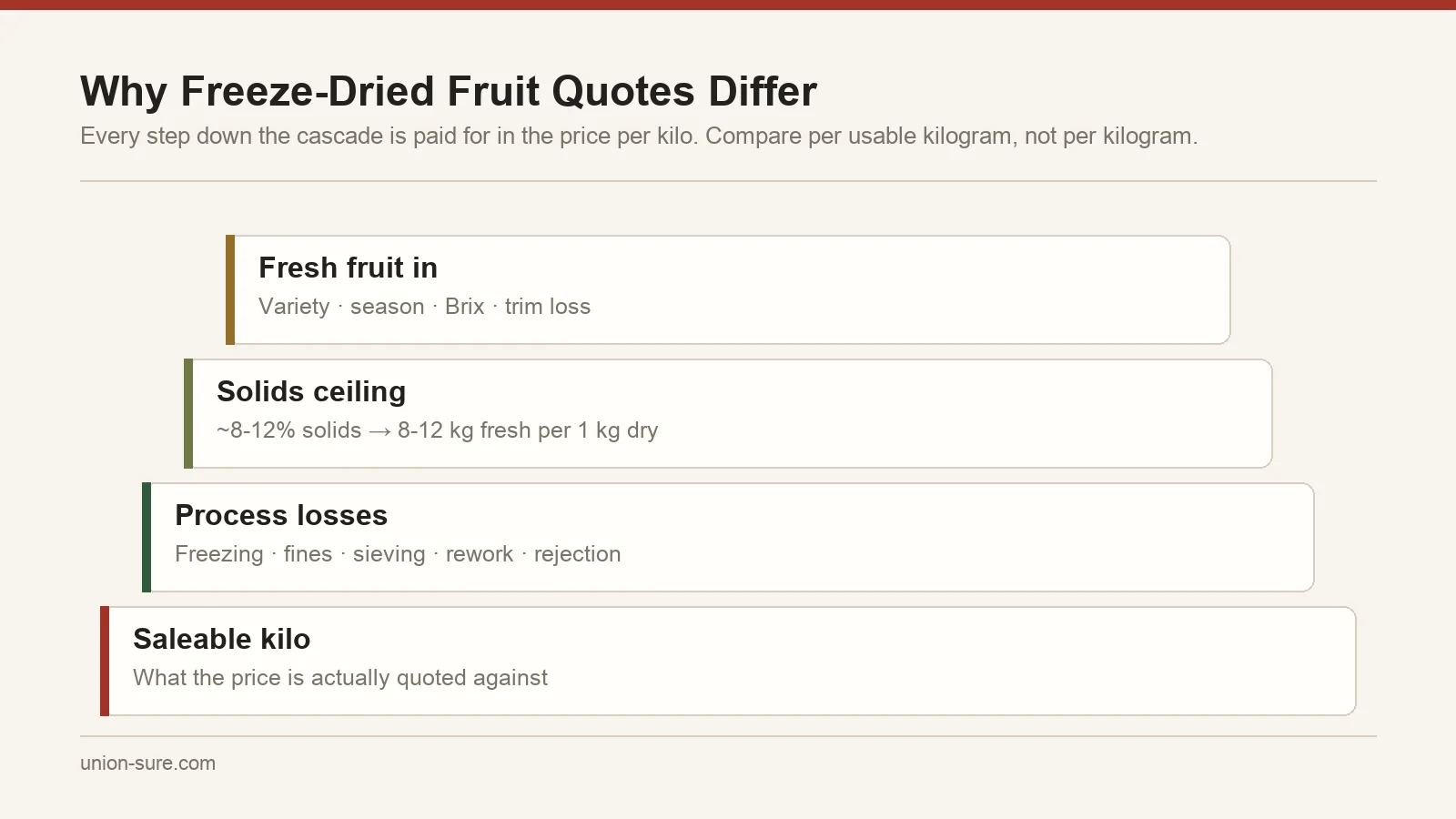
Start with the solids equation
Drying removes water but retains most non-volatile solids. A simplified theoretical calculation is:
Finished mass = fresh input × fresh solids fraction ÷ finished solids fraction
If a fruit contains 10% solids and the finished product contains 97% solids, then—before trimming, sampling, sticking, process loss and grading—100 kg of fresh input would theoretically produce:
100 × 0.10 ÷ 0.97 = 10.31 kg finished product
This is a fictional illustration, not a Union Sure yield or a supplier guarantee.
Utah State University Extension publishes an older illustrative table in which strawberries are listed at 9% solids, raspberries at 14% and bananas at 26%. (USU dryness guide) These figures are useful for understanding why fruit type matters, but commercial buyers should use current lot-specific solids, ripeness and process data.
Add the losses that theory omits
Agricultural selection
Ripeness, cultivar, rain, soluble solids, size and defects change usable input. Fruit rejected for mould, bruising or colour never reaches the chamber but remains part of procurement and sorting cost.
Preparation loss
Washing, draining, hulling, peeling, coring, destoning and cutting remove mass. A whole raspberry and a peeled mango dice have different preparation yields.
Process handling
Product can adhere to trays, fracture, remain under-dried, collapse or be rejected. Cycle development balances dryness, structure and throughput; “longer” is not automatically better.
Grading loss
The buyer may accept whole pieces but not fragments or powder. The factory can sell other fractions, yet their value may be lower and demand uneven. Whole-piece recovery therefore affects the offered grade.
Sampling and retention
Laboratory, retention and inspection samples are small but real parts of the lot, especially in short runs.
The practical equation becomes:
Accepted finished yield = fresh input × preparation yield × process yield × accepted-grade yield
Each term needs a defined basis.
Fruit type and format change chamber economics
Freeze drying freezes the food and removes ice by sublimation under vacuum. (USU freeze-drying overview) Commercial economics then depend on:
- product thickness and surface area;
- sugar composition and glass-transition/collapse behaviour;
- freezing method and ice structure;
- loading per tray and chamber;
- primary and secondary drying time;
- vacuum and refrigeration performance;
- endpoint and release tests;
- cleaning and changeover;
- batch size and utilisation.
A review of food freeze drying shows that cycle and product design affect structure and final quality. (2026 review) It does not support one universal energy cost or cycle time.
Powder can fill trays and packages differently from whole pieces. Powder may be intentionally milled from suitable dried material, recovered from broken product, or made from purée with a carrier. These are not automatically equivalent.
The product definition changes the quote
We can quote almost any number you like if you let us choose the definition. More fines, a thinner slice, a lower-solids variety, a shorter test panel: each of those is a legitimate product for someone, and each lowers the price. This is why a precise RFQ is worth more to a buyer than a hard negotiation. Pin the product and the price becomes comparable. Compare:
- fruit species/cultivar and origin;
- whole, slice, dice, granule or powder;
- measured particle distribution and fines;
- single ingredient versus sugar/carrier/acid;
- conventional or certified organic;
- standard or buyer-specific pesticide panel;
- microbial treatment and testing;
- moisture and water activity limits;
- colour/sensory grade;
- pack size, liner barrier and nitrogen/vacuum requirement;
- private label, retail packing or bulk industrial pack.
USDA’s freeze-dried fruit procurement requirements distinguish fruit, style, ingredients, quality, packaging and organic options. (USDA requirements) A quote should make the same distinctions even when the buyer uses a private specification.
Price per kilogram can still mislead
Calculate cost per usable kilogram in the factory.
Example, with fictional figures:
| Offer | Delivered price | Arrival fines rejected | Usable cost |
|---|---|---|---|
| A | $20.00/kg | 5% | $21.05/kg |
| B | $21.00/kg | 1% | $21.21/kg |
The offers are nearly equal after accepted yield. But if Offer B produces stronger visual impact at a lower inclusion rate, it may win; if its pieces break on the buyer’s line, it may not. Application trials decide.
For powders, compare carrier and fruit solids. A cheaper kilogram with 20% carrier is not equivalent to a single-ingredient powder when the formula is fruit-solids constrained.
Certification and compliance costs are product-specific
Organic certification adds controlled sourcing, segregation, certification and transaction-document work. Buyer-specific pesticide panels, accredited laboratory tests, steam treatment, allergen controls or retailer audits add costs only when they are actually required and performed.
Ask for evidence. Do not pay an “organic premium” for an annual certificate that does not cover the product, site or shipment. Do not assume a low price excludes compliance; compare the actual documentation and verification plan.
Packaging and freight change landed cost
Freeze-dried products have low bulk density and can be fragile. Freight may be constrained by volume before weight. Whole pieces can require more protective headspace or smaller packs; powder may pack more densely but cake or contaminate seals.
Normalise:
- net kilograms per inner pack, carton/drum and pallet;
- pallets and net kilograms per container;
- packaging cost included;
- Incoterm and named place;
- freight, insurance, destination charges and duty;
- independent testing and inspection;
- damage and breakage assumptions;
- inventory and shelf-life remaining.
“FOB $/kg” is not a landed comparison.
Seasonal and volume effects
Fruit harvest price and availability change. Spot purchases, contracted raw material, cold/frozen inventory and origin diversification create different risk and cost. Volume can improve planning and packaging efficiency, but very large orders can cross harvest, lot or chamber constraints.
Ask for price tiers with exact assumptions:
- sample;
- pilot;
- MOQ;
- one production lot;
- one shipment;
- annual forecast or contract;
- price validity and raw-material adjustment rule.
Avoid publishing a supplier’s temporary quote as a “market price.” Store dated quotes in the procurement file.
A quote-comparison worksheet
| Field | Supplier A | Supplier B |
|---|---|---|
| Product code/site | ||
| Fruit/ingredients | ||
| Origin/season | ||
| Format and size | ||
| Fines/breakage method | ||
| Moisture/aᵥ | ||
| Micro/chemical plan | ||
| Organic/claim evidence | ||
| Net kg/pack and pallet | ||
| MOQ/lot size | ||
| Incoterm/named place | ||
| Price validity | ||
| Landed cost/kg | ||
| Accepted yield | ||
| Usable cost | ||
| Application result |
Questions to ask when a quote is unusually low
When we lose on price by a wide margin we usually assume the other offer is a different specification, and we are usually right. That is not a complaint about competitors, it is a warning about enquiries. Ask the low bidder for the fines percentage, the piece distribution, the variety, the season and a recent batch COA. If those come back matching, the price is real and you should take it.
- Is the format or size distribution different?
- Are powder, fines or broken pieces included?
- Is a carrier, sugar or acid present?
- Is net weight, pack and delivery basis identical?
- Does the offer cover the same site, origin and certification?
- Are batch COA tests and methods equivalent?
- Is the offered lot aged, short-dated or spot inventory?
- Are import documents, pallets, inspection or testing excluded?
- Is the quotation based on forecast volume that has not been committed?
A low quote may be a good offer. The point is to identify what it represents.
Frequently asked questions
How much fresh fruit makes 1 kg freeze-dried fruit?
There is no single ratio. Use current raw-fruit solids, final moisture, trimming, process and accepted-grade yields. Ask the supplier for the basis of any claimed ratio.
Why can powder cost less than whole pieces?
Whole-piece recovery, selection and protective packaging may be costly. But powder identity, carrier and production route also vary, so powder is not automatically a cheaper equivalent.
Does a larger order always lower price?
No. It may improve planning and pack efficiency, but can require multiple lots, extended raw-material contracts, more storage or special capacity. Ask for the assumptions behind each tier.
Where to go next
Pricing follows from the specification. These two settle the specification.
- write the specification into the RFQ first — an underspecified enquiry produces uncomparable numbers, not competitive ones.
- format, size and application for inclusions — the format decision that changes yield and therefore price.
- the freeze-dried range — current fruits and formats.
- ask for a quote with the yield stated — send the target specification and we will show the assumptions behind the number.
Published 12 May 2026. Last reviewed 15 August 2026 by the Union Sure technical team. Regulatory limits, standards and market requirements change — verify every legal limit against the current official source before it is used to approve a shipment.