
Key points
- Choose the format by its job — visible identity, flavour delivery, texture or colour. Whole, dice, granule and powder are different products.
- Water activity governs whether an inclusion survives contact with a dough, a coating or a dairy base. Specify it with a temperature.
- In chocolate, the risk is moisture migration into the fat phase; in cereal, it is breakage in transit; in bakery, it is bleeding and hydration.
- Piece distribution must be specified as a range across screens, plus a fines limit, or the material you approve is not the material you receive.
- Run the sample under a controlled application protocol, not a bench tasting. Inclusions fail in the process, not in the bag.
A customer once approved a freeze-dried strawberry dice on the bench, then found half of it had turned to red dust by the time it reached the far end of a cereal line.
Nothing was wrong with the fruit. It was simply never specified for the mechanical handling it was about to meet. Inclusions are the category where the gap between “good product” and “right product” is widest, because almost everything that matters happens after the bag is opened.
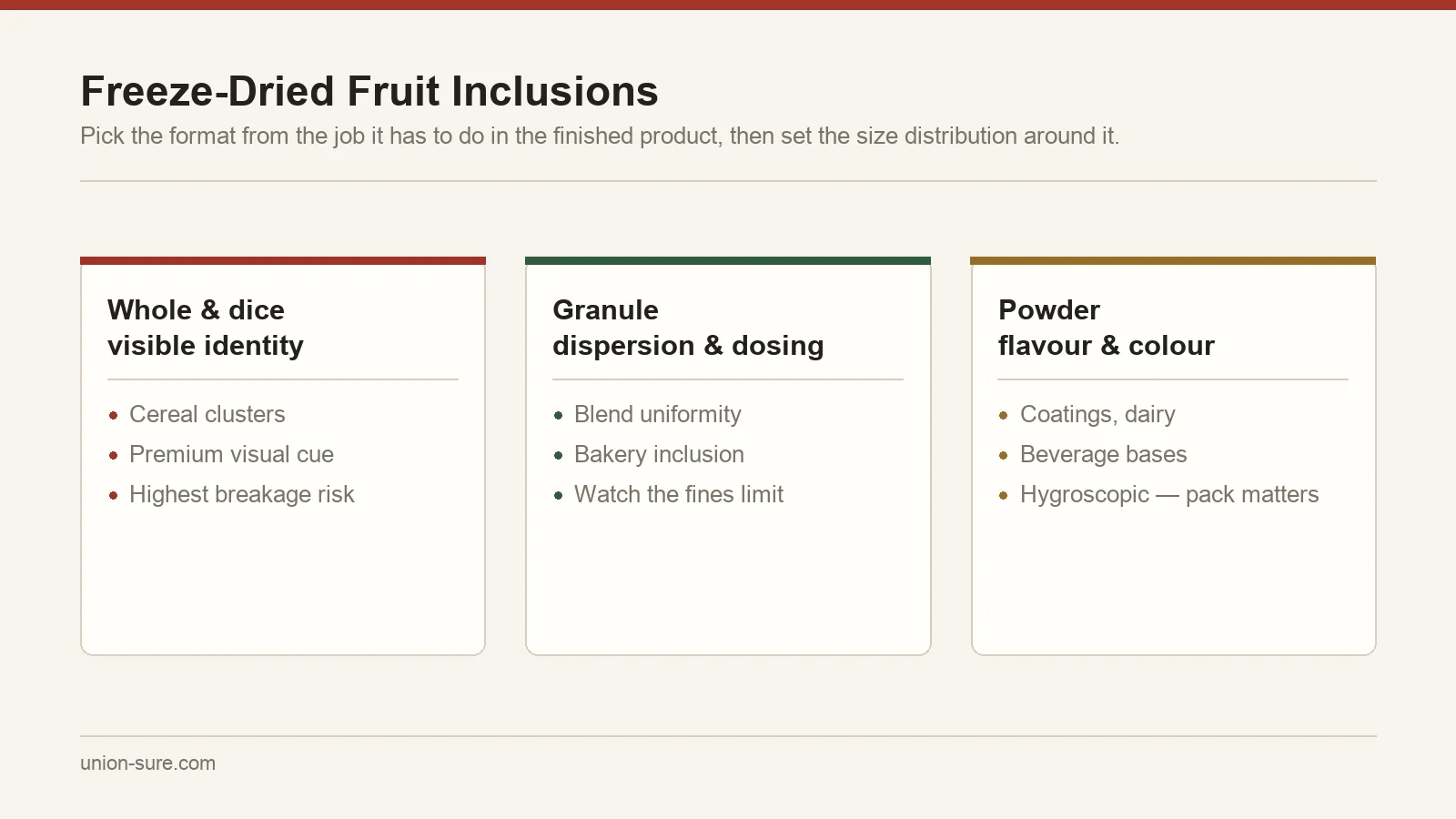
Choose the format by its job
The first question we ask on an inclusion enquiry is not the size, it is what the buyer wants the consumer to notice. Visible identity, flavour, colour and texture pull the specification in different directions, and a piece that photographs beautifully in a granola cluster is often the wrong piece for a yoghurt topping. Answer that question and the format usually chooses itself.
| Format | Useful when | Main risks to test |
|---|---|---|
| Whole / half | Visual premium, topping | Breakage, centre dryness, pack volume |
| Slices | Recognisable fruit, surface decoration | Thickness variation, curling, breakage |
| Dices / pieces | Distributed inclusions | Size distribution, fines, segregation |
| Granules | Flavour/colour specks, controlled dosing | Dust, migration, visual consistency |
| Powder | Homogeneous flavour and colour | Caking, carrier, solubility, colour shift |
Ask whether the supplier’s number is a cutter setting, nominal size or measured sieve distribution. A “5–10 mm” product with no sampling and sieve method cannot be compared reliably.
Product identity and ingredients
The specification should state:
- common and scientific fruit name where relevant;
- cultivar or origin only when contractually material;
- whole-fruit, juice/purée-derived or composite starting material;
- added sugar, maltodextrin, starch, acid, flavour, oil or anti-caking agent;
- pretreatments and processing aids;
- freeze-dried form and particle distribution;
- seeds, skin and other natural components retained;
- intended food use and label description.
Codex’s general dried-fruit standard recognises freeze-dried naming and requires styles and optional ingredients to be represented without misleading the buyer or consumer. (Codex CXS 360-2020)
Physical specification
Size distribution
Define sieve or manual measurement method, sample mass, time, and fractions. A practical table can include:
- above upper size;
- target range;
- below lower size;
- fines below a separately defined sieve;
- powder/dust if different from small pieces.
Do not hide usable small pieces and nuisance dust in one “fines” number. Their application value differs.
Breakage
Specify whether the limit applies at factory release, after shipment or after a standard handling test. A product can pass at packing and fail after pallet vibration. Retain arrival samples and compare pack positions if breakage disputes recur.
Bulk density
Bulk density influences carton volume, dosing, segregation and freight. Define tapped or loose method and units. Do not compare price per carton without net weight and bulk density.
Sensory and colour
Use an approved reference, controlled lighting and defined defects. Natural agricultural variation exists; a colourimeter may support, but not replace, an application panel. Set rules for browning, scorching, off-odour, fermentation, foreign flavour and unacceptable pale/dark pieces.
Moisture, water activity and packaging
Moisture supports mass balance and process control. Water activity helps assess available water, moisture migration and certain stability risks. They are not interchangeable.
Set both only where they add value, with methods and temperature. Avoid copying an arbitrary “aᵥ below 0.30” from a supplier page. The acceptable value for a crisp cereal inclusion may be driven by texture and migration; the hazard plan and finished-food validation remain separate.
Freeze-dried structures are porous and can pick up humidity rapidly after opening. Define:
- primary liner structure or barrier performance;
- seal method and inspection;
- nitrogen or vacuum only with measurable acceptance criteria;
- net weight and headspace/protection for fragile pieces;
- outer carton or drum strength;
- storage and maximum open exposure;
- partial-pack reclosure.
Microbiological and chemical controls
Freeze drying is not automatically a validated microbial kill step. Codex notes that pathogens can survive for extended periods in low-moisture foods even when they cannot grow. (Codex CXC 75-2015)
Build the specification from raw-material hazards, process, ready-to-eat status and finished-food use. Possible controls include pathogens, hygiene indicators, pesticide residues, heavy metals, mycotoxins or foreign material depending on the fruit and market. Define analyte lists, methods, limits and sampling; “meets international standards” is not an acceptance rule.
Application module: cereal and granola
Test:
- piece survival through blending and filling;
- segregation by density and size;
- moisture migration and crispness over shelf life;
- colour transfer;
- distribution per serving;
- package breakage and bottom-of-pack fines.
Do not set inclusion percentage from appearance alone. Lower-density pieces occupy more volume per kilogram and can look abundant while dosing by mass remains low.
Application module: chocolate and compound coatings
Test moisture/aᵥ compatibility, tempering or coating behaviour, particle fracture, flavour release and storage. A study adding freeze-dried plant powders to chocolate found formulation-specific changes in moisture, water activity, composition and sensory attributes. (Open-access chocolate study) That supports testing; it does not provide a universal inclusion rate.
For powder, distinguish flavouring an existing chocolate from replacing part of sugar or solids. Particle size and acidity can affect rheology and perception. For visible pieces, confirm they remain crisp and anchored without creating package abrasion.
Application module: bakery
Define whether fruit enters dry mix, batter/dough, filling, icing or post-bake decoration. Measure:
- water uptake and local dry spots;
- colour after pH and heat exposure;
- piece integrity after mixing;
- bake loss and flavour intensity;
- effect on dough/batter viscosity;
- storage migration and mould risk in the final product.
Powder can be easier to distribute but changes the continuous formula; pieces create local interactions. Run at least a controlled baseline and multiple candidate levels, then choose on measured product performance.
Application module: dairy and frozen desserts
Clarify whether the product is rehydrated, blended, layered or used as a topping. Test dispersion, sedimentation/flotation, colour bleed, acidity, protein interaction, piece softening, microbiological controls and freeze-thaw performance where relevant.
Do not assume a low-aᵥ dry inclusion makes the final wet dairy food shelf-stable. Once hydrated, the finished system needs its own validated controls.
Sample and approval protocol
Please run the trial on the real line. We are happy to send samples and we would rather you rejected one at pilot scale than approved it on a bench and discovered the breakage at production scale. Where we have the same fruit in more than one cut, ask for both and put them through the identical protocol; the comparison is far more informative than either sample alone.
- Approve a paper specification and recent batch COA.
- Confirm the sample represents the offered factory, product code and process.
- Measure incoming size distribution, fines, moisture/aᵥ and sensory.
- Run the application under recorded conditions.
- Pack the finished product in the intended system.
- Evaluate early, mid and end-of-life quality using a justified study.
- Approve exact site, code, specification and pack.
- Define routine COA, independent verification and change notification.
RFQ checklist
- Fruit identity and complete ingredients
- Origin/site and process
- Format and measured size distribution
- Fines and breakage method
- Bulk density
- Moisture and aᵥ methods
- Sensory/colour reference
- Microbiological and contaminant plan
- Pack structure, net weight and atmosphere
- Batch COA and sample size
- MOQ, production lot, lead time and seasonality
- Destination, Incoterm and forecast
- Application and critical defect
Frequently asked questions
What is the best particle size for cereal?
There is no universal size. It depends on cereal geometry, density, serving, filling line and visual target. Compare controlled size distributions in the actual process.
Can freeze-dried fruit be added directly to chocolate?
Often it can be evaluated, but moisture, particle size, flavour, fracture and storage must be tested in the exact chocolate and process.
Is powder cheaper than pieces?
Not necessarily. Powder may be intentionally produced or recovered from breakage and can have different raw material, sieving, carrier and application value. Compare specification and usable dose, not format name alone.
Where to go next
An inclusion specification stands on the two numbers that decide whether it survives the process.
- moisture content versus water activity — the single most important pair of numbers in an inclusion specification.
- choosing between air drying, freeze drying and vacuum frying — check that freeze drying is really the process this application needs.
- the freeze-dried range — current fruits, cuts and formats.
- request matched samples — tell us the application, the process step and the finished-product defect you are trying to avoid.
Published 9 December 2025. Last reviewed 15 August 2026 by the Union Sure technical team. Regulatory limits, standards and market requirements change — verify every legal limit against the current official source before it is used to approve a shipment.