
Key points
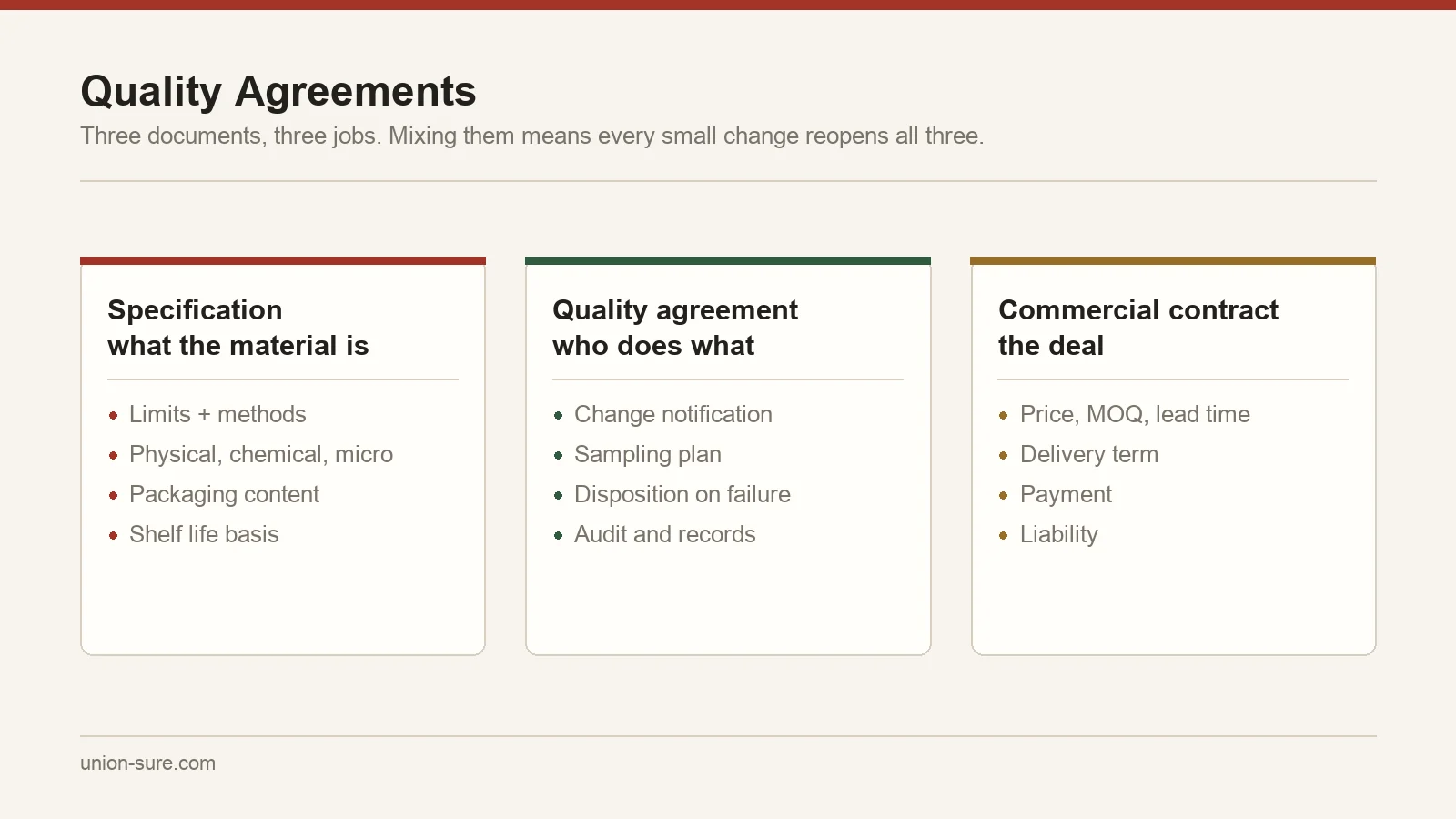
- A specification describes the material. A quality agreement assigns the responsibilities — who does what, when, and what happens on a failure.
- Change notification is the highest-value clause. Require prior notice for origin, process, treatment, site, subcontractor, formulation and pack.
- Write the disposition process before you need it: investigation, evidence, timescale, who decides, who pays.
- Agree the sampling plan in advance. Most quality disputes are sampling disputes wearing a laboratory result as a disguise.
- Keep it short enough that both sides have actually read it. An unread agreement is worse than none.
The moment a quality agreement earns its cost is the moment something goes wrong — a marginal result, a changed process, a lot that arrives different. If the agreement was written then, it is a negotiation. If it was written before, it is a procedure.
That is the whole argument for having one, and it is why the clauses worth spending time on are the ones nobody wants to think about at signature.
Draw the line against the specification
Keep the two documents doing different jobs:
| Specification | Quality agreement |
|---|---|
| What the material must be | Who is responsible for what |
| Limits, methods, units | Sampling, testing and release process |
| Physical and chemical properties | Change notification and approval |
| Packaging and labelling content | Audit rights and record access |
| Shelf life and its basis | Disposition when something fails |
The practical benefit: the specification can be revised when the material changes without renegotiating responsibilities, and the agreement can be revised when responsibilities change without touching the material description.
The clauses that actually matter
Change notification. If you only get one clause right, get this one. Require prior written notice — not notice with the shipment — for changes to: agricultural origin or growing region, manufacturing or packing site, subcontractors, process parameters, microbial treatment, formulation including processing aids, test methods, size screens, packaging, and certification status. Say which changes require your prior approval versus notification only, and say what happens if notice is not given.
Sampling. Agree the plan, the number of increments, where they are drawn from, how the composite is reduced, and who witnesses. Most disputes that look like laboratory disagreements are sampling disagreements — two parties measuring different material and both being right.
Disposition. Write down what happens when a result misses: who investigates, on what timescale, what evidence is exchanged, whether re-testing is permitted and on what sample, who decides, and who bears the cost under each outcome. Include the case of a marginal result within measurement uncertainty, which is the common one.
Records and retention. What is retained, by whom, for how long, and how quickly it must be produced. Tie the retention period to shelf life plus a margin and to the destination market’s own rules.
Audit and access. Frequency, notice period, scope, whether remote is acceptable and for what, and access to subcontractors. A right to audit that cannot reach the subcontractor doing the treatment is not much of a right.
Complaints and recall. Contact points on both sides, response times, cooperation obligations, and how a mock recall is coordinated across the two organisations.
Clauses that generate friction and are worth it anyway
Two that suppliers push back on, and that we think buyers should hold:
- Notification before shipment rather than with it. A supplier who tells you about a process change on the packing list has technically notified you and practically given you no options.
- Access to the treatment or processing subcontractor. Where a critical step is outsourced, an audit right that stops at the main site leaves the important part unverified.
Neither is unreasonable, and a supplier who refuses both is telling you where the risk sits.
Keep it readable
A forty-page agreement that nobody on either side has read protects nobody. The useful version is short enough that the people who will actually execute it — QA, planning, the person who takes the call when a container is held — can find their part in it.
Write it in the order things happen: qualification, ordering, production, release, shipment, receipt, failure, change, review.
Frequently asked questions
Do I need a quality agreement for a small supplier?
The document can be short, but the questions still need answers. Even a two-page version that covers change notification, sampling, disposition and records is worth far more than nothing when the first marginal result arrives.
Who should sign it?
Someone on each side with authority over quality decisions, not only commercial ones. If only the sales and purchasing contacts sign, the clauses that bind QA may never reach QA.
Should the agreement name the specification revision?
It should reference the specification and say how revisions are handled, but not hard-code a revision number — otherwise every specification update reopens the agreement. Say which revision governs an open order instead.
Where to go next
The agreement sits between the specification and the audit.
- writing the specification it references — the material description that the agreement deliberately does not duplicate.
- what to verify at the supplier — audit rights are only useful if you know what to look at.
- handling an out-of-specification result — the disposition clause in practice.
- ask for our standard terms — send your draft and we will mark what we can commit to and what we cannot.
Published 21 April 2026. Last reviewed 15 August 2026 by the Union Sure technical team. Regulatory limits, standards and market requirements change — verify every legal limit against the current official source before it is used to approve a shipment.