
Key points
- A hand-picked sample is the best material the supplier has. A production lot is the average. Approving one and ordering the other is the classic failure.
- Qualify in four stages: lab sample, pilot quantity, first commercial lot, ongoing verification. Each answers a different question.
- Fragile products fail at handling scale, not at tasting scale. Test on the real line before approving.
- Approve a specification with tolerances, not a sample. The sample is a reference; the tolerance is the contract.
- Keep a sealed, dated retained reference under controlled storage — and agree what happens when a lot differs from it.
The samples we send are, honestly, our good material. Not a special batch made for the occasion, but drawn from a lot we are happy with, packed carefully, and shipped fast. Every supplier does this and it is not deception. It is just what a sample is.
The problem starts when a buyer approves that sample and orders twenty tonnes against it. The order is not the sample. It is the average of a production run, packed on a normal day, and shipped for four weeks.
Qualification is the process of finding out the difference before the money moves.
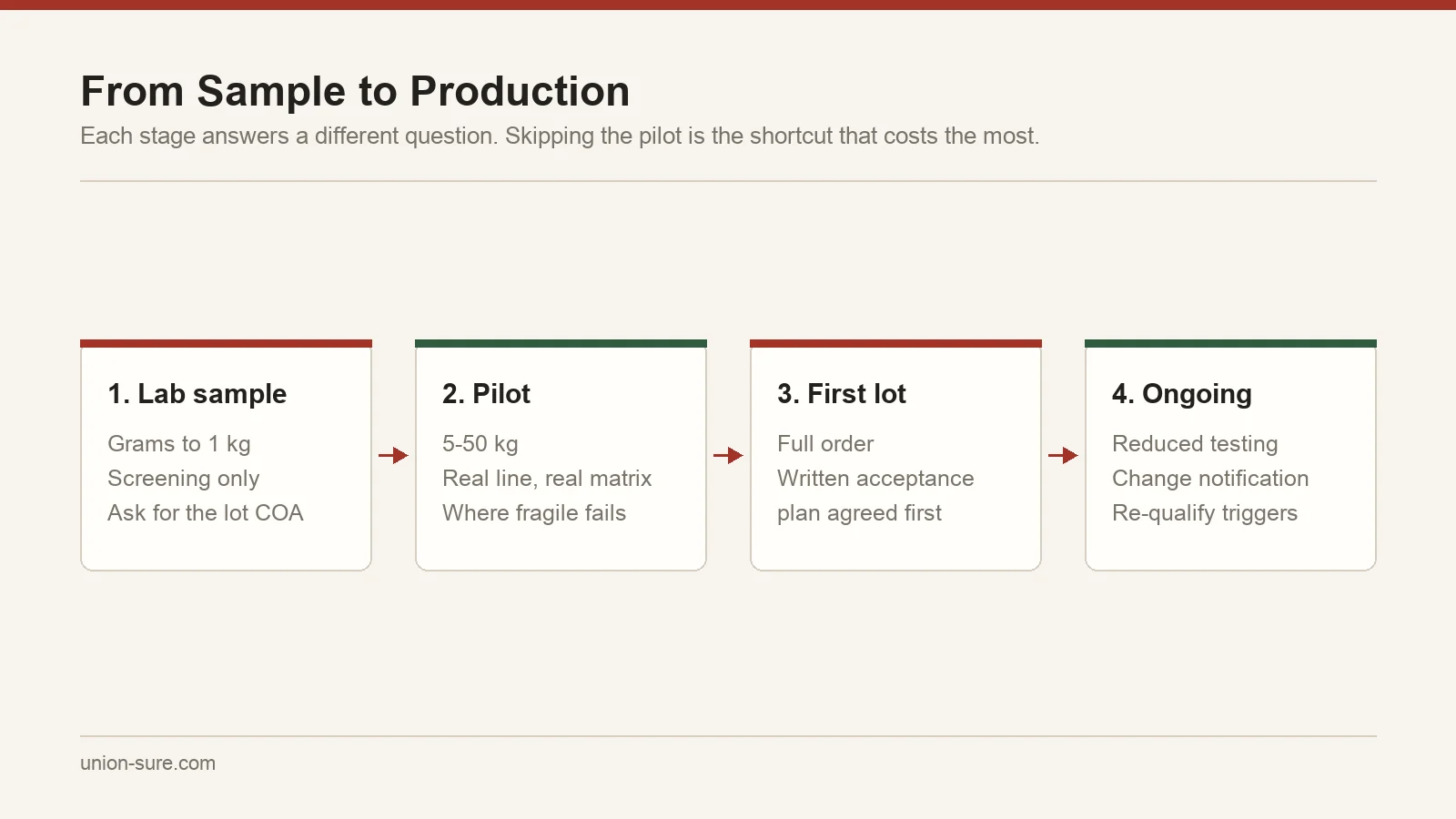
Four stages, four different questions
| Stage | Quantity | The question it answers |
|---|---|---|
| Lab sample | grams to 1 kg | Is this roughly the right material? |
| Pilot | 5–50 kg | Does it survive my process? |
| First commercial lot | Full order | Is the production average acceptable? |
| Ongoing | Every lot | Is it staying acceptable? |
Skipping the pilot is the single most common shortcut and the most expensive one. It is where mechanical damage, dispersion problems, colour bleed and dosing variation first appear, and it costs a fraction of a full order.
Stage 1: the lab sample
The job here is screening, not approval. Check identity, obvious sensory character, and whether the basic specification lines are in range. Do not run a full sensory panel on a sample that has been in a courier bag for a week.
Two things worth requesting with the sample and routinely forgotten: the COA for the lot the sample came from, and confirmation of whether the sample is representative or hand-selected. Most suppliers will answer that honestly if asked directly.
Stage 2: the pilot
Run it on the real equipment, at the real settings, in the real matrix. This is where you learn what a bench tasting cannot tell you:
- how much breakage the material takes through your conveying and mixing;
- whether a powder disperses or lumps at your addition rate and temperature;
- whether colour holds or bleeds in your product;
- whether moisture migrates between your components;
- whether dosing is uniform at your batch size.
If the product is fragile, this is the stage that decides everything. A freeze-dried dice that is beautiful in a bag can be half dust by the far end of a cereal line, and no amount of specification language substitutes for putting it through.
Stage 3: the first commercial lot
Treat it as a test with a written acceptance plan, not as a normal delivery. Before it ships, agree:
- what will be tested on arrival, by whom, against which limits;
- how many units are sampled and from where in the load;
- what happens on a marginal result — investigation, not automatic rejection;
- who pays for what under each outcome.
Agreeing this before the lot ships is the whole point. Agreeing it after a marginal result is a negotiation, and negotiations under time pressure with a container on the ground go badly for everyone.
Stage 4: ongoing verification
Qualification does not end at approval. Set a reduced but real ongoing check: which lines are tested every lot, which are periodic, and what triggers a return to full testing. Then define what requires re-qualification — a change of origin, process, treatment, site, formulation, pack or size screen should all require prior notice, and some should require a new pilot.
Approve a specification, not a sample
This is the point most worth taking away. A sample cannot be a contract because no two lots are identical and nobody can measure “the same as the sample”. What you approve is a specification with tolerances, and the sample becomes a reference for the attributes that are hard to express numerically — colour, aroma, character.
So: keep a sealed, dated retained reference under controlled storage. Photograph it with a scale. And write down what happens when a lot sits inside the numeric tolerances but visibly differs from the reference, because that is the argument you will actually have.
Frequently asked questions
How much pilot material should I ask for?
Enough to run your real process once, plus retains. That is usually far more than a sample and far less than an order. Suppliers expect this request; a supplier who will only send 200 g for a process that needs 20 kg is telling you something.
Is a hand-selected sample dishonest?
Not if it is disclosed. Almost all first samples are the supplier’s good material. Just ask whether it is representative or selected, and base the acceptance limits on a production lot rather than on the sample.
What triggers re-qualification?
A change to origin, growing region, process, microbial treatment, manufacturing site, subcontractor, formulation, pack format or size screen. Put the notification duty in the quality agreement and require it before shipment, not with it.
Where to go next
Qualification connects the sample to the specification and the specification to the order.
- what to verify at the supplier — an approved sample from an unapproved site is not an approval.
- the RFQ fields that define what you are qualifying — you cannot qualify against an underspecified enquiry.
- reading the COA that comes with the lot — ask for the certificate of the lot the sample came from.
- request pilot quantities — tell us the process step and we will send enough to run it properly.
Published 20 January 2026. Last reviewed 15 August 2026 by the Union Sure technical team. Regulatory limits, standards and market requirements change — verify every legal limit against the current official source before it is used to approve a shipment.