
Key points
- Air drying gives the lowest cost per kilo and the highest bulk density. Right for soups, sauces, seasonings and anything that will be rehydrated and cooked.
- Freeze drying preserves structure, colour and piece integrity at the highest cost. Right for visible inclusions, dry-eat snacks and anything going into chocolate or cereal.
- Vacuum frying produces a crisp texture and adds fat. It is a finished-snack process, not a drying process, and “vacuum-fried” is not a synonym for low-fat.
- Cost comparison must start with mass balance. Fresh-to-dry ratios differ enough between processes that price per kilo is misleading.
- The expensive process is not automatically the better one. For a soup vegetable, freeze drying is usually money set on fire.
We run all three processes in the same catalogue. That is a little unusual — most suppliers specialise in one and then quietly recommend it for everything — and the practical consequence is that we spend a fair amount of time talking buyers out of the expensive option.
Freeze drying is not automatically better. It is better at some things, worse at others, and for a vegetable destined for a soup sachet it is generally money set on fire. Below is how the three compare once you start from what the ingredient actually has to do in the finished product.
What each process does
Air drying (AD)
In convective or hot-air drying, heated air transfers energy to the product and carries evaporated water away. Equipment can be continuous and commercially efficient. Temperature, air velocity, humidity, piece thickness, loading and pretreatment influence drying time and quality.
Longer heat and oxygen exposure can cause shrinkage, hardening, colour change or loss of volatile aroma in some products. That is a process risk, not an inevitable result for every ingredient. Reviews of food drying show both the versatility and the product-specific trade-offs of convective drying. (Drying-techniques review)
Freeze drying (FD)
The product is frozen, then pressure is reduced so ice is removed primarily by sublimation. A secondary drying stage removes more bound water. The porous structure left by ice crystals can support rapid rehydration and low shrinkage.
Freezing rate, ice-crystal structure, product thickness, chamber pressure, shelf temperature and endpoint control all matter. Freeze drying is not “no heat”; energy is supplied during drying, and poorly controlled cycles can collapse, overdry or leave excessive moisture. (2026 freeze-drying review)
Vacuum frying (VF)
Food is immersed in hot oil in a reduced-pressure system. Lower pressure reduces water’s boiling temperature, allowing water removal at lower frying temperatures than atmospheric deep frying. Oil can enter product pores, particularly around depressurisation and cooling, so de-oiling conditions matter.
Vacuum-fried fruit or vegetable is still a fried, oil-containing product. It should not be marketed or specified as equivalent to plain dried fruit. Reviews report lower oil uptake or less thermal damage than conventional atmospheric frying in various products, but the magnitude changes with raw material, pretreatment and process. (Vacuum-frying review)
A buyer’s comparison matrix
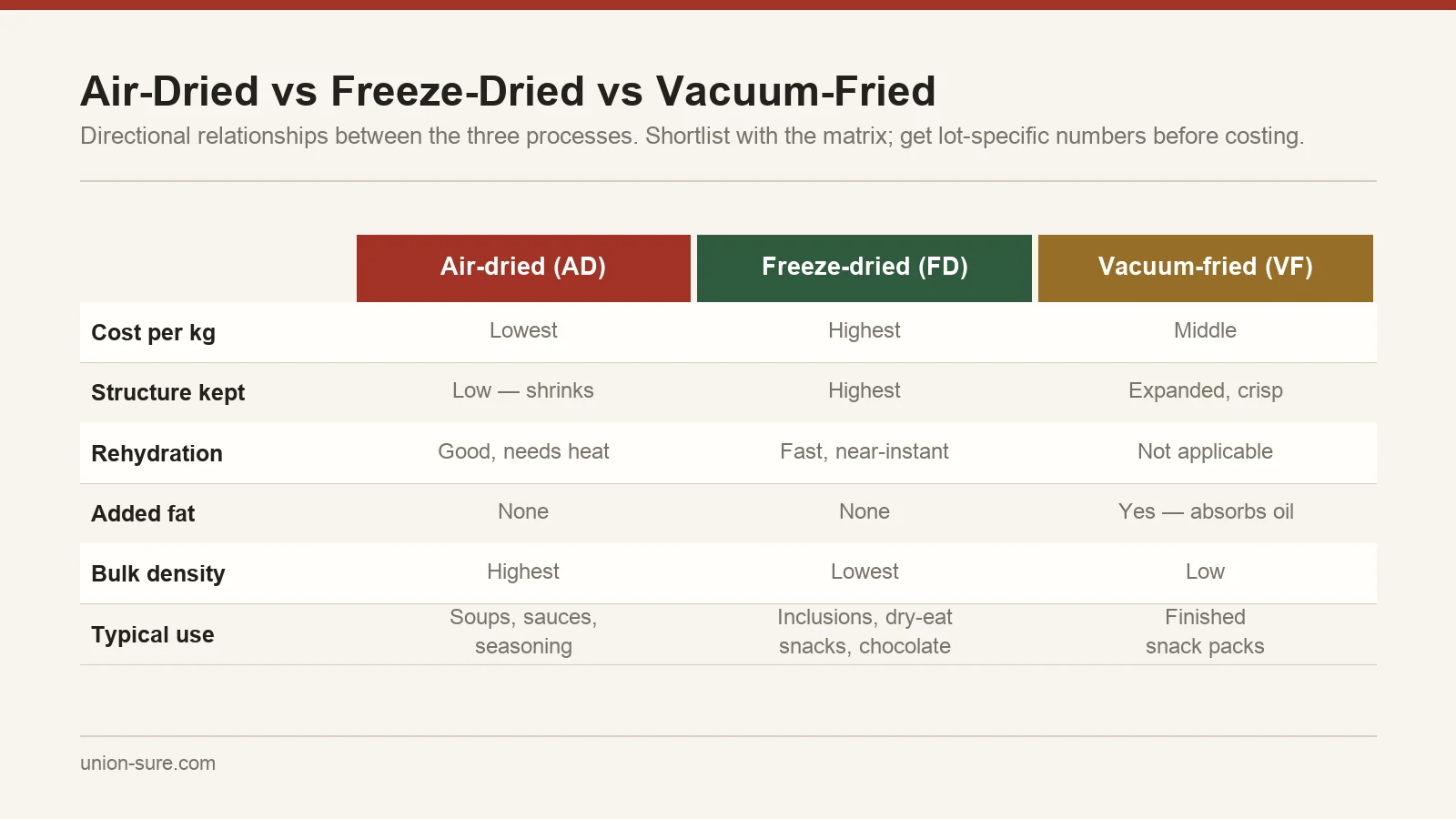
A caveat on every table like this one, including ours: these are directional relationships between processes, not specification values for a particular product. Fresh-to-dry ratio, rehydration behaviour and bulk density all move with the raw material, the variety, the season and the cut. Use the matrix to shortlist a process, then get lot-specific numbers before anything reaches a costing sheet.
| Decision factor | Air-dried | Freeze-dried | Vacuum-fried |
|---|---|---|---|
| Heat/mass transfer | Water evaporates into heated air | Ice sublimes under vacuum | Water boils from food immersed in oil under vacuum |
| Typical structure | Dense, leathery or firm depending on product | Porous, light, often crisp when dry | Crisp fried matrix |
| Added oil | Usually none unless separately added | Usually none unless formulated | Inherent to the frying process |
| Rehydration | Product-dependent; often slower or less complete | Often rapid because of porous structure | Normally selected as a snack/inclusion, not for fresh-like rehydration |
| Oxygen sensitivity | Depends on product and process | Porous structure can expose large surface area after drying | Oil oxidation becomes a key shelf-life concern |
| Handling | Often relatively dense and robust | Fragile pieces and fines can be significant | Crisp pieces may break; oil can affect pack needs |
| Cost drivers | Energy, time, pretreatment, yield and scale | Raw-material yield, freezing, vacuum cycle, equipment time | Oil, vacuum cycle, de-oiling, oil management and yield |
| Label/product identity | Dried/dehydrated plus ingredients | Freeze-dried plus ingredients | Fried/vacuum-fried plus oil and other ingredients |
This table describes common tendencies, not guaranteed specifications.
Application fit
Cereal and dry snack inclusions
Freeze-dried pieces can provide low-density crispness and visible colour but need strong moisture protection. Air-dried fruit may bring chew and density. Vacuum-fried pieces bring fried flavour, crispness and oil. Compare piece survival during blending, filling and distribution.
Chocolate and coatings
Moisture and water activity matter because fruit can soften or affect the surrounding matrix. Freeze-dried powders or pieces are commonly screened, but validate particle size, water activity, flavour and storage migration in the actual chocolate. Vacuum-fried product introduces oil that can interact with the fat phase.
Bakery
Air-dried pieces may soften during baking; freeze-dried pieces can absorb formula water and fracture during mixing; powders can change colour, acidity and water demand. Vacuum-fried pieces may bring oil and a fried note. Bench tests should measure dough/batter handling and post-bake distribution.
Instant meals and soups
Rehydration time, floating, piece integrity and broth colour are more important than a generic “premium” label. Air-dried vegetables can be highly suitable when their cut and rehydration are designed for the cook step; freeze drying may add value where rapid rehydration and shape are important.
Finished snacks
Vacuum frying is often a product architecture, not merely a preservation step. Define oil type, total fat, sensory profile, de-oiling, oxidation control and label. A plain freeze-dried fruit snack answers a different consumer and formulation brief.
Compare specifications, not just acronyms
Request the following for each candidate:
- full ingredient statement and process description;
- raw-material origin and ripeness or maturity controls where relevant;
- pretreatments: blanching, osmotic treatment, sugar, acid, sulphites or carriers;
- piece size and distribution;
- moisture and water activity with methods;
- bulk density and piece/fines limits;
- colour and sensory acceptance method;
- rehydration ratio/time where relevant;
- oil type, total fat, free surface oil and oxidation indicators for VF;
- microbiological specification and kill-step status;
- packaging barrier and shelf-life basis;
- batch COA and change notification.
“100% fruit” needs verification against carriers, processing aids, added sugar and oil—not inference from the process name.
Nutrient and quality claims need the right denominator
This is where marketing claims about drying processes usually go wrong, and we would rather lose an argument than repeat one. Comparing nutrient content per 100 g of dried product against per 100 g of fresh product compares two different amounts of food. Convert to a dry-solids basis, or express both as the quantity delivered in one serving of the finished product. Most of the dramatic retention claims in this category quietly disappear when you do. Drying removes water, so nutrients per 100 g can appear more concentrated even when some component is lost. Compare on a dry-matter basis or against the same starting material when studying process retention. Control cultivar, maturity, pretreatment, process and storage.
One comparative study can show freeze drying performs better for a certain colour or compound while another product and endpoint favours hot-air drying. That is why this guide does not attach universal retention percentages to AD, FD or VF.
Cost begins with mass balance
Fresh produce contains different amounts of solids. A low-solids berry needs more fresh input to produce one kilogram of dry product than a higher-solids banana, before trimming and process losses. Freeze-dryer cycle time, air-dryer throughput, frying oil management, sorting, fines and packaging then change the quote.
Compare usable cost in the application:
usable ingredient cost = delivered cost ÷ accepted yield after fines, breakage and application loss
A dense air-dried piece may cost less per kilogram but require a different inclusion rate. A fragile freeze-dried piece may lose more to fines. A vacuum-fried piece includes oil mass. A formulation trial must accompany the price comparison.
A seven-step selection protocol
- Define the sensory and functional job.
- Exclude process/ingredient statements that do not fit the label or market.
- Align measurable specifications.
- Obtain representative samples and batch COAs.
- Run the same application trial and packaging exposure.
- Compare usable yield and landed cost.
- Approve one product code, site, process and pack—not an acronym.
Frequently asked questions
Is freeze-dried always more nutritious than air-dried?
No universal conclusion is defensible. Results depend on the food, nutrient, pretreatment, time, temperature, oxygen exposure, storage and comparison basis.
Is vacuum-fried fruit low-fat?
It contains frying oil. It may contain less oil than a named atmospheric-fried comparator under controlled conditions, but verify the batch specification and do not translate that into an unqualified “low-fat” claim.
Can the three methods use the same packaging?
Not automatically. Freeze-dried products can be extremely moisture-sensitive; vacuum-fried products add oxygen-sensitive oil; air-dried products vary widely in moisture and texture. Design packaging from the product’s measured risks.
Where to go next
Choosing a process is step one. These cover the specification work that follows it.
- freeze-dried, dehydrated and VF ranges — the current freeze-dried catalogue, with forms and cuts listed per item.
- dehydrated vegetables by cut and mesh — once you have chosen air drying, cut size becomes the specification that matters.
- moisture content versus water activity — the two numbers that decide shelf life across all three processes.
- ask for matched samples — tell us the application and we will send the same fruit in more than one process where we have it.
Published 28 April 2026. Last reviewed 15 August 2026 by the Union Sure technical team. Regulatory limits, standards and market requirements change — verify every legal limit against the current official source before it is used to approve a shipment.