
Key points
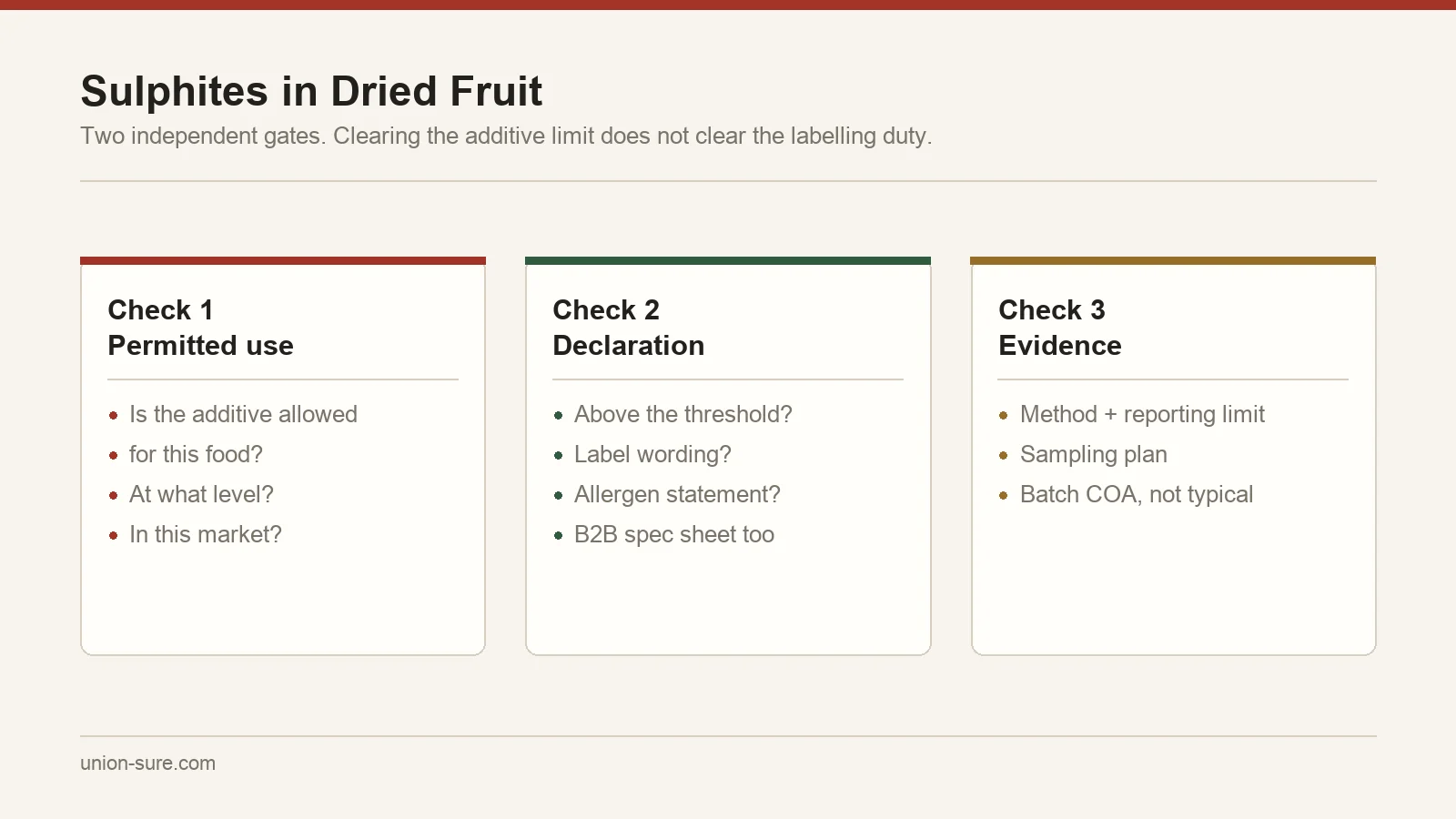
- Permitted use and allergen labelling are two separate checks. Passing the additive limit does not remove the labelling duty.
- “Sulphite-free”, “no added sulphites” and “below the declaration threshold” mean three different things. Only one of them is testable as written.
- A laboratory number is only interpretable with the method, the reporting limit and the sampling plan attached.
- Sample the lot properly. Sulphite residue is not evenly distributed, and the easiest bag to reach is the least representative.
- Untreated dried fruit looks different. Darker colour is the expected outcome, not a defect — agree that before the first container.
Colour is the reason sulphites exist in this category, and colour is also the reason buyers get surprised by them.
Our own default for dried fruit is SO₂-free processing unless a customer asks for otherwise, and the conversation that follows is almost always about appearance rather than chemistry: untreated fruit is darker, and someone downstream has to be told that before the first pallet arrives. The regulatory side is more straightforward than the commercial side, provided you keep two questions apart — is this use permitted, and does it have to be declared.
First identify the substance and process
“Sulphites” is a family description. Ask the processor whether it uses sulphur dioxide, sodium sulphite, sodium or potassium bisulphite, sodium or potassium metabisulphite, or another agent. Record:
- purpose of use;
- point and concentration of addition;
- washing, drying and storage steps;
- whether other ingredients carry sulphites into the product;
- target and actual residual result;
- analytical expression, normally as total sulphur dioxide where the rule specifies it;
- market and customer restrictions.
Natural background and cross-contact can complicate interpretation in some foods. Do not infer intentional use solely from a result without investigating the process, method and product matrix.
EU: permitted use and allergen information are separate checks
EU food-additive permissions and maximum levels sit under Regulation (EC) No 1333/2008. The allowed maximum for sulphur dioxide/sulphites is not one universal dried-fruit number: it depends on the legal food category and, in some entries, the particular fruit. (Regulation 1333/2008)
Before approving a specification:
- classify the exact food, including whether it is dried, candied, processed or an ingredient in another food;
- find the current category entry and conditions of use;
- confirm whether the level applies as total SO2 and on which basis;
- check the latest consolidated text and subsequent amendments;
- document who performed the legal classification and when.
Do not reuse an apricot limit for banana, ginger or a fruit preparation.
EU food-information rules separately identify sulphur dioxide and sulphites for declaration above 10 mg/kg or 10 mg/L under the conditions in Regulation (EU) No 1169/2011. (Regulation 1169/2011) The European Commission’s 2026 consumer guidance repeats that threshold and places the substances among the 14 categories requiring clear allergen information. (European Commission allergen guidance)
Passing the additive maximum does not remove a declaration duty. Conversely, the declaration threshold is not an authorization to use the additive.
United States: technical effect changes the logic
FDA Import Alert 99-21 provides a useful current explanation of U.S. enforcement logic for added sulfiting agents. It distinguishes four situations. (FDA Import Alert 99-21)
- Naturally occurring sulfites are treated differently from added agents.
- An added agent below 10 ppm may be an incidental additive only when it has no technical or functional effect and the other regulatory conditions are met.
- An added agent at 10 ppm or more without a technical effect must be declared as an ingredient.
- An added agent that still has a technical or functional effect must be declared by its common or usual name regardless of level.
If the agent functions as a preservative, FDA also describes declaring the function. Sulfites are not a U.S. “major food allergen,” and the Import Alert says they should not be listed in the U.S. Contains statement on that basis.
The familiar “10 ppm” figure therefore does not mean “nothing needs to be declared below 10” in every case. Purpose and technical effect matter.
Translate marketing claims into testable definitions
“Sulphite-free” is the phrase we are asked for most and the one we are most careful about. Free of what, measured how, down to which reporting limit? Some fruits contain naturally occurring sulphur compounds, and a method with a low enough limit will find something. Write the claim as a number with a method attached, and everyone downstream can actually verify it.
“No added sulphites”
This is principally a process claim: neither the manufacturer nor an upstream ingredient supplier intentionally adds a sulphiting agent. Support it with a signed formulation/process statement, upstream declarations, change control and risk-based testing. It does not necessarily mean an analytical result of absolute zero.
“Unsulphured”
This trade word is often intended to mean no sulphur treatment. Define it in the contract as “no sulphiting agent intentionally used at any stage,” then decide how background or cross-contact results will be handled.
“Below 10 mg/kg”
This is an analytical specification. State the method, reporting units, sample basis and whether the rule is less than 10.0 mg/kg or not detected at an adequate reporting limit. Confirm that the method is suitable for the fruit matrix.
“SO2 free”
Avoid this phrase unless regulatory counsel and the laboratory definition support it. No measurement proves absolute absence. A result of “ND” means not detected under a particular method and reporting limit.
Use language such as:
No sulphiting agents intentionally added. Total sulphur dioxide: less than [buyer-defined limit] mg/kg by [method], with a laboratory reporting limit no higher than [value].
The bracketed values must be selected for the product, market and claim; they are not universal recommendations.
Make the laboratory result interpretable
FDA’s current Import Alert names a liquid chromatography–mass spectrometry method for initial analysis and an official Monier–Williams method for check analysis in its enforcement context. It also allows an appropriately validated alternate method when equivalence and matrix performance are demonstrated. (FDA analytical guidance within Import Alert 99-21)
For each result, retain:
- exact method and version;
- analyte and result expression;
- sample preparation and matrix;
- limit of detection and limit of quantification/reporting;
- measurement uncertainty where used in the decision rule;
- accredited-laboratory scope;
- sampling plan and sample identity;
- actual numeric result, not only “pass.”
A laboratory reporting limit of 20 mg/kg cannot substantiate “below 10 mg/kg.” “ND” under that method is insufficient for the claim.
Build a destination-specific specification
Use a market matrix rather than one global line:
| Field | What to define |
|---|---|
| Product identity | Fruit, form, ingredients and legal category |
| Process condition | Added/not added; agent and technical purpose |
| Maximum residual | Market/customer-specific total SO2 limit |
| Test | Method, units, LOQ/reporting limit and frequency |
| Label input | Exact ingredient/allergen information supplied downstream |
| Evidence | Batch COA plus periodic independent verification |
| Change control | Agent, process, upstream ingredient or method changes |
| Deviation | Hold, confirmatory test, investigation and disposition |
If one lot serves the EU and U.S., apply the approved specification and documentation needed for both; do not assume the same label statement works in both markets.
Sample the lot, not the easiest bag
Worth being blunt: if the sample was pulled from the bag nearest the door, the result describes that bag. Residue varies within a lot, and disputes over sulphite results are usually disputes over sampling. Agree the sampling plan in the quality agreement, and both sides can defend the number later. Sulphite distribution may vary with treatment, drying and piece size. Agree how packages and positions are selected and how increments are composited. Test an unopened production lot representative of the shipment. Maintain reserve samples and chain of custody for disputes.
The COA should reconcile product, lot, manufacture date, method and result. For higher-risk claims, use an independent laboratory at a defined frequency instead of relying indefinitely on supplier self-reporting.
Read enforcement data correctly
FDA maintains an Import Alert for food products containing undeclared added sulfiting agents. The European Commission’s January 2026 food-fraud-suspicion report listed individual dried-apricot entries with high reported sulphur-dioxide values. (EU January 2026 report)
These sources demonstrate that undeclared or excessive residues remain an enforcement issue. They do not establish a market-wide failure rate, and they do not prove anything about a supplier not named in the records.
Investigate an unexpected result
Place the lot on hold and check:
- sample and lot identity;
- method suitability, reporting limit and possible interference;
- intentional treatment and production records;
- sulphites carried by compound ingredients;
- rework or shared equipment;
- cleaning chemical or packaging contribution where plausible;
- supplier change records;
- label and customer impact;
- need for a representative confirmatory sample.
Do not average away a non-compliant result unless the sampling plan and legal decision rule explicitly permit that treatment.
Final approval checklist
- [ ] Exact fruit form and legal category are confirmed.
- [ ] Permitted use and maximum level are checked in current destination law.
- [ ] Intentional use and technical effect are documented.
- [ ] “No added,” “below limit” and “ND” are kept distinct.
- [ ] Method, result expression and reporting limit support the claim.
- [ ] Supplier COA is verified at a risk-based independent frequency.
- [ ] EU and U.S. label decisions are made separately.
- [ ] Customer or retailer limits are captured in addition to law.
- [ ] Unexpected results trigger hold and investigation.
- [ ] Any process or formulation change requires notification.
The objective is not the lowest possible number in a supplier brochure. It is a lawful, testable and accurately labelled control that survives review from procurement through the finished product.
Frequently asked questions
Is ‘sulphite-free’ the same as ‘no added sulphites’?
No. ‘No added sulphites’ describes the process. ‘Sulphite-free’ is an absolute claim that a sufficiently sensitive method may contradict, because some fruits contain naturally occurring sulphur compounds. Write the claim as a limit with a named method and reporting limit.
Does staying under the additive limit remove the labelling duty?
Not necessarily. Permitted use and declaration are separate checks in most markets, and the declaration threshold is usually much lower than the maximum permitted level. Verify both for the destination market.
Why is untreated dried fruit darker?
Sulphites inhibit the browning reactions that occur during drying and storage. Without them, a darker colour is the expected result rather than a defect. Agree the colour expectation with everyone downstream before the first container ships.
Where to go next
Sulphites sit at the intersection of specification, labelling and market access.
- the dried fruit range — our dried fruit lines and their processing defaults.
- reading chemical results on a COA — a residue number needs its method and reporting limit to be interpretable.
- labelling and documents for the destination — the declaration duty travels with the market, not with the product.
- ask for the processing declaration — tell us the destination market and the claim you intend to make on pack.
Published 9 June 2026. Last reviewed 15 August 2026 by the Union Sure technical team. Regulatory limits, standards and market requirements change — verify every legal limit against the current official source before it is used to approve a shipment.